


Skipper Sampsa Jalo greets three young children on their way home from school as they board an unusual amphibious vessel docked and humming at a wooden pier on the frozen Baltic Sea.
Due to unusually thick ice this winter, a hovercraft called “Snovit” (“Snow White”) has replaced the ferries that normally transport 12-year-old Hugo Wickstrom, nine-year-old Julia Jalkanen and eight-year-old Nils-Johan Ostman to the islands where they live in southwestern Finland’s Pargas archipelago. This is only the third time in 15 years that hovercrafts have been brought in because of thick ice in Finland’s archipelagos.
More than 81,000 islands dot the Nordic country’s 1,100-kilometer coastline.
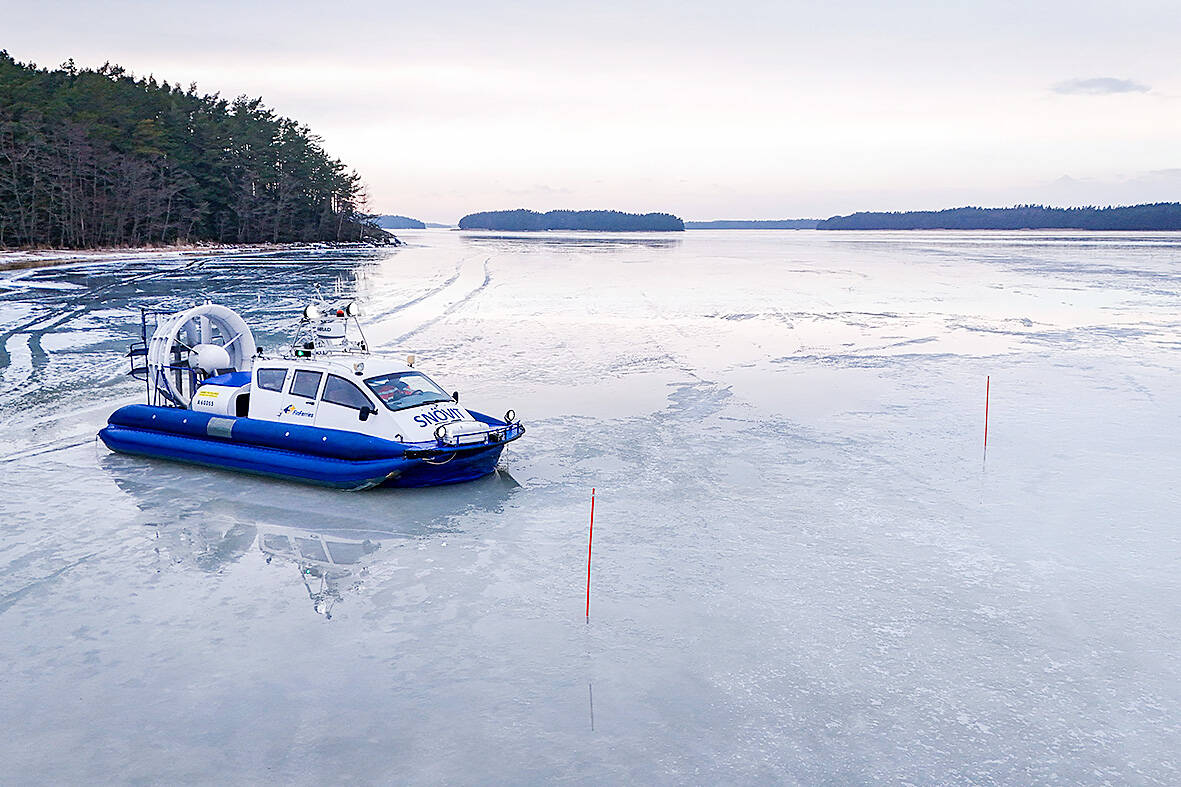
Photo: AFP
Here in the Pargas archipelago, 107 islands are inhabited year-round by nearly 3,000 residents. As the cushions under the vessel filled with air, the hovercraft lifted off the icy surface and set out across the frozen sea. In the back seat, the three children agreed their school commute was “very exciting.”
“Especially when it drifts like this,” said Wickstrom, showing how the hovercraft glides sideways on the ice. “It moves very fast,” Jalkanen said with a little smile. State-owned ferry operator Finferries replaced some of its regular vessels with six hovercrafts when freezing temperatures in February led to the formation of unusually thick ice.
“The ships can handle the ice but it’s so slow and expensive because it uses a lot of fuel,” Jalo explained.
A trip with a commuter ferry or vessel that normally takes an hour now takes “five or six hours to cover the same distance” due to the current ice conditions, he explained.
By hovercraft, “the same journey can be completed in 10 minutes.”
Behind the windows of the vessel, which has room for five to seven people, forest-covered islands slid by.
Soon it was time for Ostman to disembark. Jalo said piloting the hovercraft required “constant concentration” as wind conditions, fog and snowfall all posed challenges when manoeuvring through the landscape at a speed of 30 knots.
“The weather conditions change rapidly here... Let’s say it is both challenging and fun,” he said, smiling. This winter was the second time since 2009 that he had the chance to sit behind the wheel of a hovercraft.
“This is the kind of device you don’t normally see in the archipelago,” he said.
Even sea eagles and a wolf had come up close, “as the animals don’t know to be afraid of it.”
UNUSUAL CONDITIONS
This year’s ice cover in the Baltic Sea was unusual, said researcher Mika Rantanen at the Finnish Meteorological Institute. Peaking on February 20, “the ice cover has been the most extensive in the entire Baltic Sea region since 2011”, he said.
In Finland, winters with long cold periods are becoming increasingly rare due to climate change, Rantanen noted. Of the world’s coastal seas, the Baltic — surrounded by Denmark, Finland, Germany, Poland, Russia, Sweden and the three Baltic states — is warming the fastest.
“Our winters are becoming milder and warmer,” Rantanen said. “In the long term, the maximum winter ice cover in the Baltic Sea is shrinking, and that is due to climate change,” he said.
The lowest ice cover level ever recorded was in 2020. When the hovercraft stopped briefly at a sandy beach, Wickstrom climbed out in his snowsuit and thick winter hat, waving goodbye as pine trees swayed behind him in the wind.
In the morning, he would be picked up again, gliding towards the mainland where a taxi would drive him to school about 30 minutes away. Soon, migrating birds will return and the sea ice will melt completely, transforming the quiet archipelago.
Ship traffic will then resume as normal and Finns who live on the mainland will start heading out to their summer cottages on the islands, often rustic and without running water.
In the Pargas archipelago, there are 9,000 second homes on 1,070 islands, according to Pargas’ head of archipelago affairs, Benjamin Donner.
“Ice is melting really quickly now,” Jalo noted, looking at the thin layer of water covering the ice, before starting the engine and heading back to shore.

By global standards, the traffic congestion that afflicts Taiwan’s urban areas isn’t horrific. But nor is it something the country can be proud of. According to TomTom, a Dutch developer of location and navigation technologies, last year Taiwan was the sixth most congested country in Asia. Of the 492 towns and cities included in its rankings last year, Taipei was the 74th most congested. Taoyuan ranked 105th, while Hsinchu County (121st), Taichung (142nd), Tainan (173rd), New Taipei City (227th), Kaohsiung (241st) and Keelung (302nd) also featured on the list. Four Japanese cities have slower traffic than Taipei. (Seoul, which has some

In our discussions of tourism in Taiwan we often criticize the government’s addiction to promoting food and shopping, while ignoring Taiwan’s underdeveloped trekking and adventure travel opportunities. This discussion, however, is decidedly land-focused. When was the last time a port entered into it? Last week I encountered journalist and travel writer Cameron Dueck, who had sailed to Taiwan in 2023-24, and was full of tales. Like everyone who visits, he and his partner Fiona Ching loved our island nation and had nothing but wonderful experiences on land. But he had little positive to say about the way Taiwan has organized its

Writing of the finds at the ancient iron-working site of Shihsanhang (十 三行) in New Taipei City’s Bali District (八里), archaeologist Tsang Cheng-hwa (臧振華) of the Academia Sinica’s Institute of History and Philology observes: “One bronze bowl gilded with gold, together with copper coins and fragments of Tang and Song ceramics, were also found. These provide evidence for early contact between Taiwan aborigines and Chinese.” The Shihsanhang Web site from the Ministry of Culture says of the finds: “They were evidence that the residents of the area had a close trading relation with Chinese civilians, as the coins can be

Michael slides a sequin glove over the pop star’s tarnished legacy, shrouding Michael Jackson’s complications with a conventional biopic that, if you cover your ears, sounds great. Antoine Fuqua’s movie is sanctioned by Jackson’s estate and its producers include the estate’s executors. So it is, by its nature, a narrow, authorized perspective on Jackson. The film ends before the flood of allegations of sexual abuse of children, or Jackson’s own acknowledgment of sleeping alongside kids. Jackson and his estate have long maintained his innocence. In his only criminal trial, in 2005, Jackson was acquitted. Michael doesn’t even subtly nod to these facts.


 RSS
RSS