


The Korea Times will host its third Korean Language Speaking Contest from now to May 7, offering participants a chance to showcase their Korean language skills and compete for prizes worth a total of 12 million won (US$9,000).
The contest drew about 1,800 applicants last year, reflecting growing global interest in Korean language and culture, according to the Korea Times.
This year, one award recipient currently enrolled in a Korean university or graduate school will be offered a summer internship with the Korea Times’ video production team.

Photo: Reuters
All participants may also request an official certificate of participation, which organizers say can help foreign students demonstrate Korean proficiency in academic and professional settings.
The competition is divided into two categories: speech and pronunciation.
In the speech category, applicants may submit either a long or short-form video on a topic of their choice or the suggested theme, “What is my favorite Korean thing?”
The pronunciation category will take the form of a timed tongue-twister video challenge. Participants may enter one or both categories.
A total of 20 winners will be selected. The grand prize winner will receive the Minister of Culture, Sports and Tourism Award.
The event is sponsored by several major institutions, including the Ministry of Education, the National Institute for International Education, the King Sejong Institute Foundation and Korea Cyber University.
The contest is also open to Korean language learners who do not hold Korean citizenship. Applicants must upload their videos to social media platforms such as YouTube, TikTok or Instagram with the required hashtags and submit an application form through the Korea Times Web site.
Winners will be announced May 26 in the newspaper and on the Korea Times Web site.
“We hope this event will serve as a bridge for foreigners to explore the depth of Korean culture and connect more closely with Korean society,” a Korea Times official said.
“Through the internship opportunity, we also hope to give outstanding global talent a chance to gain valuable workplace experience in Korea and build a foundation for future growth.”

By global standards, the traffic congestion that afflicts Taiwan’s urban areas isn’t horrific. But nor is it something the country can be proud of. According to TomTom, a Dutch developer of location and navigation technologies, last year Taiwan was the sixth most congested country in Asia. Of the 492 towns and cities included in its rankings last year, Taipei was the 74th most congested. Taoyuan ranked 105th, while Hsinchu County (121st), Taichung (142nd), Tainan (173rd), New Taipei City (227th), Kaohsiung (241st) and Keelung (302nd) also featured on the list. Four Japanese cities have slower traffic than Taipei. (Seoul, which has some

In our discussions of tourism in Taiwan we often criticize the government’s addiction to promoting food and shopping, while ignoring Taiwan’s underdeveloped trekking and adventure travel opportunities. This discussion, however, is decidedly land-focused. When was the last time a port entered into it? Last week I encountered journalist and travel writer Cameron Dueck, who had sailed to Taiwan in 2023-24, and was full of tales. Like everyone who visits, he and his partner Fiona Ching loved our island nation and had nothing but wonderful experiences on land. But he had little positive to say about the way Taiwan has organized its

Michael slides a sequin glove over the pop star’s tarnished legacy, shrouding Michael Jackson’s complications with a conventional biopic that, if you cover your ears, sounds great. Antoine Fuqua’s movie is sanctioned by Jackson’s estate and its producers include the estate’s executors. So it is, by its nature, a narrow, authorized perspective on Jackson. The film ends before the flood of allegations of sexual abuse of children, or Jackson’s own acknowledgment of sleeping alongside kids. Jackson and his estate have long maintained his innocence. In his only criminal trial, in 2005, Jackson was acquitted. Michael doesn’t even subtly nod to these facts.
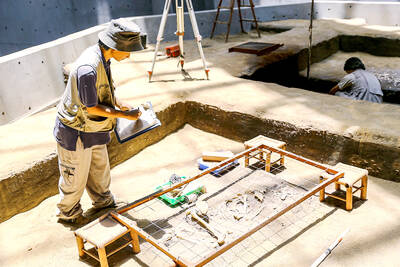
Writing of the finds at the ancient iron-working site of Shihsanhang (十 三行) in New Taipei City’s Bali District (八里), archaeologist Tsang Cheng-hwa (臧振華) of the Academia Sinica’s Institute of History and Philology observes: “One bronze bowl gilded with gold, together with copper coins and fragments of Tang and Song ceramics, were also found. These provide evidence for early contact between Taiwan aborigines and Chinese.” The Shihsanhang Web site from the Ministry of Culture says of the finds: “They were evidence that the residents of the area had a close trading relation with Chinese civilians, as the coins can be


 RSS
RSS