


The Taipei Times reported this week that “independent” Legislator May Chin (高金素梅), who aligns with the Chinese Nationalist Party (KMT), and 17 others were questioned after prosecutors searched her office over alleged corruption involving national security concerns tied to campaign finances and assistant expenses. Chin is notorious for her connections to the People’s Republic of China (PRC).
On social media platforms there were the usual tiresome complaints from the pan-Blue side that the prosecutors were targeting opponents of the ruling Democratic Progressive Party (DPP). But Chin has long been criticized by watchdog groups for failing to attend the legislature and failing to do much work on legislation. One would think that if the DPP were controlling the prosecutors, they would be going after more competent and influential targets. How is it that powerful faction heads and KMT higher ups still walk free?
Among other crimes, Chin was accused of embezzling fees intended for her assistants. This crime has become a sort of tradition among lawmakers at all levels and in all parties.
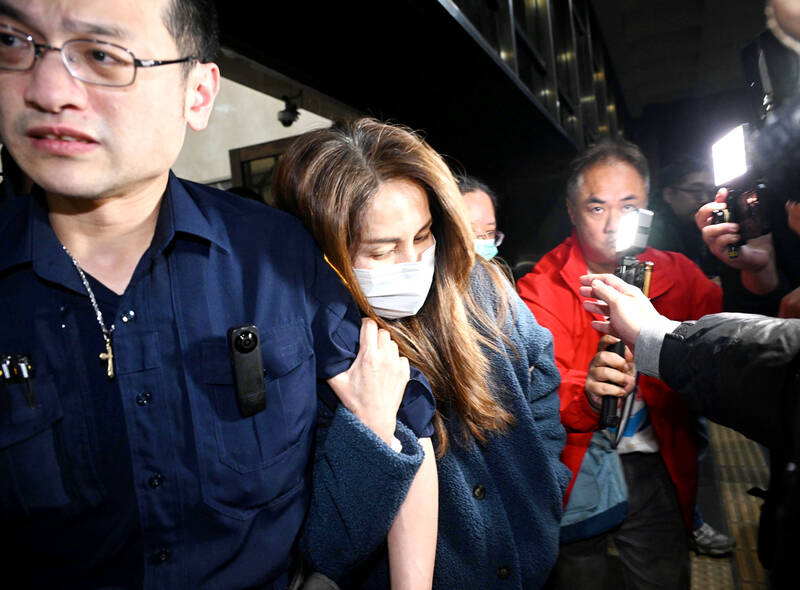
Photo: Peter Lo, Taipei Times
For example, the Tainan District Prosecutors Office in October last year indicted DPP Legislator Lin I-chin (林宜瑾) for alleged embezzlement over NT$14 million of public funds intended for assistant salaries.
DPP legislator Lin Tai-hua (林岱樺) was indicted in June of last year for alleged embezzlement of over NT$14 million in legislative aide salaries by the Kaohsiung District Prosecutors Office. Lin’s sister was also indicted for allegedly receiving NT$320,000 in assistant salary payments. Just last month Taipei City Councilor Chen E-jun (陳怡君) of the DPP was given seven years and 10 months for embezzling assistants’ fees (and bribery).
It seems intuitive that if the DPP was controlling the prosecutors, they would have ignored a DPP politician’s wrongdoing, especially in the DPP stronghold of Tainan. It’s almost as if the prosecutors are in fact independent.
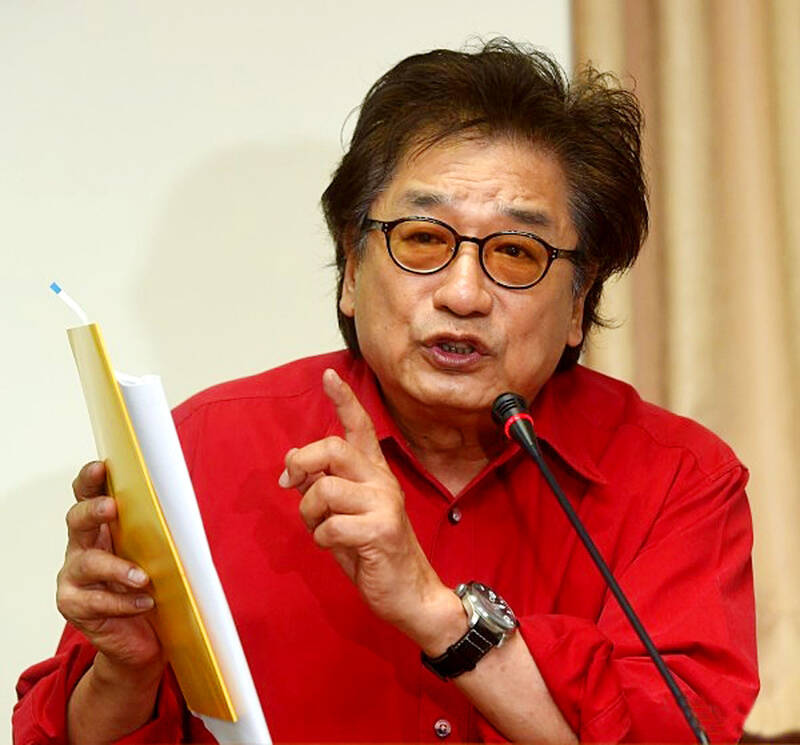
Photo: TT file photo
The list of politicians from all parties indicted for this crime is long and decades old. KMT lawmaker Yen Kuan-heng (顏寬恒) was indicted in 2023 for allegedly stealing NT$1.08 million in staff salaries through a proxy. Yen was eventually convicted of that crime, and claimed that he was being politically persecuted after being sentenced to 8 years and 4 months.
Hsinchu Mayor Ann Kao (高虹安) of the Taiwan People’s Party (TPP) was also indicted for this crime, but was recently acquitted after being convicted in the first trial. Lee Ching-hua (李慶華), who had been in two KMT spin-off parties before rejoining the party, was indicted in September 2018 by the New Taipei City District Prosecutors’ Office — a city then under a KMT mayor — on charges of embezzling NT$5.23 million, an amount meant to pay for his legislative assistants’ salaries. Et cetera, et cetera.
This particular crime follows a similar pattern. Legislators “hire” family members, business associates, romantic partners, friends and so forth, as “assistants.” The public funds intended for assistant pay are then retained by the legislator. Public suspicion is triggered when the legislator displays their gains in public in the form of expensive cars and property acquisitions.
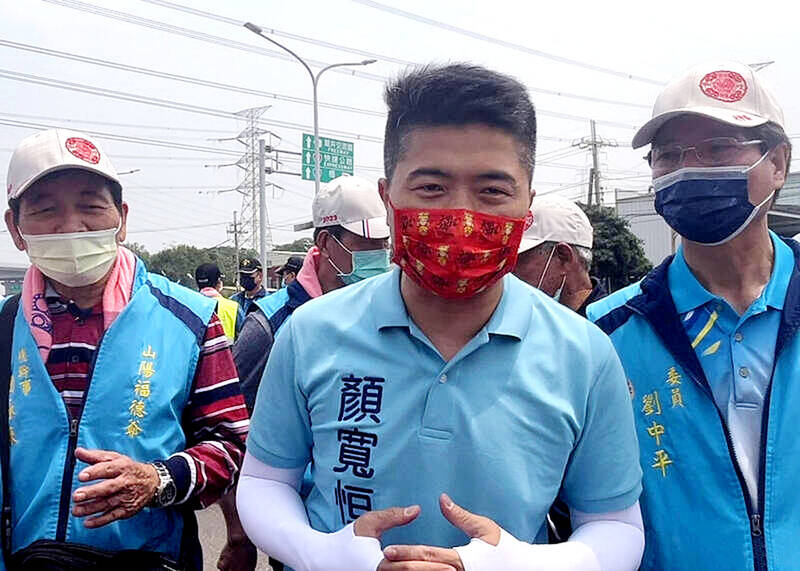
Photo: TT file photo
DECRIMINALIZING CORRUPTION
The recent response to this age-old problem by the KMT-controlled legislature was not to regulate the criminal practice, but to institutionalize it. Initially, KMT legislator Jessica Chen (陳玉珍) submitted a bill that critics said was an attempt to decriminalize the misuse of legislative aide funds. Chen was accused of attempting to protect Yen Kuan-heng, who is from a powerful central Taiwan family.
Decriminalizing corruption is an old pattern of the KMT. In the authoritarian era over 6,500 officials at all levels, from public school principals to presidents, were given discretionary funds. In 2006 well over NT$900 million a month went to such special funds.
For example, when Ma Ying-jeou (馬英九) was mayor of Taipei, he received a monthly “special allowance fund” of NT$340,000, NT$170,000 of which, along with his monthly paycheck of NT$150,000, went into his bank account each month. Ma was required only to submit “claim forms” detailing how that portion of his funds were spent. The other NT$170,000 was then issued as reimbursements after submission of receipts to the Ministry of Audit (today known as the National Audit Office). For many politicians it was routine to submit fake receipts and then claim that money as well. An executive order requiring receipts and auditing of all special funds went into effect on Jan. 1, 2007.
After Ma was indicted for abuse of these funds, he defended himself with several arguments, one of which was that it is the intent of the government that the funds be given as a subsidy to public officials. Ma reported the funds, his defense team argued, implying he didn’t intend to steal them. The court bought all his defense team’s arguments, and he was acquitted.
COMPLICITY
The key point was the intent of the rules. The purpose of the authoritarian government’s structuring of the discretionary funds was to ensure that most public officials at all levels were at least somewhat dirty, making everyone complicit in the KMT’s system. People waxing nostalgic for the Chiang Ching-Kuo (蔣經國) years have forgotten how completely corrupt things were in those days. The ability of legislators at all levels to doctor their payments to assistants is a relic of this era and this mindset.
Two decades later, we’ve come full circle. KMT Legislator Niu Hsu-ting (牛煦庭) introduced a separate bill that amended the Organic Act of the Legislative Yuan (立法院組織法) to address the legislative aide salary issue. It was passed last month.
As revised, aides’ salaries are “lawmaker subsidies” provided each year from public funds. The new laws state that subsidies equivalent to five times a legislator’s annual remuneration will be given to cover aides’ salaries and employer’s labor costs mandated by law. However, the lawmakers themselves can then determine each aide’s wages. The legislature then makes the payments.
Surely a bill intending to regulate this common practice would have provisions regarding the hiring of family members and so forth, and would have created a salary structure ensuring fair pay. Legislative aides from the two major parties were highly critical of the bill, according to local media reports.
Instead, the revisions appear to treat the legislative salary subsidies as discretionary payments. This is an invitation for more of the same corruption so many legislators at all levels have been busted for. It ensures that even legislators who deal fairly with their aides are complicit in the criminality of the system, since many of them will be aware of other legislators who are stealing the legislative aide subsidies.
These KMT proposals and amendments should be viewed as part of a larger program of KMT obstructionism and attacks on good governance in Taiwan. Remember, the pro-China side wins if it wins elections, and it wins if pro-Taiwan governance fails.
Notes from Central Taiwan is a column written by long-term resident Michael Turton, who provides incisive commentary informed by three decades of living in and writing about his adoptive country. The views expressed here are his own.

As mega K-pop group BTS returns to the stage after a hiatus of more than three years, one major market is conspicuously missing from its 12-month world tour: China. The omission of one of the group’s biggest fan bases comes as no surprise. In fact, just the opposite would have been huge news. China has blocked most South Korean entertainment since 2016 under an unofficial ban that also restricts movies and the country’s popular TV dramas. For some Chinese, that means flying to Seoul to see their favorite groups perform — as many were expected to do for three shows opening
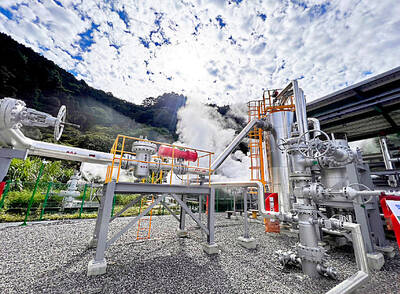
Taiwan’s semiconductor industry consumes electricity at rates that would strain most national grids. Taiwan Semiconductor Manufacturing Co (TSMC) alone accounted for more than 9 percent, or 2,590 megawatts (MW), of the nation’s power demand last year. The factories that produce chips for the world’s phones and servers run around the clock. They cannot tolerate blackouts. Yet Taiwan imports 97 percent of its energy, with liquefied natural gas reserves measured in days. Underground, Taiwan has options. Studies from National Taiwan University estimate recoverable geothermal resources at more than 33,000 MW. Current installed capacity stands below 10 MW. OBSTACLES Despite Taiwan’s significant geothermal potential, the

The entire Li Zhenxiu (李貞秀) saga has been an ugly, complicated mess. Born in China’s Hunan Province, she moved to work in Shenzhen, where she met her future Taiwanese husband. Most accounts have her arriving in Taiwan and marrying somewhere between 1993 and 1999. She built a successful career in Taiwan in the tech industry before founding her own company. She also served in high-ranking positions on various environmentally-focused tech associations. She says she was inspired by the founding of the Taiwan People’s Party (TPP) in 2019 by Ko Wen-je (柯文哲), and began volunteering for the party soon after. Ko

Chinese Nationalist Party (KMT) Chair Cheng Li-wun (鄭麗文) returned from her trip to meet People’s Republic of China (PRC) dictator Xi Jinping (習近平) bearing “a gift” for the people of Taiwan: 10 measures the PRC proposed to “facilitate the peaceful development of cross-strait relations.” “China on Sunday unveiled 10 new incentive measures for Taiwan,” wrote Reuters, wrongly. The PRC’s longstanding habit with Taiwan relations is to repackage already extant or once-existing policies and declare that they are “new.” The list forwarded by Cheng reflects that practice. NEW MEASURES? Note the first item: establishing regular communication mechanisms between the Chinese Communist Party


 RSS
RSS