


On a sweltering summer night 30 years ago, infant Li Yuanpeng was finally fast asleep, nestled between his parents, when a group of men burst into their home in southern China’s Guangdong province.
They beat Chen Mingxia and her husband and tied them up as baby Li, in his pale green gown and whorl of dark hair, wailed from the bed. It was the last time they would ever see their son. They “took my child away,” Chen said between sobs. Baby Li was kidnapped in 1995 when China’s one-child policy was in force and child-trafficking was rampant.
While no official data is publicly available, Li is one of thousands of children that experts estimate went missing in China during the 1980s and 90s. In the days after Li’s kidnapping, Chen and her husband would leave home before dawn, searching the mountains for their son, who was a few weeks shy of his first birthday.
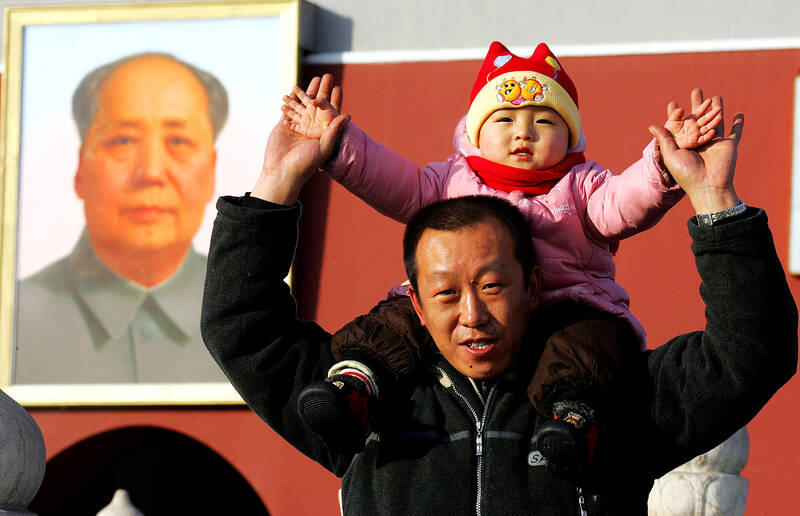
Photo: AP
Chen still clings to the hope of one day reuniting with her son, and says only then will “the burden on my heart be lifted.”
“It feels like a heavy stone is crushing my chest. If I don’t find my son, it will be a huge regret in my life,” the 52-year-old factory worker said.
PREFERENCE FOR SONS
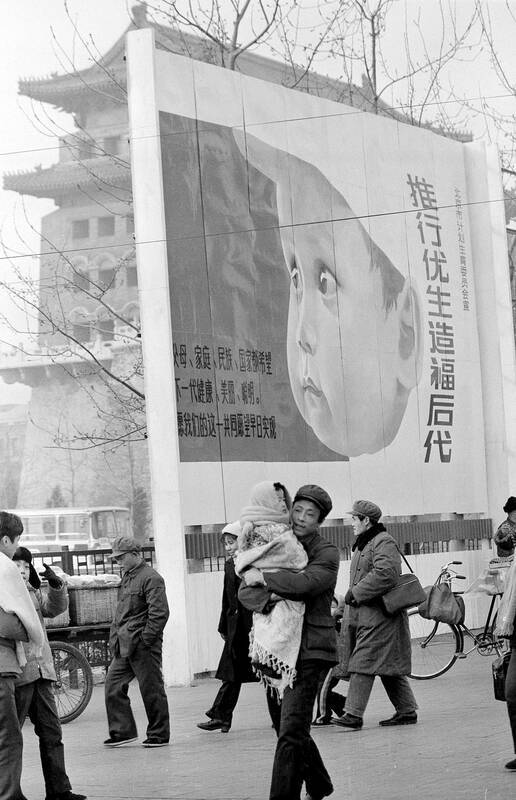
Photo: AP
During the one-child era, the trafficking of young boys was fuelled by parents seeking a son to carry on the family line, experts say. Unwanted girls were often abandoned or sold into sex work, forced marriage or labor.
“Only a male heir was seen as a legitimate vessel for the family line,” said Jingxian Wang, a researcher at King’s College London’s Lau China Institute.
The Communist Party introduced the strict population planning initiative in 1979 to address poverty and overpopulation, and maintained it for decades despite demographers’ warnings.
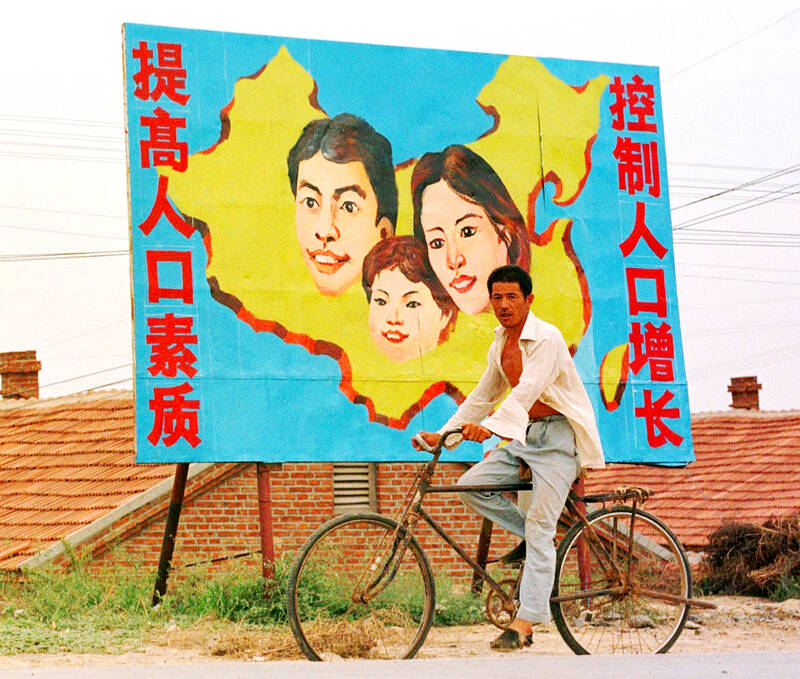
Photo: AP
While the policy ended in 2016, its effects still linger, with the drop in children and ensuing sex imbalance contributing to a demographic bottleneck.
Last year, the country’s birth rate plunged to its lowest level since records began in 1949.
The legacy of the kidnappings is also apparent, with social media platforms like Xiaohongshu and Douyin awash with “missing person” photos, including some posted by families still searching for their sons.
Xu Guihua hopes crowd-sourcing among China’s one billion internet users could help locate her nephew, who disappeared the same year as baby Li.
‘MISS YOU’
Four-year-old Chi Jianyong was returning home alone after helping deliver food to his mother’s vegetable market stall. He never made it back.
“How could we have known that there were so many human traffickers back then?” Xu said. “There was no surveillance (then)... That’s why human traffickers could operate so freely.”
Most of the network ran via direct arrangements between families and traffickers, who often moved victims long distances to make it difficult for them to trace their way home or be located by authorities, researcher Wang said.
Chinese authorities launched a nationwide crackdown on trafficking in 2024, handing out death sentences to some of those convicted.
Convicted child trafficker Wang Haowen’s death sentence was upheld in January last year, while a month later a woman accused of having abducted 17 children was executed, according to state media reports.
Xu said she has never given up on finding her nephew, and has travelled throughout the country carrying missing person signs in search of Chi.
She wants her nephew to know that he is loved and missed by his biological family who have gone to great lengths to find him.
“Why don’t you come out? Why don’t you show yourself and find us? Your aunt, your father and your mother have been searching for you everywhere,” she said.
“We miss you so much.”
By global standards, the traffic congestion that afflicts Taiwan’s urban areas isn’t horrific. But nor is it something the country can be proud of. According to TomTom, a Dutch developer of location and navigation technologies, last year Taiwan was the sixth most congested country in Asia. Of the 492 towns and cities included in its rankings last year, Taipei was the 74th most congested. Taoyuan ranked 105th, while Hsinchu County (121st), Taichung (142nd), Tainan (173rd), New Taipei City (227th), Kaohsiung (241st) and Keelung (302nd) also featured on the list. Four Japanese cities have slower traffic than Taipei. (Seoul, which has some

In our discussions of tourism in Taiwan we often criticize the government’s addiction to promoting food and shopping, while ignoring Taiwan’s underdeveloped trekking and adventure travel opportunities. This discussion, however, is decidedly land-focused. When was the last time a port entered into it? Last week I encountered journalist and travel writer Cameron Dueck, who had sailed to Taiwan in 2023-24, and was full of tales. Like everyone who visits, he and his partner Fiona Ching loved our island nation and had nothing but wonderful experiences on land. But he had little positive to say about the way Taiwan has organized its

Michael slides a sequin glove over the pop star’s tarnished legacy, shrouding Michael Jackson’s complications with a conventional biopic that, if you cover your ears, sounds great. Antoine Fuqua’s movie is sanctioned by Jackson’s estate and its producers include the estate’s executors. So it is, by its nature, a narrow, authorized perspective on Jackson. The film ends before the flood of allegations of sexual abuse of children, or Jackson’s own acknowledgment of sleeping alongside kids. Jackson and his estate have long maintained his innocence. In his only criminal trial, in 2005, Jackson was acquitted. Michael doesn’t even subtly nod to these facts.

Writing of the finds at the ancient iron-working site of Shihsanhang (十 三行) in New Taipei City’s Bali District (八里), archaeologist Tsang Cheng-hwa (臧振華) of the Academia Sinica’s Institute of History and Philology observes: “One bronze bowl gilded with gold, together with copper coins and fragments of Tang and Song ceramics, were also found. These provide evidence for early contact between Taiwan aborigines and Chinese.” The Shihsanhang Web site from the Ministry of Culture says of the finds: “They were evidence that the residents of the area had a close trading relation with Chinese civilians, as the coins can be


 RSS
RSS