


The undercurrents of adolescent cruelty churn queasily in Charlie Polinger’s stylish first feature, The Plague.
The title of Polinger’s film might bring to mind Stephen King or recent global history, but The Plague is set entirely around the clear, chlorinated pools and shadowy hallways of a water polo camp, circa 2003. There, 12-year-old Ben (Everett Blunck), a scrawny and sensitive kid, arrives for the second session. That’s a key detail: Is there any greater horror than joining a summer camp where the friend groups are already established?
But there is really only one group: a lewd and boisterous lot led by a smirking, cocksure kid named Jake (Kayo Martin). And there is one outcast: Eli (Kenny Rasmussen), the kind of 12-year-old who’s obviously smart but whose awkward, introverted manner and fondness for things such as magic tricks and Les Miserables inevitably make him an outsider. He also is covered in acne and has rashes across his back. Jake and the rest all say he has the plague. “No cure for him,” Jake tells Ben.

Photos: AP
These are the troubled coming-of-age waters that The Plague swims in. From the start, it’s clear that Polinger, who also wrote the film, has a keen eye for both darkly gleaming surfaces and for the roiling torments that lurk below. The Plague is by no means charting new ground when it comes to adolescent torments; this is a movie working with very recognizable preteen types. But Polinger’s talent for crafting ominous, murky atmospheres and perceptive adolescent dynamics make The Plague an auspicious debut feature.
While coming-of-age tales have played out before on baseball diamonds and football gridirons, the deep pools of water polo are a more novel setting. From the start, Polinger’s camera, working with cinematographer Steven Breckon in 35mm, drifts eerily toward the quiet frenzy underwater: the kicking legs and agitated bubbles. Their entry to adulthood is a sink-or-swim, with nothing to stand on.
When their coach (Joel Edgerton, also a producer) asks what water polo is, he calls on Ben, who offers: “Working together as one big family, or whatever.” But far from collective, the world of The Plague is primal and survivalist. The coach is kind but ineffectual. Parents are distant and out of reach. This is Lord of the Flies in the pool.
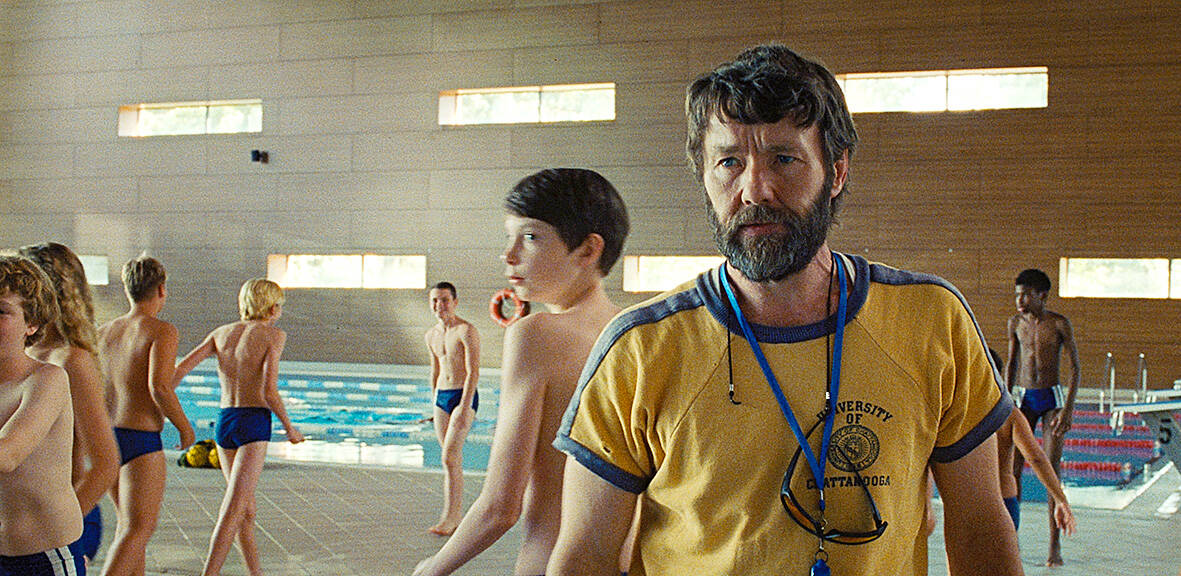
Photo: AP
That connection is most clear one night when the boys sneak out to some abandoned building, make a bonfire, smash a bunch of stuff and watch as Eli — who usually isn’t even allowed in their presence — dances by spinning wildly around. Ben is more sensitive than Jake and his pals, and he looks concerned for Eli as soon as he arrives. But he’s also more anxious about his own, tenuous-at-best place in the group, and he uses this moment to crash into Eli, knock him down and then make a show of cleaning off any “plague” residue on his arm.
In The Plague, ostracism is as permanent and irremediable as any pandemic infection. As big-screen bullies go, Jake is a classic one, terrifically played with smarmy malice by Martin. Jake isn’t taller or stronger than the rest, but he has a maturely manipulative feel for weak points. He doesn’t so much unleash putdowns as he repeats back an awkward answer and lets his victim twist in the wind. Psychologically, he towers over the rest.
It’s clear enough that The Plague is building toward some eruption of violence. Eli even looks a little like a young Vincent D’Onofrio in Full Metal Jacket. Pain in the The Plague, though, manifests itself inwardly. The most tragic thing in it is that even Eli seems to think “the plague” is real, that there really is something wrong with him. After briefly befriending him, Ben develops pimples and rashes of his own. Does he want to convince the others that there’s no such thing as “the plague,” or does he just want them to know he doesn’t have it?
Polinger’s film isn’t a comfortable watch and it’s not meant to be. It gets under the skin. That it’s drawn partially from its director’s own memories is surely one source of its potency. Yet because it’s a movie about childhood that’s clearly not for kids, one can shake off The Plague, grateful to have left adolescence behind. This is a movie that makes you all the more thankful for adulthood, just as it renews your sympathy for those still wading such daunting waters.

Following the rollercoaster ride of 2025, next year is already shaping up to be dramatic. The ongoing constitutional crises and the nine-in-one local elections are already dominating the landscape. The constitutional crises are the ones to lose sleep over. Though much business is still being conducted, crucial items such as next year’s budget, civil servant pensions and the proposed eight-year NT$1.25 trillion (approx US$40 billion) special defense budget are still being contested. There are, however, two glimmers of hope. One is that the legally contested move by five of the eight grand justices on the Constitutional Court’s ad hoc move

Stepping off the busy through-road at Yongan Market Station, lights flashing, horns honking, I turn down a small side street and into the warm embrace of my favorite hole-in-the-wall gem, the Hoi An Banh Mi shop (越南會安麵包), red flags and yellow lanterns waving outside. “Little sister, we were wondering where you’ve been, we haven’t seen you in ages!” the owners call out with a smile. It’s been seven days. The restaurant is run by Huang Jin-chuan (黃錦泉), who is married to a local, and her little sister Eva, who helps out on weekends, having also moved to New Taipei

The Directorate-General of Budget, Accounting and Statistics (DGBAS) told legislators last week that because the Chinese Nationalist Party (KMT) and Taiwan People’s Party (TPP) are continuing to block next year’s budget from passing, the nation could lose 1.5 percent of its GDP growth next year. According to the DGBAS report, officials presented to the legislature, the 2026 budget proposal includes NT$299.2 billion in funding for new projects and funding increases for various government functions. This funding only becomes available when the legislature approves it. The DGBAS estimates that every NT$10 billion in government money not spent shaves 0.05 percent off

Dec. 29 to Jan. 4 Like the Taoist Baode Temple (保德宮) featured in last week’s column, there’s little at first glance to suggest that Taipei’s Independence Presbyterian Church in Xinbeitou (自立長老會新北投教會) has Indigenous roots. One hint is a small sign on the facade reading “Ketagalan Presbyterian Mission Association” — Ketagalan being an collective term for the Pingpu (plains Indigenous) groups who once inhabited much of northern Taiwan. Inside, a display on the back wall introduces the congregation’s founder Pan Shui-tu (潘水土), a member of the Pingpu settlement of Kipatauw, and provides information about the Ketagalan and their early involvement with Christianity. Most


 RSS
RSS