


Dec. 29 to Jan. 4
Like the Taoist Baode Temple (保德宮) featured in last week’s column, there’s little at first glance to suggest that Taipei’s Independence Presbyterian Church in Xinbeitou (自立長老會新北投教會) has Indigenous roots.
One hint is a small sign on the facade reading “Ketagalan Presbyterian Mission Association” — Ketagalan being an collective term for the Pingpu (plains Indigenous) groups who once inhabited much of northern Taiwan.
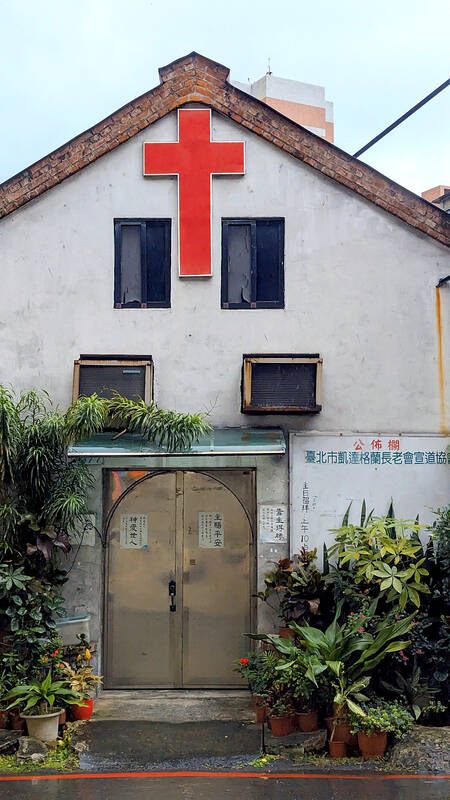
Photo: Han Cheung, Taipei Times
Inside, a display on the back wall introduces the congregation’s founder Pan Shui-tu (潘水土), a member of the Pingpu settlement of Kipatauw, and provides information about the Ketagalan and their early involvement with Christianity. Most of the worship songs are sung in Hoklo (commonly known as Taiwanese), though a few hymns are based on ancient Pingpu melodies.
Kipatauw’s Christian lineage traces back to the 19th century, when Canadian missionary George Leslie Mackay began preaching in Taipei’s Beitou area as early as March 1873. Trained as a physician, Mackay also offered medical treatment, most notably extracting teeth.
In 1876, Mackay established a small wooden chapel near Kipatauw’s lower settlement of Fanzaicuo (番仔厝), one of the few remaining Indigenous communities in Beitou at the time. By the time Japanese anthropologist Ino Kanori visited Kipatauw’s upper settlement in 1896, he observed that many residents had converted to Christianity.
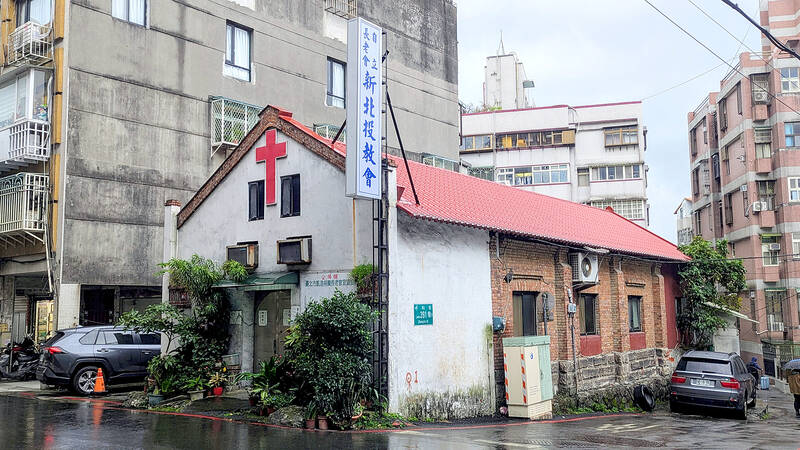
Photo: Han Cheung, Taipei Times
The century that followed was marked by repeated forced displacement and marginalization of Kipatauw’s residents, who once called home a large part of Beitou District (北投). With its descendants dispersed through the city today, the Independence Presbyterian Church remains one of the few tangible, living links to the settlement’s heritage.
THE PREACHER-DOCTOR

Photo courtesy of Wikimedia Commons
The first three articles of the “Echoes of Kipatauw” series trace how Kipatauw gradually lost its land and assimilated into Han culture between the 1600s and 1800s — despite maintaining a distinct identity from their neighbors. By the late 1800s, only three settlements remained: the upper settlement near Guizikeng (貴子坑), the middle settlement near Fuxinggang (復興崗) and the lower settlement near today’s Beitou MRT station.
Today, two religious institutions have endured, both established by the Pan (潘) family originally from the upper settlement: Baode Temple and Independence Presbyterian Church in Xinbeitou.
Mackay first landed in Kaohsiung in December 1871. He soon traveled north, reaching Tamsui in March 1872. A month later, he established the Tamsui Presbyterian Church, the first Presbyterian church in northern Taiwan. He baptized his first converts there in early 1873.
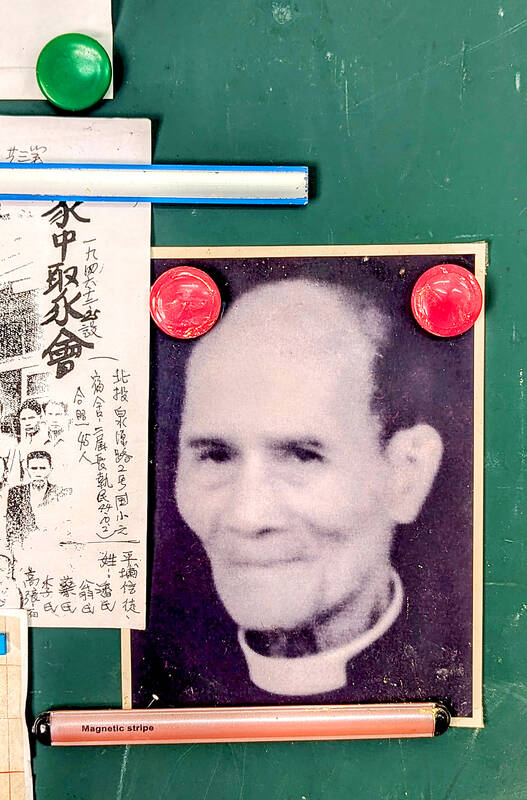
Photo: Han Cheung, Taipei Times
Scant details are available about Mackay’s direct engagement with Kipatauw, but his diary records on March 4, 1873: “Travelled round by the Sulphur Springs, preaching, singing and healing.”
The following day, he remained in the area and distributed pamphlets explaining the Ten Commandments. He continued to visit the Beitou area over the next few months, visiting families and performing medical procedures.

Photo: Han Cheung, Taipei Times
CONVERTS OF KIPATAUW
There’s little mention of Mackay’s subsequent activity in Beitou until the establishment of a new church site on April 26, 1891. It was a full house that day, he observed. The preacher was Han who was married to a Pingpu woman, and it was attended by both Indigenous and Han worshippers. The congregation did not stay there long, relocating from the rented house to a permanent site on Feb. 10, 1893.
By that time, the religion had spread to Kipatauw’s upper settlement, located further from the church. According to church records, among the earliest converts were village headman Lin Wu-tu (林烏凸, known as Lim O-pon in Taiwanese), who was baptized in 1890 at the age of 64, and his wife Pan Liu (潘劉), aged 53. Their two sons were baptized two years later. Lin later served as an elder in the church.

Photo courtesy of Tamsui Oxford Archives, Aletheia University
When Ino visited the settlement in July 1896, Lin greeted him and gave him a tour of the village. Lin appears at least once in Mackay’s diary: on March 7, 1897, Mackay visited the church, baptized six people and administered the Lord’s Supper. That night, they shared a meal at Lin’s house.
Independence Presbyterian Church founder Pan Shui-tu was four years old when his father Pan Shui-sheng (潘水生) converted in 1900 at the age of 33. According to family lore, Pan Shui-sheng’s father Pan Chu-shan (潘朱山) had once dueled with Lin for the position of village headman, later dying from his injuries. The two families reconciled in front of the congregation after they both joined the church.
NEW CHURCHES
Mackay’s diary shows that he continued to visit the Beitou church from time to time until his death in 1901. Fellow Canadian missionary William Gauld, who arrived in Taiwan in 1893, carried on the work of the Presbyterian Mission’s. In June 1912, Gauld designed a new building for the church, which still stands today on Zhongyang S Road (中央南路) and is currently under renovation. Gauld is responsible for a number of schools and other churches across northern Taiwan.
The land was donated by Chen Chin (陳近), who, according to Elder John Lai’s Archives (賴永祥長老資料庫), moved from Tamsui to Beitou to farm. Chen was baptized by Mackay in 1888, and reportedly told Gauld he was free to choose both the location and plot size. Pan Shui-sheng also pitched in for the construction; several sources state that he sold a daughter to obtain the funds.
Pan Shui-tu was part of the first graduating class of Tamkang High School in 1919, established by Mackay’s son George William Mackay. He then completed his studies at Taihoku Theological College. In 1923, he began his career as a minister in Dajia, Taichung, serving across central and northern Taiwan over the next 23 years.
In 1946, Pan returned to Beitou. However, according to the Beitou District Annals (北投區志), the Han majority at the church were allegedly unwilling to accept an Indigenous minister, leading to his departure. He began leading worship in his home, and later oversaw the construction of the Independence Presbyterian Church on Zhonghe Street (中和街). The red brick building was inaugurated in either 1960 or 1961.
Today, Pan Shui-tu’s son Pan Hui-an (潘慧安) continues to serve the church as elder.
Taiwan in Time, a column about Taiwan’s history that is published every Sunday, spotlights important or interesting events around the nation that either have anniversaries this week or are tied to current events.

If a leisurely afternoon of high-end dining and watching the scenery roll by from the comfort of a plush armchair sounds like a good time to you, consider a trip on the Sea Breeze (海風號). This culinary, cultural and scenic experience is the perfect setting for a date, a celebratory outing with a small group of friends or a relaxing solo ride. The price tag is steep, especially if you consider the short distance the train actually covers over the 3.5-hour journey. But what you’re paying for on the Sea Breeze isn’t transportation; it’s the comfort, the service, the exclusivity, the

June 15 to June 21 According to legend, a giant from Orchid Island (Lanyu, 蘭嶼) named Si Mangangavang once built a large tatala canoe capable of carrying 16 people. He set sail southward to the Batanes in the Philippines, where he traded with the local Ivatan people. One of the goods they coveted was cowhide, which the Tao people of Orchid Island used to make armor. Through continued trade, the Tao and Ivatan forged close ties, and Si Mangangavang became good friends with a Batanes giant named Si Vakag. This story, collected in a 1998 book by ethnologist Yu Guang-hong (余光弘)
Taiwan’s renewable shortfall is a problem of execution, not resources. Japan’s long-cycle, joined-up energy planning is the model worth studying — but what Taiwan can borrow is the institutional machinery, not the politics. When Nvidia CEO Jensen Huang (黃仁勳) used his visit to Taipei last month to warn that the country needs far more electricity, he was naming a constraint its own planners already know well: Taiwan Power Co (Taipower, 台電) expects demand from the semiconductor and artificial intelligence (AI) sector alone to exceed 5 gigawatts (GW) by 2030. The harder question is not whether to build more capacity but which

One of the wildest things about the reception of Chinese Nationalist Party (KMT) Chair Cheng Li-wun (鄭麗文) in the international media is the way her words are presented without being contextualized, let alone challenged. The Financial Times, for example, interviewing her during her visit to New York, said that she blamed the halt to exchanges between Taiwan and the People’s Republic of China (PRC) for raising tensions. “There has been no dialogue, so you can see that the situation is almost on the brink of war,” the Financial Times quoted her as saying, without any hint that the PRC, not


 RSS
RSS