


Stepping off the busy through-road at Yongan Market Station, lights flashing, horns honking, I turn down a small side street and into the warm embrace of my favorite hole-in-the-wall gem, the Hoi An Banh Mi shop (越南會安麵包), red flags and yellow lanterns waving outside.
“Little sister, we were wondering where you’ve been, we haven’t seen you in ages!” the owners call out with a smile.
It’s been seven days.
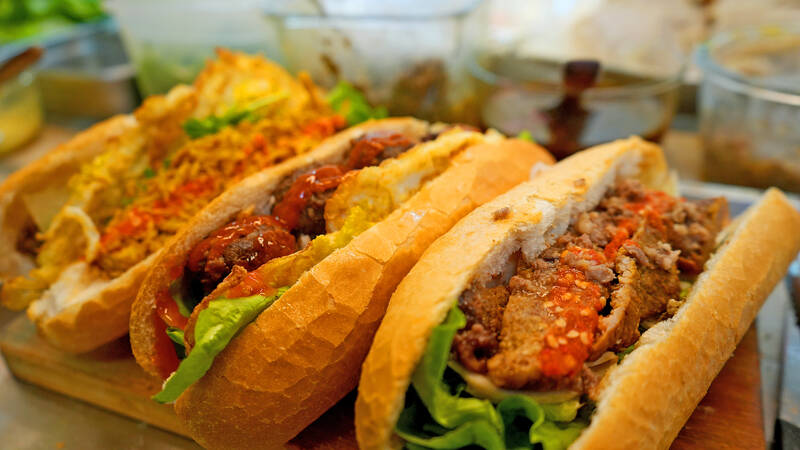
Photo: Hollie Younger, Taipei Times
The restaurant is run by Huang Jin-chuan (黃錦泉), who is married to a local, and her little sister Eva, who helps out on weekends, having also moved to New Taipei City to study her for Master’s degree here. The pair serve up fresh sandwiches that keep the vibrant immigrant community in Jhonghe District (中和) lining up day after day.
Banh mi, in my opinion, is the world’s greatest sandwich.
When the French occupied Vietnam in the 19th century, they brought cheese, bakeries and cured meats to Indochina.
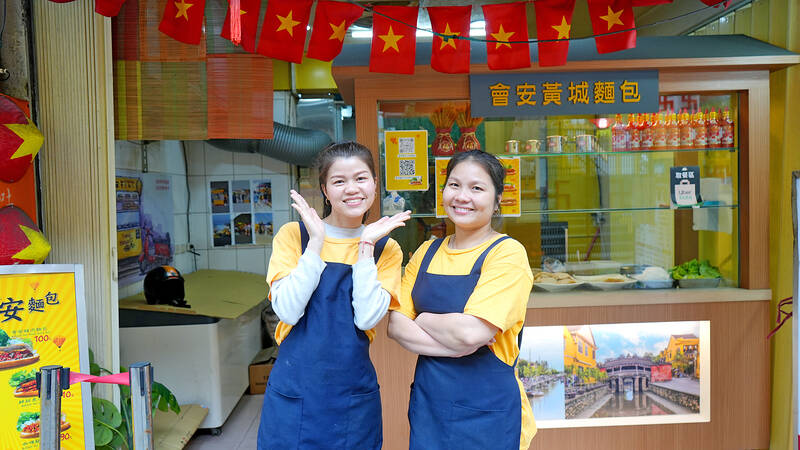
Photo: Hollie Younger, Taipei Times
Once they departed Vietnam in the 1950s, expensive Parisian cold-cut sandwiches were revolutionized into a spicy local delicacy, a cheap roadside breakfast and an emblem of the fall of European colonialism.
Warmed, crispy batons are slathered with mayonnaise and a chunky pate, then traditionally stuffed with a combination of crispy pork cuts and a sausage-like pork patty, topped with tangy pickled daikon, cucumber, cilantro and a healthy dose of chili sauce.
The secret is that Huang makes the sandwich exactly how she likes it — she eats one for breakfast every morning — and she’s got darned good taste.
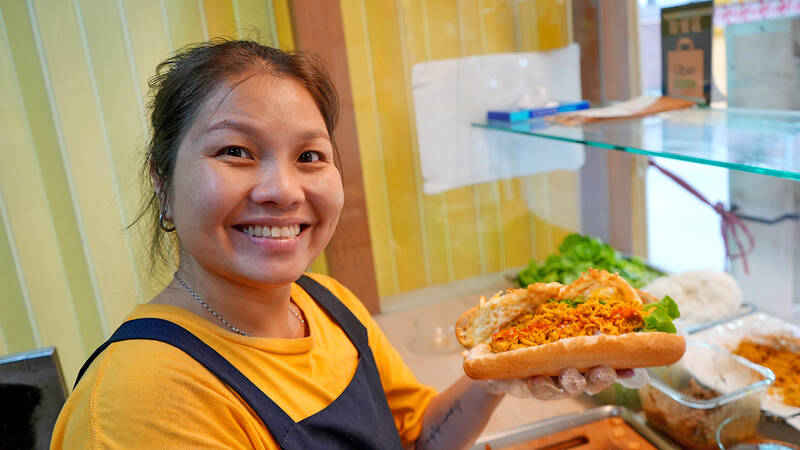
Photo: Hollie Younger, Taipei Times
I remain loyal to an original banh mi (NT$110), served with lean grilled pork and sausage, hold the egg, make it spicy. The pork is never fatty or greasy and they warm the baguettes on an open grill before serving them up warm and crispy.
But the girls also offer a wider menu that we sample for research purposes.
Our new favorite is the beef meatball and kimchi sandwich (NT$130) with Vietnamese sriracha-like sauce. Meatballs are rolled with lashings of lemongrass and southeast Asian aromatics. This option is apparently very popular among locals. We pop in one of the fried eggs that they sizzle up in the back.
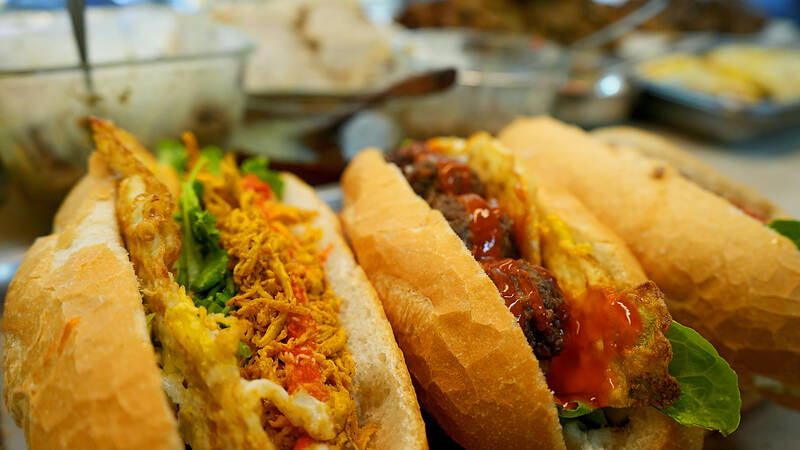
Photo: Hollie Younger, Taipei Times
The shredded curry chicken (NT$100) is also divine, with a delicate curry flavor and juicy meat, again topped with as much chili as requested and all the same crunchy accoutrements.
Top it off with a Vietnamese coffee (NT$65), which packs a sweet punch, though nothing compared to the teeth-numbing sugary hit you’ll find in Saigon. Huang adapts her brews to Taiwanese tastes, finding the right balance of bitter and sweet.
Despite some small tweaks, the sisters, from Vietnam’s sunny southern coast, keep it close to classic Vietnamese flavors. One of New Taipei City’s biggest draws is the fantastic access to affordable and authentic Southeast Asian cuisine, and this is a treat well worth the 10-minute MRT journey south of the river.
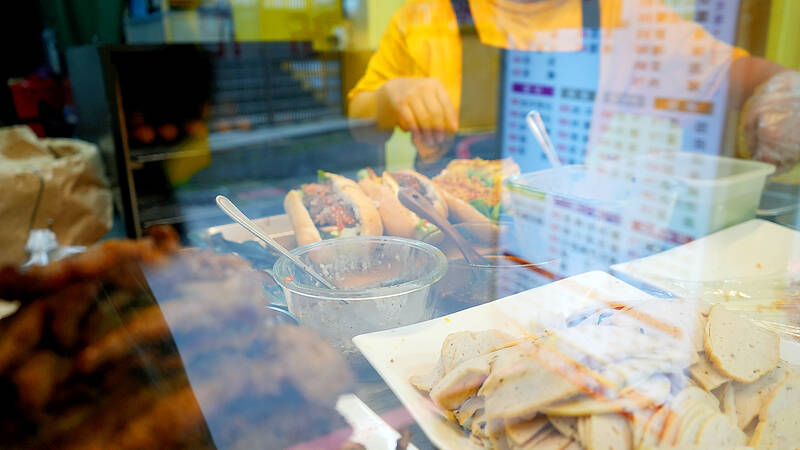
Photo: Hollie Younger, Taipei Times
Service with a smile is a given here. It’s the definition of supporting local businesses, sharing cultures and finding new flavors that become favorites. At least that’s how I justify my own addiction.
Check it out and tell them their little sister sent you.
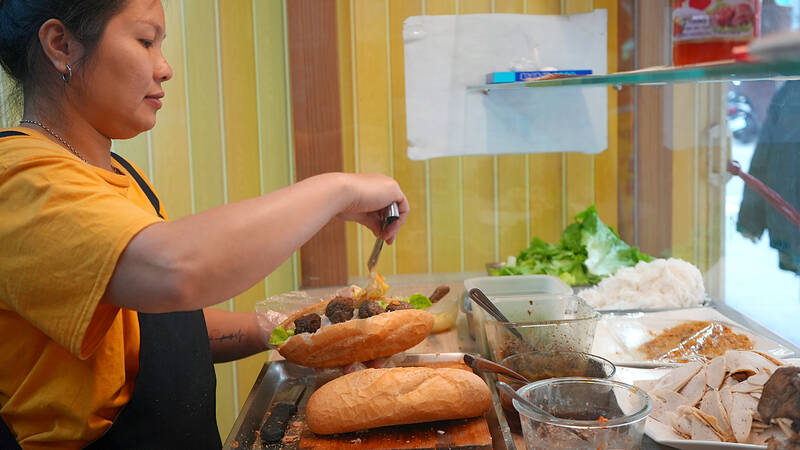
Photo: Hollie Younger, Taipei Times
Google unveiled an artificial intelligence tool Wednesday that its scientists said would help unravel the mysteries of the human genome — and could one day lead to new treatments for diseases. The deep learning model AlphaGenome was hailed by outside researchers as a “breakthrough” that would let scientists study and even simulate the roots of difficult-to-treat genetic diseases. While the first complete map of the human genome in 2003 “gave us the book of life, reading it remained a challenge,” Pushmeet Kohli, vice president of research at Google DeepMind, told journalists. “We have the text,” he said, which is a sequence of
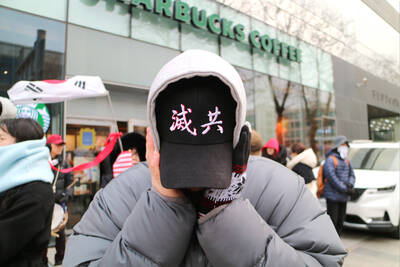
On a harsh winter afternoon last month, 2,000 protesters marched and chanted slogans such as “CCP out” and “Korea for Koreans” in Seoul’s popular Gangnam District. Participants — mostly students — wore caps printed with the Chinese characters for “exterminate communism” (滅共) and held banners reading “Heaven will destroy the Chinese Communist Party” (天滅中共). During the march, Park Jun-young, the leader of the protest organizer “Free University,” a conservative youth movement, who was on a hunger strike, collapsed after delivering a speech in sub-zero temperatures and was later hospitalized. Several protesters shaved their heads at the end of the demonstration. A
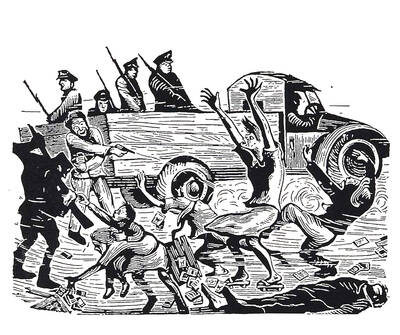
In August of 1949 American journalist Darrell Berrigan toured occupied Formosa and on Aug. 13 published “Should We Grab Formosa?” in the Saturday Evening Post. Berrigan, cataloguing the numerous horrors of corruption and looting the occupying Republic of China (ROC) was inflicting on the locals, advocated outright annexation of Taiwan by the US. He contended the islanders would welcome that. Berrigan also observed that the islanders were planning another revolt, and wrote of their “island nationalism.” The US position on Taiwan was well known there, and islanders, he said, had told him of US official statements that Taiwan had not

We have reached the point where, on any given day, it has become shocking if nothing shocking is happening in the news. This is especially true of Taiwan, which is in the crosshairs of the Chinese Communist Party (CCP), uniquely vulnerable to events happening in the US and Japan and where domestic politics has turned toxic and self-destructive. There are big forces at play far beyond our ability to control them. Feelings of helplessness are no joke and can lead to serious health issues. It should come as no surprise that a Strategic Market Research report is predicting a Compound


 RSS
RSS