


On a harsh winter afternoon last month, 2,000 protesters marched and chanted slogans such as “CCP out” and “Korea for Koreans” in Seoul’s popular Gangnam District. Participants — mostly students — wore caps printed with the Chinese characters for “exterminate communism” (滅共) and held banners reading “Heaven will destroy the Chinese Communist Party” (天滅中共).
During the march, Park Jun-young, the leader of the protest organizer “Free University,” a conservative youth movement, who was on a hunger strike, collapsed after delivering a speech in sub-zero temperatures and was later hospitalized. Several protesters shaved their heads at the end of the demonstration.
A MOVEMENT’S FAST GROWTH
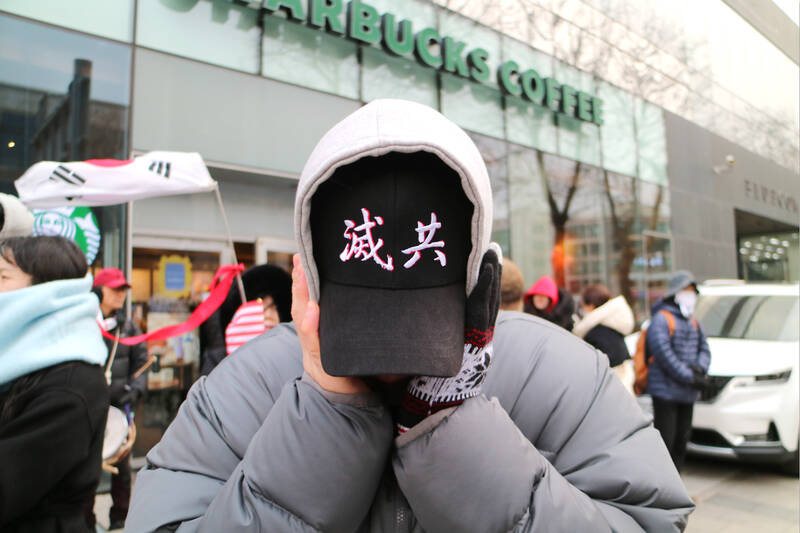
Photo: Don Huh
Since the movement’s first rally in another of Seoul’s renowned tourist sites, Myeongdong, in June last year, participation has climbed seven to eightfold, reaching about 10,000 people or more, organizers say. Similar protests have since spread, led by other groups in other tourist sites like Hongdae, as well as in Daerim-dong, which has a significant Chinese community.
“Our motivation is just to do our best for Korea,” said Lee Saya, a student at Jeonbuk National University — majoring in art, and a member of the movement.
Lee said the group initially protested near the Chinese Embassy in Myeongdong, but later shifted locations due to police intervention.
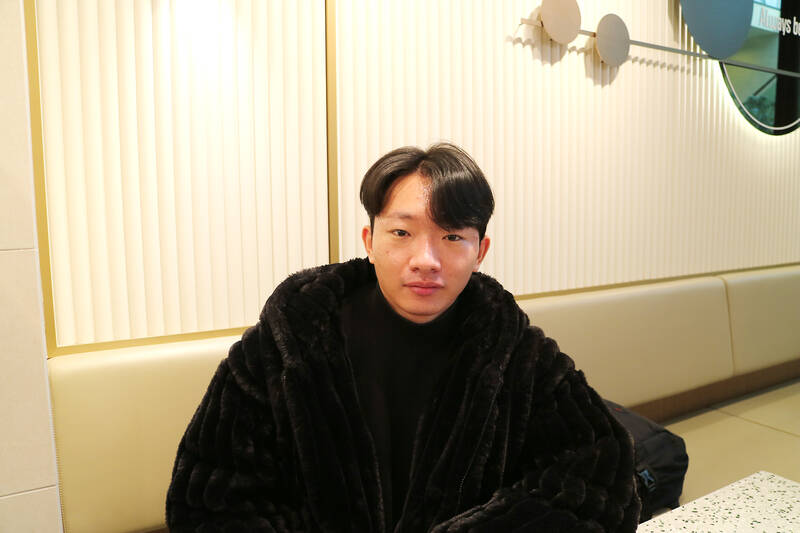
Photo: Don Huh
The Chinese Embassy in Seoul on July 9 last year lodged a complaint with the South Korean government over the protests and advised Chinese nationals in the country to be cautious. The central government subsequently barred rallies directly in front of the embassy, but allowed them in Myeondong.
“That crackdown happened because the Lee [Jae-myung] administration fears China,” Lee Saya said. “We were investigated by police for tearing the five-star red flag, and after President Lee Jae-myung ... officially condemned the marches on Sept. 9 last year, we could no longer organize protests in Myeongdong.”
Those restrictions continued through President Lee’s two summits with Chinese leader Xi Jinping (習近平) — at Asia-Pacific Economic Cooperation forum in Gyeongju on Nov. 1 last year and in Beijing on Jan. 5 — and remain in effect. In addition, a ruling party legislator proposed in October last year banning the movement’s China-bashing song and slogans, with violators facing up to five years in prison.
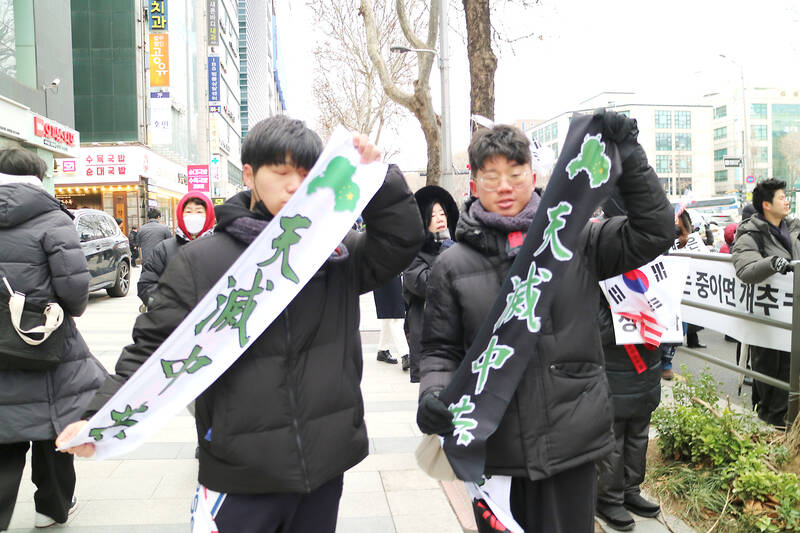
Photo: Don Huh
“By contrast, there have been numerous anti-US and anti-Japan protests in this country, including tearing the Stars and Stripes, but the government never intervened,” Lee said.
Despite the harsh rhetoric, the protests have remained nonviolent. Another member of the movement said that during a different group’s protest in Daerim-dong, some Chinese residents threw bottles at demonstrators despite the presence of police.
ANTI-CHINA SENTIMENT
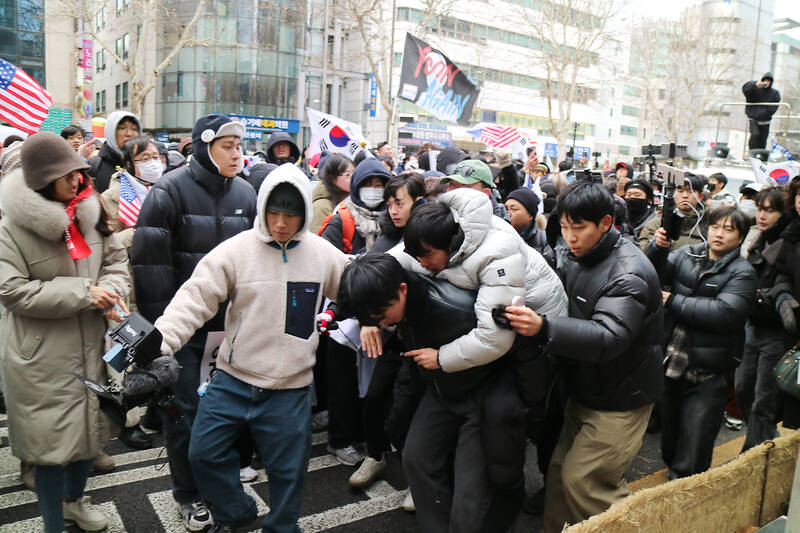
Photo: Don Huh
Anti-China sentiment in South Korea has been building for more than a decade. Surveys show that unfavorable views of China stood at 31 percent in 2002 and 49 percent in 2008, according to World Public Opinion surveys. The figure surged to 80 percent in 2022, according to the Pew Research Center, and stood at 72 percent last year, according to Gallup Korea.
Reasons cited for the sentiment are, first, misconduct by some Chinese tourists; second, China’s diplomatic and military pressure on South Korea, like the dispute over the US deployment of the Terminal High Altitude Area Defense (THAAD) system in 2017; and third, social issues involving Chinese nationals, including rising land prices linked to property purchases and short-term residents’ access to the country’s low-cost national health insurance system.
The situation has also affected Taiwanese visitors, as Mandarin spoken by Taiwanese is almost indistinguishable to Korean ears. One Taiwanese resident said that while speaking Mandarin on a bus near Seoul, a driver shouted at him to be quiet — a reaction he claims does not happen with other languages.
As a result, some Taiwanese tourists now wear badges stating “I am Taiwanese” while visiting South Korea. Hong Kong visitors have also reported similar experiences when speaking Cantonese on the street.
However, such encounters are not universal. Another Taiwanese visitor, surnamed You, said in December that he spoke Mandarin freely with his Taiwanese friend at the restaurants in Seoul without attaching a badge, but encountered no problems.
Even so, some Western and Japanese news outlets have described the South Korean protests as “racist” or “misled by fake news.”
That framing began appearing in South Korea’s pro-government news outlets in the second half of last year. While those outlets reported on anti-China sentiment as a social phenomenon through 2024, they began criticizing the protests as racist and insensitive to other ethnic groups as the demonstrations grew in scale.
Lee rejected that characterization, arguing that criticism from pro-government media also indicates fear of China.
“Nobody regards anti-US or anti-Japan protesters as racist here,” he said, “we are criticizing China based on what we have seen and experienced.”
Lee said that anti-China sentiment has intensified partly due to what he described as China’s cultural and commercial practices.
“China keeps pushing cultural projects and producing copycats of South Korean brands, such as the recently opened Chinese cosmetics shop ‘Only Young’ that imitates South Korea’s ‘Olive Young,’” Lee said.
He also recalled that during the South Korea’s 2019 trade dispute with Japan, his hometown of Jeonju were covered with anti-Japan banners.
“Many of those claims later turned out to be groundless rumors,” he said, “the ruling party exploited anti-Japan sentiment for political purposes and now accuses us of racism. That double standard infuriates me.”
Lee added that several government and ruling party figures, including the incumbent prime minister, were imprisoned for violent protests and arson attacks on the American Cultural Center during the 1980s and 1990s.
“They glorify their protests as democratic,” he said, “but we’re just singing and chanting, no violence.”
Another member of the movement also said that South Korea’s movement shares anti-China protests in Taiwan and Hong Kong’s characteristics in terms of “resistance to domination.”
“Several Hong Kong residents in Seoul planned to speak at our Myeongdong protest last year, but they canceled due to safety concerns,” the member said.
As anti-China sentiment increasingly moves from opinion polls to the streets, the protests are evolving from purely political concerns into cultural and everyday-life issues.
“We keep discussing our future direction every day,” Lee Saya said, “we always work for our homeland.”


Taiwan’s English education system is being pulled apart by three opposing forces. Bilingual Nation 2030 pulls students toward English and global communication. Artificial Intelligence (AI) readiness pulls them toward digital judgment, verification and AI-mediated work. But Taiwan’s old exam culture pulls them back toward memorization, grammar drills, timed reading and correct answers. If the education system keeps using old exams to define success, it risks producing graduates who are neither genuinely bilingual nor genuinely AI-ready, but trained for tasks machines can already perform. The first force is Bilingual Nation 2030. Launched in 2018, the policy aimed to “help Taiwan’s workforce connect

“Taiwan’s Opposition Leader Comes to US With a Message Straight Out of Beijing” read a May 31 headline in the Wall Street Journal. Top US administration officials and members of Congress almost certainly read the WSJ, and if there was a bullet point takeaway that people in Washington should absorb ahead of Chinese Nationalist Party (KMT) Chair Cheng Li-wun’s (鄭麗文) arrival in DC on June 9, that headline is it. The last few columns have discussed this very topic, and the timing is not coincidental. While those top officials likely do not read the Taipei Times, judging by the number
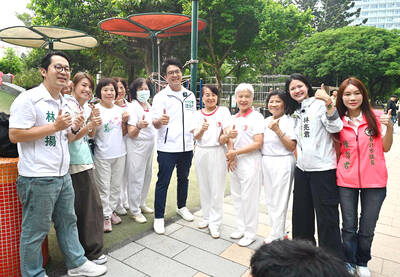
With weighty, anxiety-inducing geopolitical topics dominating the headlines, checking in on the wild and weird state of local politics can take some of the edge off. This November’s elections will determine who will be in charge of fixing potholes in your neighborhood, not the potholes in Taiwan’s complicated geopolitical space. Recently, after an online interview with a Taipei-based journalist, I commented that Taipei journalists never go further than the MRT can take them. He laughed and agreed. Naturally, the Taipei mayoral race is eating up much of the press attention. TAIPEI CITY Democratic Progressive Party (DPP) candidate Puma Shen (沈伯洋) has
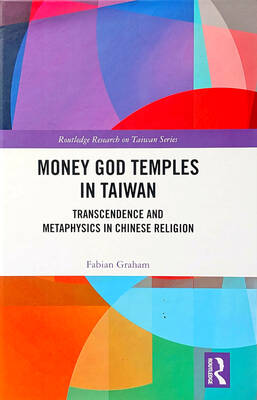
As someone who normally steers clear of books with “transcendence” or “metaphysics” in their subtitles, this reviewer — a casual observer of local belief systems since the 1990s — found Fabian Graham’s Money God Temples in Taiwan a challenging read. Those who’ve only dipped their toes into temple culture will likely need to parse several sections with special care if they’re to keep up with the author, a British ethnographic researcher whose previous books have investigated religious practices among ethnic Chinese in Southeast Asia. This scholarly volume examines a facet of Taiwan’s religious landscape that didn’t exist a century ago, and


 RSS
RSS