

Google unveiled an artificial intelligence tool Wednesday that its scientists said would help unravel the mysteries of the human genome — and could one day lead to new treatments for diseases.
The deep learning model AlphaGenome was hailed by outside researchers as a “breakthrough” that would let scientists study and even simulate the roots of difficult-to-treat genetic diseases.
While the first complete map of the human genome in 2003 “gave us the book of life, reading it remained a challenge,” Pushmeet Kohli, vice president of research at Google DeepMind, told journalists. “We have the text,” he said, which is a sequence of three billion nucleotide pairs represented by the letters A, T, C and G that make up DNA.
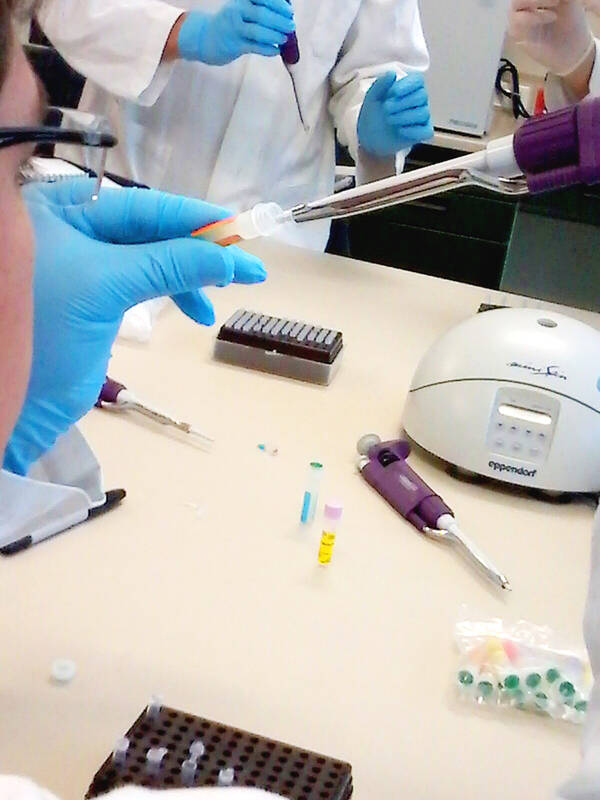
Photo courtesy of Wikimedia Commons
However “understanding the grammar of this genome — what is encoded in our DNA and how it governs life — is the next critical frontier for research,” said Kohli, co-author of a new study in the journal Nature.
Only around two percent of our DNA contains instructions for making proteins, which are the molecules that build and run the body.
The other 98 percent was long dismissed as “junk DNA” as scientists struggled to understand what it was for.

Photo: Reuters
However this “non-coding DNA” is now believed to act like a conductor, directing how genetic information works in each of our cells.
These sequences also contain many variants that have been associated with diseases. It is these sequences that AlphaGenome is aiming to understand.
A MILLION LETTERS
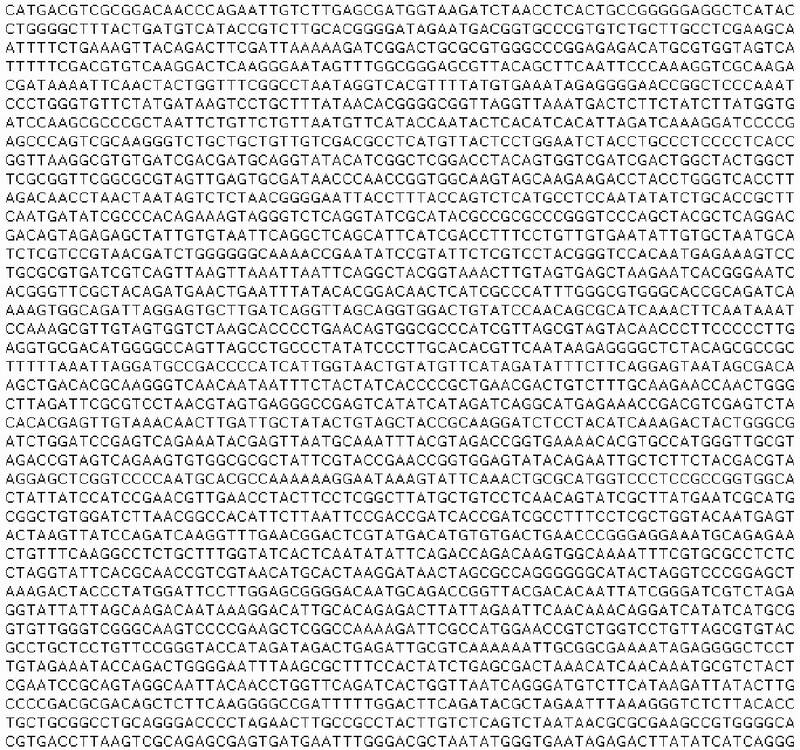
Photo courtesy of Wikimedia Commons
The project is just one part of Google’s AI-powered scientific work, which also includes AlphaFold, the winner of 2024’s chemistry Nobel.
AlphaGenome’s model was trained on data from public projects that measured non-coding DNA across hundreds of different cell and tissue types in humans and mice. The tool is able to analyze long DNA sequences then predict how each nucleotide pair will influence different biological processes within the cell.
This includes whether genes start and stop and how much RNA — molecules which transmit genetic instructions inside cells — is produced.
Other models already exist that have a similar aim. However they have to compromise, either by analyzing far shorter DNA sequences or decreasing how detailed their predictions are, known as resolution. DeepMind scientist and lead study author Ziga Avsec said that long sequences — up to a million DNA letters long — were “required to understand the full regulatory environment of a single gene.”
And the high resolution of the model allows scientists to study the impact of genetic variants by comparing the differences between mutated and non-mutated sequences.
“AlphaGenome can accelerate our understanding of the genome by helping to map where the functional elements are and what their roles are on a molecular level,” study co-author Natasha Latysheva said.
The model has already been tested by 3,000 scientists across 160 countries and is open for anyone to use for non-commercial reasons, Google said.
“We hope researchers will extend it with more data,” Kohli added.
‘BREAKTHROUGH’
Ben Lehner, a researcher at Cambridge University who was not involved in developing AlphaGenome but did test it, said the model “does indeed perform very well.”
“Identifying the precise differences in our genomes that make us more or less likely to develop thousands of diseases is a key step towards developing better therapeutics,” he explained.
However AlphaGenome “is far from perfect and there is still a lot of work to do,” he added.
“AI models are only as good as the data used to train them” and the existing data is not very suitable, he said.
Robert Goldstone, head of genomics at the UK’s Francis Crick Institute, cautioned that AlphaGenome was “not a magic bullet for all biological questions.”
This was partly because “gene expression is influenced by complex environmental factors that the model cannot see,” he said.
However the tool still represented a “breakthrough” that would allow scientists to “study and simulate the genetic roots of complex disease,” Goldstone added.
The column Taiwan in Time will return to this page on Sunday next week.

During the Martial Law era, newspapers and magazines were strictly controlled by the government. But from 1985 to 1990 — a period that straddled the lifting of martial law in 1987 — a free monthly expat magazine emerged as one of the first published and edited by foreigners. It was also perhaps the first to express a uniquely local expatriate voice. Taiwan Grapevine’s articles were irreverent, politically incorrect and plagued by typos. Neither editors nor writers were named in the magazine, and those bylines that appeared were obvious pseudonyms like Archibald Hellbender. Yet the magazine achieved nationwide distribution. And while

Bloomberg reported earlier this week that the People’s Republic of China (PRC) “has developed hypersonic glide vehicles that can launch air-to-air weapons, an advancement meant to threaten high-value targets such as command-and-control aircraft thousands of miles away.” Military Watch magazine reported in 2024 on one of the designs: “the vehicle is designed with payload options that include electronic warfare and reconnaissance suites, as well as bombs and both supersonic and subsonic drones that detach from the vehicle during flight,” while noting that the PRC is a world leader in such technologies. The threat from the PRC is not only increasing,
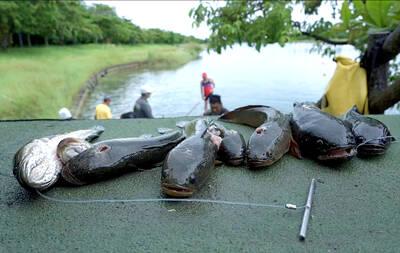
Taiwan’s rivers are significantly cleaner today than they were a few decades ago. The country’s rapid industrialization left many waterways polluted by untreated factory discharge, domestic sewage and runoff from livestock operations. Since the 1990s, expansion of municipal sewerage infrastructure and stricter enforcement of environmental standards have turned the situation around. However, freshwater ecosystems now face a very different threat — one that’s far less obvious to people living nearby. “Southern Taiwan — Tainan, Kaohsiung and Pingtung — is facing a particularly critical crisis regarding freshwater biological invasions,” says Lin Yen-ting (林晏廷), an assistant professor in the Master’s Program in Biodiversity
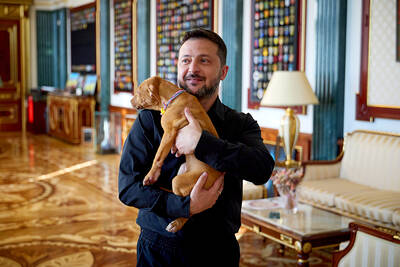
Wait. President Volodymyr Zelenskyy, Ukraine’s war chief, holding a puppy? Yes, and it’s no accident. In a collision of dog lovers, sports and ongoing war with Russia, the Ukrainian president was seen on video Tuesday as never before — cuddling and cooing over a floppy, 3-month-old American pit bull terrier, handed to him by US former boxer Terence Crawford. The cute and fluffy scene in Zelenskyy’s office in Kyiv was the latest volley in a deadly serious battle of visuals that runs in parallel to Ukraine’s fight against Russia’s brutal four-year invasion. Crawford, a longtime supporter of Ukraine and a devotee of the


 RSS
RSS