


We have reached the point where, on any given day, it has become shocking if nothing shocking is happening in the news. This is especially true of Taiwan, which is in the crosshairs of the Chinese Communist Party (CCP), uniquely vulnerable to events happening in the US and Japan and where domestic politics has turned toxic and self-destructive.
There are big forces at play far beyond our ability to control them. Feelings of helplessness are no joke and can lead to serious health issues. It should come as no surprise that a Strategic Market Research report is predicting a Compound Annual Growth Rate of 6.4 percent for antidepressant sales through 2030.
MACRO INSECURITY
Photo: EPA
The pandemic rattled the world. Taiwan was one of the best prepared to handle that crisis, but that was due to the initial botched response to the 2003 SARS epidemic. Fear of another disease spreading across our interconnected globe remains firmly in the back of everyone’s mind, just as a new report by George Washington University researchers finds that proposed Fiscal Year 2026 budget cuts to the Centers for Disease Control and Prevention, if enacted, would see cuts of 40 percent or higher — all while the US has just left the WHO.
Meanwhile, more and more countries are reaching the “point of no return” demographically, including Taiwan. Short of forcing women of childbearing age at the barrel of a gun — or bribe with massive amounts of cash — to bear three, four or five children, the population is headed in a downward spiral beyond the point that even mass immigration can’t fix. There are no longer solutions to this problem, only measures to mitigate the damage.
Technology can and eventually must help fill labor shortages, but short of a new economic model or radical social change, they are not going to be able replace consumers. All economic models are based on the assumption of a growing population. We are likely going to have to find a new economic model.
Photo: Reuters
Climate change is causing increasingly destructive weather events, with enormous financial costs and a growing human cost. Where this leads is anyone’s best guess. On one end of the spectrum, there is optimism for technological fixes that could ameliorate or even begin to reverse this process.
Conversely, there are concerns of a runaway cascading series of events, leading to a string of catastrophes compounding upon each other and accelerating the crisis to disastrous levels. For example, if the already weakening Atlantic Meridional Overturning Circulation (AMOC) ocean currents break down and stop bringing warm water from the tropics to northern climes, much of North America and Europe would be plunged into an ice age, perhaps leading to a mass refugee event and economic breakdown.
Between those extremes is a whole spectrum of possibilities ranging from problematic to deeply alarming.

Photo: Reuters
The hopes that technology can help with some of these issues, including labor shortages and helping solve climate issues, are not unfounded. The rate of technological progress is accelerating exponentially.
That comes with a new set of problems. One is simply that the rate of technological change is becoming increasingly hard to comprehend, and it is growing increasingly difficult to predict where it will go and how it will develop.
Techno-optimists foresee us crossing a “Singularity” into a future of unlimited potential, prosperity and “radical abundance.” Pessimists predict a hellscape where an artificial general intelligence (AGI) reaches the point where our little mammalian brains simply cannot keep up, and it embarks on an endless quest to expand itself, sucking up all energy to keep propelling it forward into the universe, and in such a scenario, humans would be an expensive irritant getting in its way.
POLITICAL UNCERTAINTY
Taiwan is very much at the crux of how much of this will play out. It plays an outsized role in the very technologies that could save, or destroy, humanity. However, as explored in Thursday’s column, “Kill the myth of the ‘silicon shield’” (Jan. 29, page 12), this does not provide Taiwan with any sort of protection.
A brief war in the Taiwan Strait could set those technologies back years. A full-scale war and invasion of Taiwan could set it back decades, taking not only Taiwan out of the technological supply chain but also potentially much of China’s manufacturing base, Japan and perhaps the Korean peninsula.
Death and destruction would be enormous, while a technological breakdown could cause poverty and even starvation around the globe. Oh, and lest we forget, that would be a perfect breeding ground for another pandemic, as happened after World War I.
That such a war could happen is far from certain, but recent military purges in Beijing certainly are not helping provide stability and predictability. The last people in the People’s Liberation Army (PLA) who could provide any sort of reality check to CCP Secretary-General Xi Jinping (習近平) are gone, and we have no idea who will replace them.
Rumors are flying that the entire system in China is set for a showdown between Xi and loyalists in the PLA to their previous commanders, though the evidence for this is highly conjectural. While there is no solid proof that such a scenario is developing, there is enough going on with just the purges alone to cause unease.
The other big player, the US, has crossed a Rubicon in relations with NATO, with the threatened invasion of Greenland. Previously, NATO put up with the Trump administration and had to admit he was right that member countries were not pulling their weight and needed to shape up.
They did that, and NATO countries have been stepping up, perhaps thinking the pressure would ease. It did not, and the pointless threats against Greenland shattered trust to the point it will take years, if not decades, to repair.
NATO may survive, but it will be a far less trusting and cohesive entity. This could complicate any response to aggressive moves by Xi over Taiwan. That is not a certainty, but it ramps up the level of uncertainty.
The Trump administration’s moves have already led European countries and Canada to openly chart new paths forward that reduce reliance on Washington. There is a case to be made that this was inevitable and Trump merely accelerated the timeline, but there were far less acrimonious and destructive paths this could have taken.
Already, a stream of leaders of formerly staunch US allies is making a beeline for Beijing. This is currently to shore up their economic options in response to Washington’s trade wars, but the rattling of the NATO alliance could lead to some countries deepening relations with the CCP to an alarming degree — especially if Trump continues his path of continuous destabilization of relations with nations that have long been friendly.
Challenges and risks are rising fast, and the political unity and stability that underpinned the post-war era is unravelling. This will make any coordinated response significantly harder precisely when it may be needed most.
The purpose of this column is not to cause panic. None of these doom-and-gloom scenarios are inevitable.
Historically, humanity has been adaptable and creative in overcoming challenges, though sometimes at great cost.
The most likely scenario is that we somehow muddle through, at least in the short to medium term.
The problem is the sharp rise in uncertainty on every level, and the insecurity and anxiety that comes with it.
In this uncertain universe, remember Douglas Adams’ advice from The Hitchhiker’s Guide to the Galaxy: “Don’t panic” and “always carry a towel.”
Donovan’s Deep Dives is a regular column by Courtney Donovan Smith (石東文) who writes in-depth analysis on everything about Taiwan’s political scene and geopolitics. Donovan is also the central Taiwan correspondent at ICRT FM100 Radio News, co-publisher of Compass Magazine, co-founder Taiwan Report (report.tw) and former chair of the Taichung American Chamber of Commerce. Follow him on X: @donovan_smith.

Yesterday, the Democratic Progressive Party (DPP) nominated legislator Puma Shen (沈伯洋) as their Taipei mayoral candidate, the Chinese Nationalist Party (KMT) put their stamp of approval on Wei Ping-cheng (魏平政) as their candidate for Changhua County commissioner and former legislator Tsai Pi-ru (蔡壁如) of the Taiwan People’s Party (TPP) has begun the process to also run in Changhua, though she has not yet been formally nominated. All three news items are bizarre. The DPP has struggled with settling on a Taipei nominee. The only candidate who declared interest was Enoch Wu (吳怡農), but the party seemed determined to nominate anyone
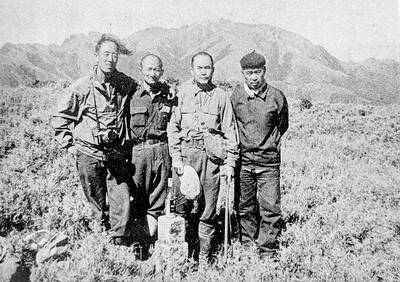
May 18 to May 24 Gathered on Yangtou Mountain (羊頭山) on Dec. 5, 1972, Taiwan’s hiking enthusiasts formally declared the formation of the “100 Peaks Club” (百岳俱樂部) and unveiled the final list of mountains. Famed mountaineer Lin Wen-an (林文安) led this effort for the Chinese Alpine Association (中華山岳協會). Working with other experienced climbers, he chose 100 peaks above 10,000 feet (3,048m) that featured triangulation points and varied in difficulty and character. The list sparked an alpine hiking craze, inspiring many to take up mountaineering and competing to “conquer” the summits. A common misconception is that the 100 Peaks represent Taiwan’s 100 tallest

In a sudden move last week, opposition lawmakers of the Chinese Nationalist Party (KMT) and Taiwan People’s Party (TPP) passed a NT$780 billion special defense budget as a preemptive measure to stop either Chinese leader Xi Jinping (習近平) or US President Donald Trump from blocking US arms sales to Taiwan at their summit in Beijing, said KMT heavyweight Jaw Shaw-kong (趙少康), speaking to the Taipei Foreign Correspondents Club on Wednesday night in Taipei. The 76-year-old Jaw, a political talk show host who ran as the KMT’s vice presidential candidate in 2024, says that he personally brokered the deal to resolve
The Chinese Nationalist Party (KMT), alongside their smaller allies the Taiwan People’s Party (TPP), are often accused of acting on behalf of the Chinese Communist Party (CCP). Some go so far as to call them “traitors.” It is not hard to see why. They regularly pass legislation to stymie the normal functioning of the ruling Democratic Progressive Party’s (DPP) administration, and they have yet to pass this year’s annual budget. They slashed key elements of the government’s proposed NT$1.25 trillion (US$40 billion) special military budget, and in the smaller NT$780 billion package they did pass, it is riddled with provisions that


 RSS
RSS