


Filmmakers Mona Fastvold and Brady Corbet are clearly fascinated by ambition. They’re fascinated, too, by dreamers — difficult dreamers, brilliant but demanding people who have plans they must fulfill no matter the personal cost.
They’re also interested in dreamers who cross the ocean to America with these difficult, lofty plans. And, finally, they find singular actors to play these roles.
You could say the couple, artistic and life partners, is on a roll. They together made The Brutalist last year, directed by Corbet and co-written with Fastvold, which won Adrien Brody an Oscar. And now, with Fastvold directing, we have The Testament of Ann Lee — a stirring and, yes, difficult movie that features a blazing Amanda Seyfried as the Shaker leader. It’s a performance that will knock your 18th-century socks off.

Photo: AP
There are, of course, key differences. For one thing, unlike fictional architect Lazlo Toth in The Brutalist, Ann Lee was a real person — a woman whose life story hasn’t been widely told (as the filmmakers have pointed out, people are more likely to remember the Shakers for their furniture design.) And she was a deeply spiritual figure: a woman who from childhood had visions of God, rejected the urgings of the flesh as sinful and was revered by followers who called her Mother and saw her as a female reincarnation of Jesus Christ.
Oh, yes, one other thing: The Testament of Ann Lee is a musical. An 18th-century religious musical — with both the agony (lots of agony) and ecstasy of Lee’s life channeled into song-and-dance numbers based on a dozen or so traditional hymns.
Yes, it’s a lot. It’s lots and lots. The film is absolutely not for everyone.
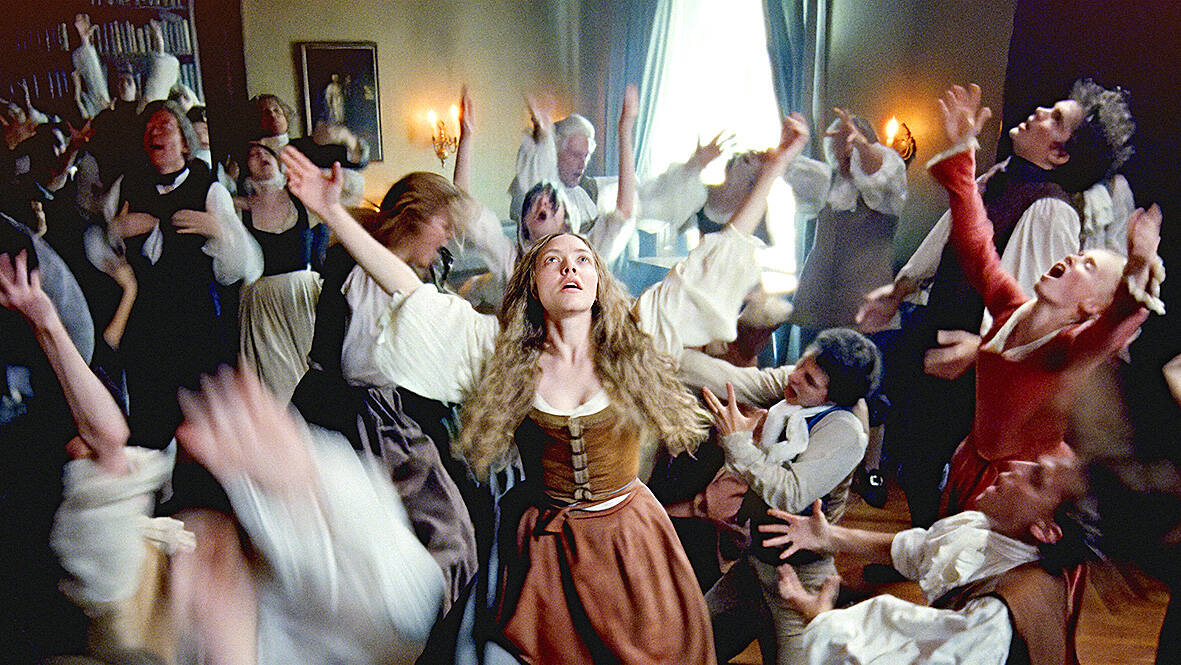
Photo: AP
But Fastvold has undeniably created something we’ve never quite seen before; speaking of visions, her singular artistic vision fills every frame. And Seyfried is a marvel, in yet another role that stretches this fiercely talented actor in ways we might not have predicted.
Fastvold, shooting on 70mm film as in The Brutalist, and cowriter Corbet divide Lee’s life into chapters. The first details her upbringing as a poor, illiterate child in Manchester, England. We’re told it was no coincidence that a “miraculous” woman would be born on Feb. 29. The year is 1736. Ann, daughter of a blacksmith, has heavenly visions as a child. (She’s also disgusted by the sight of her parents having sex.)
As a young woman, to escape the mill where her family works, Ann works as a nurse. Yearning for spiritual purpose, she attends a religious meeting and encounters a female preacher, something altogether new. The early Shakers — called the “Shaking Quakers of Manchester” — engage in an intense form of confession; the term “shaker” refers to their ecstatic gestures in worship, as if to shake off sin.
It’s tough to imagine what the film would be like without Seyfried’s grounding presence. She can be both spiritual and earthly, and when she breaks into song and dance, in numbers choreographed by Celia Rowlson-Hall to music by Daniel Blumberg (an Oscar winner for his Brutalist score), it feels organic and unforced.
Ann marries a locksmith, with whom she births four babies. All die by age 1. It’s almost too painful to watch, especially when her husband must tear away the last one from her grieving arms.
Devastated, she throws herself into worship. During a stint in jail for her heretical beliefs, she fasts, has visions and comes to believe she and her husband have been punished by God for having sexual intercourse. She will henceforth practice and preach celibacy.
The second chapter involves Ann leading a harrowing journey across the Atlantic to establish a base in the New World. (Fastvold found a fully operational 18th-century ship, with hand-stitched sails, in Sweden.) The worshippers almost don’t survive the trip.
But they arrive in New York City, somehow, two years before the American Revolution. The final act details the yearslong efforts to find a home where the Shaker community can live safely and grow — hardly a given.
Eventually the community settles upstate, where they learn to build furniture for revenue. Ann’s brother William (Lewis Pullman, excellent) sets out to find followers. The community has strict rules: celibacy, no marriage, gender equality, a pursuit of utopian perfection.
But their beliefs put them in danger. A chilling final sequence has a violent mob of townspeople setting fire to a house where the group is recruiting members.
At their peak, there were thousands of Shakers. Now there are exactly three (celibacy limited the community’s ability to grow.) It’s not unreasonable to ask: Why put so much energy and attention and craftsmanship into telling this particular story?
Well, one answer is pretty simple: they had Seyfried. The actor spent a year before shooting simply working on her 18th-century Manchester accent. She sings, she dances. And she gives one of the rawest renderings of childbirth, and child loss, that you’ll see on-screen.
No matter how you feel about the history here, it’s a visceral performance that simply demands to be seen.

Ajay Verma, a consultant gastroenterologist at Kettering general hospital in Northamptonshire, says our gut is a “complex machine.” “It is constantly providing us with the nutrition we need, initially to grow and develop, and then for us to survive, thrive and repair from injury and illness.” How can we keep it functioning well? Put simply: “Make sure what you put into it is balanced, and that you clear out its waste products adequately,” Verma says. “In a general gastroenterology clinic, the most common conditions we see are irritable bowel syndrome (IBS), gastroesophageal reflux disease, inflammatory bowel disease and constipation,” says Nisha
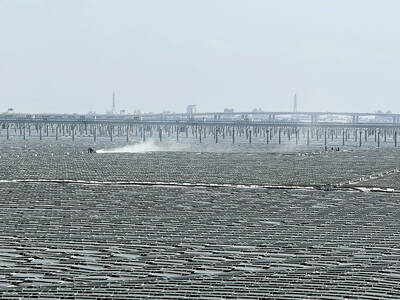
The arithmetic is straightforward and uncomfortable. By the end of 2025, Taiwan had committed itself to a 50-30-20 electricity mix — half natural gas, 30 per cent coal, 20 per cent renewables. The Ministry of Economic Affairs’s (MOEA) own monthly energy reports tell a different story. Natural gas reached 47.8 per cent of generation last year. Coal stood at 35.4 per cent, comfortably above its target ceiling. Renewables came in at 13.1 per cent, well short of the 20 per cent Taipei had pledged a decade earlier. Installed renewable capacity reached roughly half of the 12 gigawatts (GW) the government

Last week US President Donald Trump was asked by a reporter whether he would speak on the phone to the President of Taiwan. “l’ll speak to him. I speak to everybody. We have that situation very well in hand,” Trump said. This marked the second time in a couple of weeks he had said he would talk to the President of Taiwan. In 2016 he famously took a call from then-president Tsai Ing-wen (蔡英文), when he was president-elect. Despite warnings that the apocalypse was nigh because of a phone call, the world quickly forgot about the conversation between two democratically-elected presidents.
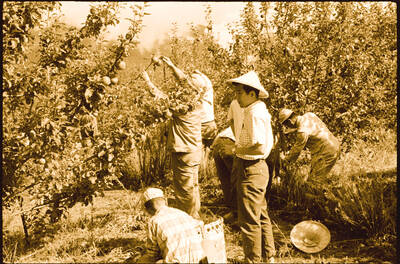
May 25 to May 31 Few believed that apples could be cultivated on a commercial scale in Taiwan’s high mountains. When horticulturalist Cheng Chao-hsiung (程兆熊) first proposed the idea in 1955, both American and Taiwanese colleagues dismissed it as implausible, arguing that temperate fruit could not be reliably grown on a subtropical island, especially on rugged terrain. However, it was this terrain in the Central Mountain Range where many Chinese Civil War veterans were resettled in the late 1950s. With limited job prospects and no family in Taiwan, they were placed on cooperative farms aimed toward self-sufficiency. Some say the conditions


 RSS
RSS