


Hong Kong fire survivor Yip Ka-kui has turned happy holiday photos into a heartfelt tribute to his beloved wife a month after she died in the huge blaze that destroyed their home.
Yip, 68, is among thousands grieving the 161 killed at the Wang Fuk Court housing complex, a disaster few could imagine happening in one of Asia’s safest and most developed cities.
Even as the Hong Kong government forges ahead with investigations and relief efforts, experts caution that the psychological scars will be hard to heal for survivors, bereaved families and onlookers alike.
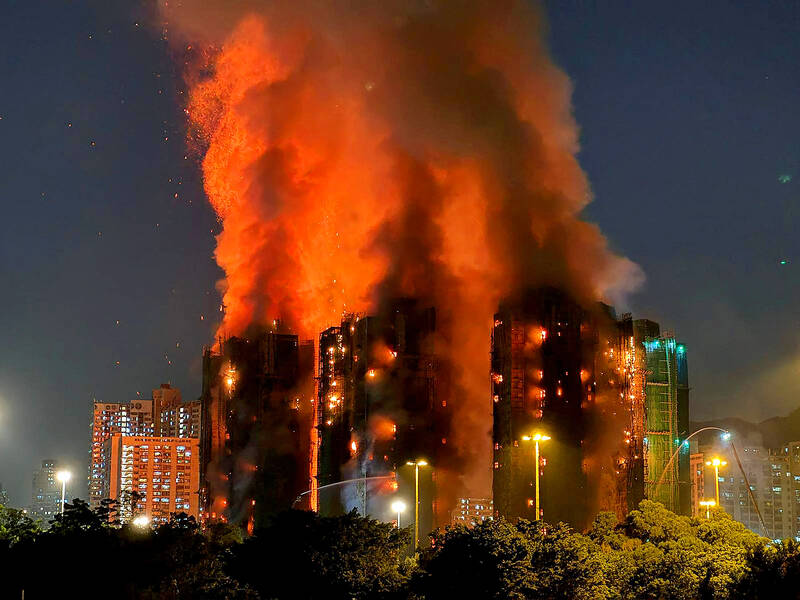
Photo: AFP
In dozens of shots compiled into a memorial video, Yip’s wife of four decades, Pak Shui-lin, 66, gently smiles at the camera at the Pyramids of Giza, the Taj Mahal and the Eiffel Tower.
“I blame myself. I always feel I was late to warn her, so she couldn’t escape in time,” said retired engineer Yip, recalling how the couple tried to flee the burning building on Nov. 26.
Flames quickly engulfed seven out of eight residential towers, which were undergoing renovations and wrapped in substandard netting that may have contributed to the fire’s spread.
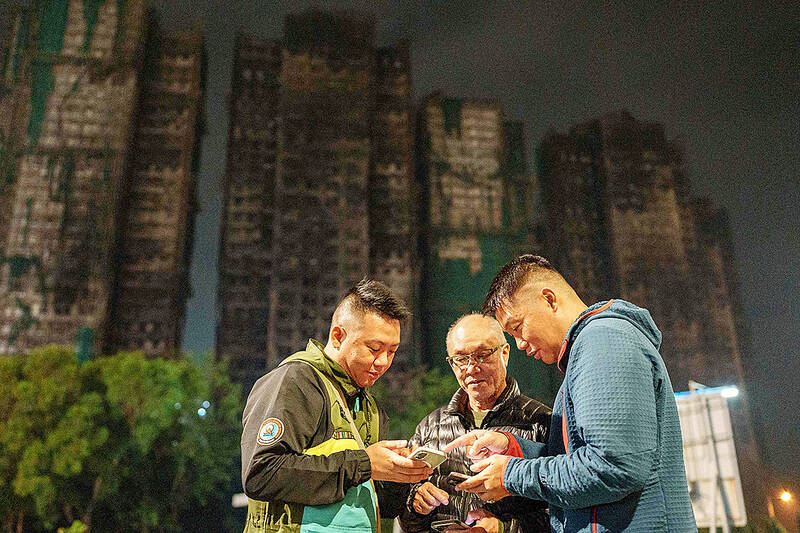
Photo: AFP
Yip got out first. When the fire alarms failed to sound, his wife knocked on neighbors’ doors to warn them, according to one person she saved.
Yip said he did not think Pak was trying to “exchange one life for another,” only that she was “doing what needed to be done.”
“The difference of a few minutes between us means that I will never see her again. That’s what I can’t accept.”
LIKE FIGHTING A WAR ‘EVERY DAY’
Not long after the fire started, counseling psychologist Isaac Yu helped organize dozens of others in his field to support displaced residents.
“The scale, immediacy and level of shock of this (incident) were beyond” anything they had trained for, Yu said.
Those who lost everything might have appeared calm at first, he recalled, but the fear was that they would break down during quiet moments and develop post-traumatic stress disorder.
NGOs such as the Samaritan Befrienders have contacted bereaved families to offer free mental-health services, with additional support available in transitional housing and schools, authorities said.
Many of Hong Kong’s 7.5 million residents obsessively followed live updates of the fire, which could have caused them mental strain, Yu added.
“For those who don’t actively seek help, I’m worried about missing the chance to intervene, which may lead to more serious mental health problems and tragedies,” he said.
Johnson Wong, a 51-year-old business manager, said that his family struggled to process their grief while two of their relatives remained unaccounted for.
While most of the bodies have been identified, some remains have turned to ash and time-consuming DNA tests are needed, police said, adding the death toll could rise further.
Wong’s wife, a nurse, had hoped that her mother and sister would survive. But her worst fears were all but confirmed when she was shown pictures of two charred bodies found inside their flat.
“If the (DNA test) is a match, that marks an ending. But if not, what can we do?” Wong said, adding that the fire had likely deprived his niece, a university student, of her only remaining parent.
“Every day we have been fighting a war... It will take a long time to calm the family.”
‘INCOMPREHENSIBLE’
As Hong Kong marks the festive season, more than 4,600 people displaced by the fire still rely on temporary accommodation including hotels, according to Hong Kong’s government.
Some elderly people who were shunted into unfamiliar districts have had trouble adapting, according to local media.
Having moved in with his sons, Yip said his “unrealistic” wish was for his home to be rebuilt the way it was.
The government has yet to commit to renovating or knocking down the ruined estate, and industry figures say resettlement will take years.
On Tuesday, a judge-led committee visited the site as part of an investigation that is expected to yield a report in nine months.
Police said in early December that 21 people linked to various construction and contractor firms had been arrested, most for manslaughter and some for fraud. Those numbers have not been updated since.
Yip said he hoped the authorities would find the truth in the many “incomprehensible” aspects of the tragedy, but Wong was less sanguine.
“Getting an answer is better than none, but can it restore what we lost?” Wong said.
“What we need most are our family members. Two of them are gone.”

Ajay Verma, a consultant gastroenterologist at Kettering general hospital in Northamptonshire, says our gut is a “complex machine.” “It is constantly providing us with the nutrition we need, initially to grow and develop, and then for us to survive, thrive and repair from injury and illness.” How can we keep it functioning well? Put simply: “Make sure what you put into it is balanced, and that you clear out its waste products adequately,” Verma says. “In a general gastroenterology clinic, the most common conditions we see are irritable bowel syndrome (IBS), gastroesophageal reflux disease, inflammatory bowel disease and constipation,” says Nisha
The arithmetic is straightforward and uncomfortable. By the end of 2025, Taiwan had committed itself to a 50-30-20 electricity mix — half natural gas, 30 per cent coal, 20 per cent renewables. The Ministry of Economic Affairs’s (MOEA) own monthly energy reports tell a different story. Natural gas reached 47.8 per cent of generation last year. Coal stood at 35.4 per cent, comfortably above its target ceiling. Renewables came in at 13.1 per cent, well short of the 20 per cent Taipei had pledged a decade earlier. Installed renewable capacity reached roughly half of the 12 gigawatts (GW) the government

Last week US President Donald Trump was asked by a reporter whether he would speak on the phone to the President of Taiwan. “l’ll speak to him. I speak to everybody. We have that situation very well in hand,” Trump said. This marked the second time in a couple of weeks he had said he would talk to the President of Taiwan. In 2016 he famously took a call from then-president Tsai Ing-wen (蔡英文), when he was president-elect. Despite warnings that the apocalypse was nigh because of a phone call, the world quickly forgot about the conversation between two democratically-elected presidents.
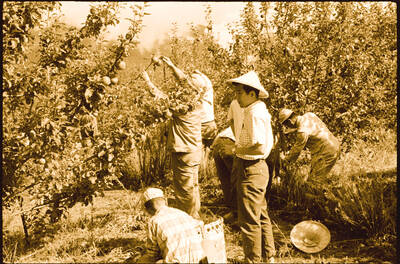
May 25 to May 31 Few believed that apples could be cultivated on a commercial scale in Taiwan’s high mountains. When horticulturalist Cheng Chao-hsiung (程兆熊) first proposed the idea in 1955, both American and Taiwanese colleagues dismissed it as implausible, arguing that temperate fruit could not be reliably grown on a subtropical island, especially on rugged terrain. However, it was this terrain in the Central Mountain Range where many Chinese Civil War veterans were resettled in the late 1950s. With limited job prospects and no family in Taiwan, they were placed on cooperative farms aimed toward self-sufficiency. Some say the conditions


 RSS
RSS