


China is ramping up objections to what it sees as Japan’s desire to acquire nuclear weapons, despite Tokyo’s longstanding renunciation of such arms, deepening another fissure in the two neighbors’ increasingly tense ties.
In what appears to be a concerted effort, China’s foreign and defense ministries issued statements on Thursday condemning alleged remilitarism efforts by Tokyo.
The remarks came as two of the country’s top think tanks jointly issued a 29-page report framing actions by “right-wing forces” in Japan as posing a “serious threat” to world peace.

Photo: Reuters
While that report did not define “right-wing forces,” the Chinese Ministry of Foreign Affairs was more explicit.
Ministry spokeswoman Mao Ning (毛寧) said Japanese Prime Minister Sanae Takaichi and other senior officials had revealed their ambitions by seeking to revise the three non-nuclear principles, discussing the potential introduction of nuclear-powered submarines and calling for boosting “extended deterrence.”
“Such moves of the Japanese side form a grave challenge to the international nuclear non-proliferation regime based on the Treaty on the Non-Proliferation of Nuclear Weapons and the postwar international order, and have been met with strong opposition from the international community and people from various sectors within Japan,” Mao said.
Asked about China’s claims regarding Japan’s nuclear ambitions, Japanese Minister of Foreign Affairs Toshimitsu Motegi said: “I’d like to state that there is absolutely no truth to such claims.”
The three nonnuclear principles refers to Japan’s long-standing commitment to not possess, produce or permit the entry of nuclear weapons.
Takaichi has said her government abides by the principles, but has not been clear on whether that commitment would remain unchanged as the government seeks to overhaul its national defense strategy.
Amid growing concerns about Beijing’s own military buildup, and the possibility that China would attack Taiwan, Japan in 2022 launched a five-year, ¥43 trillion (US$272.84 billion) defense buildup aiming to roughly double defense spending to 2 percent of GDP.
Takaichi has accelerated that spending goal to the 2025 fiscal year, while Japanese Minister of Defense Shinjiro Koizumi has reportedly said the nation needs to discuss whether to develop nuclear-powered submarines.
Ties between Asia’s top economies deteriorated late last year after Takaichi remarked that if military force were used in a Taiwan conflict, it could be a “survival-threatening situation” for her nation. That classification would provide a legal justification for Japan to deploy its military to help defend friendly nations.
The Chinese Ministry of National Defense accused Japan of “brazenly exporting lethal weaponry” and going against international sentiment by advocating for the possession of nuclear weapons.
Japanese leaders have consistently said the country would not seek atomic weapons.
Still, Itsunori Onodera, the ruling party’s head of research on security, has said his nation should not shy away from discussing nuclear arms, after it was reported another lawmaker expressed a personal opinion in favor of such weaponry.
Even as Beijing stepped up its criticism, an opinion survey published yesterday found that China’s military is the biggest security concern for Japanese people.
More than 68 percent of respondents picked China as a concern, placing it ahead of North Korea for the first time since 2015.
The survey of views on defense issues was carried out in November and December last year. A record 45 percent of respondents said the armed forces should be bolstered, but they were not asked whether Japan should acquire nuclear weapons.

SILENCING CRITICS: In addition to blocking Taiwan, China aimed to prevent rights activists from speaking out against authoritarian states, a Cabinet department said The Ministry of Foreign Affairs (MOFA) yesterday condemned transnational repression by Beijing after RightsCon, a major digital human rights conference scheduled to be held in Zambia this week, was abruptly canceled due to Chinese pressure over Taiwanese participation. This year’s RightsCon, the world’s largest conference discussing issues “at the intersection of human rights and technology,” was scheduled to take place from tomorrow to Friday in Lusaka, and expected to draw 2,600 in-person attendees from 150 countries, along with 1,100 online participants. However, organizers were forced to cancel the event due to behind-the-scenes pressure from China, the ministry said, expressing its “strongest condemnation”
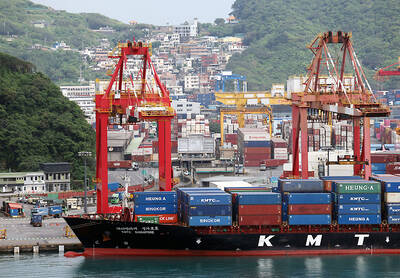
Taiwan’s economy grew far faster than expected in the first quarter, as booming demand for artificial intelligence (AI) applications drove a surge in exports, spilling over into investment and consumption, the Directorate-General of Budget, Accounting and Statistics (DGBAS) said yesterday. GDP growth was 13.69 percent year-on-year during the January-to-March period, beating the DGBAS’ February forecast by 2.23 percentage points and marking the most robust growth in nearly four decades, DGBAS senior official Chiang Hsin-yi (江心怡) told a news conference in Taipei. The result was powered by exports, which remain the backbone of Taiwan’s economy, Chiang said. Outbound shipments jumped 51.12 percent year-on-year to
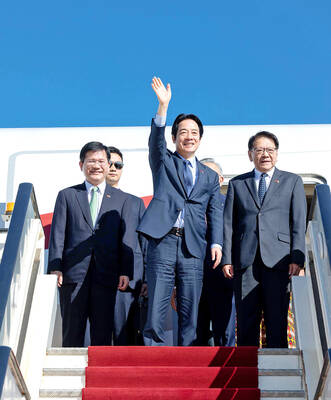
DELAYED BUT DETERMINED: The president’s visit highlights Taiwan’s right to international engagement amid regional pressure from China President Willaim Lai (賴清德) yesterday arrived in Eswatini, more than a week after his planned visit to Taiwan’s sole African ally was suspended because of revoked overflight permits. “The visit, originally scheduled for April 22, was postponed due to unforeseen external factors,” Lai wrote on social media. “After several days of careful arrangements by our diplomatic and national security teams, we successfully arrived today.” Lai said he looked forward to further deepening Taiwan-Eswatini relations through closer cooperation in the economy, agriculture, culture and education, as well as advancing the nation’s international partnerships. The president was initially scheduled to arrive in time to celebrate
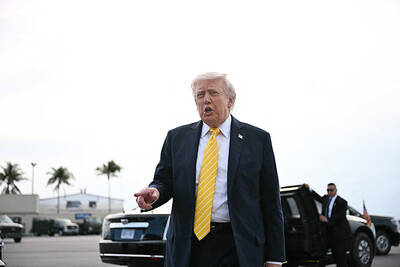
Iran’s Islamic Revolutionary Guard Corp (IRGC) yesterday said the US faced a choice between an “impossible” military operation or a “bad deal” with Tehran, after US President Donald Trump disparaged Iran’s latest peace proposal. Negotiations between the two countries have been deadlocked since a ceasefire came into effect on April 8, with only one round of direct peace talks held so far. Iran’s Tasnim and Fars news agencies reported that Tehran had submitted a 14-point proposal to mediator Pakistan, but Trump was quick to cast doubt on it. “I will soon be reviewing the plan that Iran has just sent to us, but


 RSS
RSS