


The Republic of China (ROC) Constitution was, for most of its existence, little more than the candy coating over the authoritarian one-party state of the Chinese Nationalist Party (KMT). Political decisions were determined at the top of the party, and sent down. Today, because of a series of amendments passed in the 1990s and early 2000s to enable democratic governance, it has achieved a certain legitimacy among all parties as the basis for legal governance and free elections. That real but impaired legitimacy, and the contradictions inherent in adapting a one-party document to a democracy, makes it the perfect framework for an attack on governance by a party acting in bad faith.
The KMT, of course, detests democracy because the party has always known that democracy would mean the end of KMT rule and the possibility of an independent Taiwan.
“But responsible Formosan leaders, both Kuomintang [KMT] and opposition members, have told me that more than 90 per cent of the people desire the establishment of an independent Formosan republic,” Albert Axelbank wrote in Harper’s magazine in 1963 after visiting.
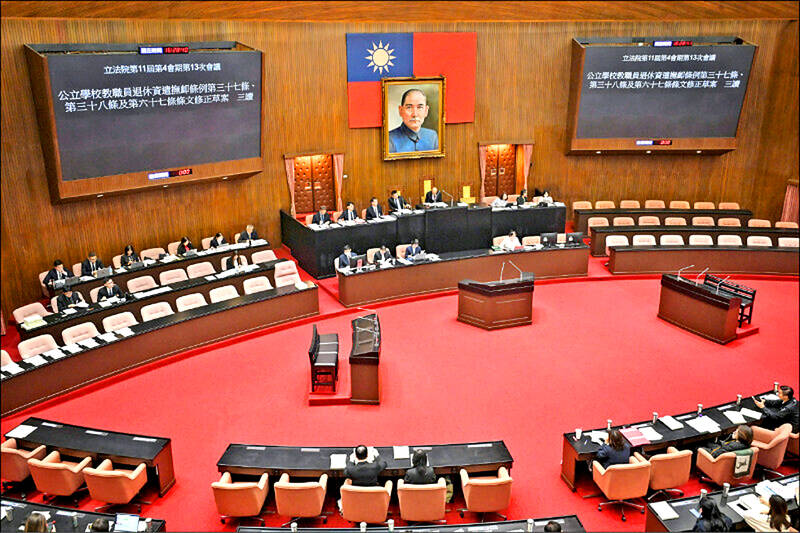
Photo: TT file photo
The KMT was deeply unpopular then. Indeed, it is one of the chief ironies of the democratic era that the KMT probably has more popular support today than it ever enjoyed in the Martial Law era.
CONSTITUTIONAL CRISIS?
The current crisis, in which Premier Cho Jung-tai (卓榮泰) is refusing to countersign spending bills passed by the legislature, is generally interpreted as a “constitutional crisis.” Nathan Batto takes this route in a superb post at his blog Frozen Garlic this week laying out the constitutional and political ins-and-outs of the premier’s decision. It leads to a conclusion many observers have arrived at: “the president is effectively telling the legislature to make a choice: either restore the power of the Constitutional Court or accept that the executive branch has an absolute veto [over the legislature’s actions].”
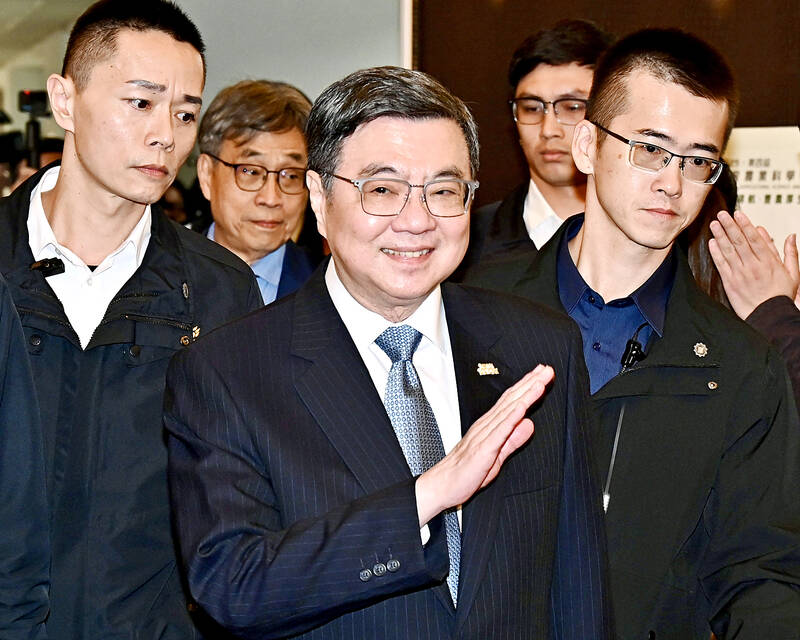
Photo: Tu Chien-jung, Taipei Times
As Batto observes, the KMT is likely to embrace neither. What then, will it choose?
The crisis was manufactured by the KMT-controlled legislature. Last year it raised the quorum of justices required to issue rulings above the current number of justices, and then blocked the administration’s nominees to ensure that the Constitutional Court could not function to overrule either party. That move laid the foundation for the current crisis: the KMT then passed a spending bill that raised the share of the central government budget given to local governments, which it disproportionately controls.
Such a move would force the central government to violate either the Constitution (by refusing to carry out the law) or the Public Debt Act (公共債務法), which limits government borrowing, degrading Taiwan’s legendary fiscal discipline. Note that either of those choices results in degraded governance. Win-win, if you don’t care about Taiwan.
The Constitution was never meant to contain such a crisis, because such a crisis could never occur in a one-party state. The ruling party leadership would have arranged for it to be resolved.
Premier Cho described the KMT’s legislative moves as “strange and controversial bills” that limit the Executive Yuan’s ability to plan and implement policies for the fair distribution of central government revenue to local governments. Much spending at the local level will have to be suspended, including flood control projects and programs aimed at boosting Taiwan’s AI industry. The public will of course blame the central government, as it did under the Chen Shui-bian (陳水扁) administration.
Expect some coordination with Beijing — in 2006 Beijing suspended gravel exports to Taiwan, and the price of gravel more than doubled. Many local infrastructure projects were slowed or suspended, lending plausibility to the KMT’s claims that Taiwan (then in the midst of a massive export boom) was suffering and Chen was mismanaging the economy.
OLD VINEGAR IN NEW BOTTLES
Two issues are important here. First, none of this is new. The KMT is using the same set of tactics (budget shenanigans, demands the president appear before the legislature, recall and impeachment threats, crippling central government agencies by refusing to approve nominees) it deployed against Chen Shui-bian. Second, the goal here, as Premier Cho alluded to in an interview this week with the Liberty Times (the Taipei Times’ sister paper), is to obstruct governance.
What we actually are facing is a crisis of political responsibility on the part of the KMT, which is playing out as a constitutional crisis because the constitution provides the framework for resolving political conflict. Even if some solution to the current mess is found, the pro-China parties in the legislature — the KMT and the Taiwan People’s Party (TPP) — will continue to generate political crises by eviscerating governance and then passing laws to exploit the weaknesses they have created. This will never stop. It is not a constitutional crisis, but a permanent strategy. Understanding this, the government has chosen to attempt to force the KMT to restore the Constitutional Court, to put a stop to the KMT’s anti-governance shenanigans.
This suggests that one among the several forks in the KMT’s current political strategy may be to establish the conditions under which the public will accept strongman rule under a hollowed out constitutional framework. The KMT’s accusation that President William Lai (賴清德) is a “dictator” should be viewed through the rubric that every accusation is a confession. If governance via democratic interaction between parties fails and political crises become a permanent feature of Taiwanese life, the alternative will become obvious.
Consider: the public is sick of politics. To mention politics to a Taiwanese is to provoke eye rolling and expressions of disgust. People still vote, despite this. But the public is aging and the youth bloc is shrinking as Taiwan’s suicidal demographic policies take hold. The upper tiers of the workforce and retirees consist of people for whom the era of autocrat Chiang Ching-kuo (蔣經國) represents a sort of Golden Age of political competence and economic growth, one constantly invoked by Taiwan’s politicians. This feeling may reinforce the native conservatism of Taiwan’s seniors, who have disproportionately benefited from two decades of Taiwan’s real estate-driven domestic economy and don’t want change.
It is not a coincidence that former Taipei mayor and former TPP chairman Ko Wen-je (柯文哲) consciously modeled himself on Chiang Ching-kuo during his presidential run last year. He was attempting to appeal to that elderly voter bloc, and to project the image of a competent strongman who made the right decisions and wasn’t ideological. Ko’s social media programming similarly went after the young, especially young males, who are sick of the two major parties.
The (fortunately temporary) success of Ko suggests that a slicker, more competent candidate modeled on Chiang Ching-kuo promising to end political wrangling could establish themselves as a strongman along the lines of Victor Orban in Hungary, provided they had the backing of one of the major parties. The prominence of Chiang Ching-kuo in political nostalgia suggests that if fascism ever comes to Taiwan, it will appear as populism masked as constitutionalism, and it will be wrapped in Chiang Ching-kuo garments.
Notes from Central Taiwan is a column written by long-term resident Michael Turton, who provides incisive commentary informed by three decades of living in and writing about his adoptive country. The views expressed here are his own.
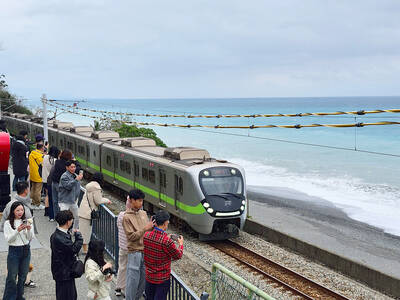
The small platform at Duoliang Train Station in Taitung County’s Taimali Township (太麻里) served villagers from 1992 to 2006, but was eventually shut down due to lack of use. Just 10 years later, the abandoned train station had become widely known as the most beautiful station in Taiwan, and visitors were so frequent that the village had to start restricting traffic. Nowadays, Duoliang Village (多良) is known as a bit of a tourist trap, with a mandatory, albeit modest, admission fee of NT$10 giving access to a crowded lane of vendors with a mediocre view of the ocean and the trains

For many people, Bilingual Nation 2030 begins and ends in the classroom. Since the policy was launched in 2018, the debate has centered on students, teachers and the pressure placed on schools. Yet the policy was never solely about English education. The government’s official plan also calls for bilingualization in Taiwan’s government services, laws and regulations, and living environment. The goal is to make Taiwan more inclusive and accessible to international enterprises and talent and better prepared for global economic and trade conditions. After eight years, that grand vision is due for a pulse check. RULES THAT CAN BE READ For Harper Chen (陳虹宇), an adviser
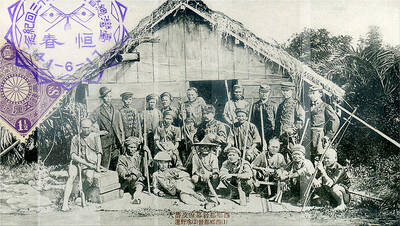
Traditionally, indigenous people in Taiwan’s mountains practice swidden cultivation, or “slash and burn” agriculture, a practice common in human history. According to a 2016 research article in the International Journal of Environmental Sustainability, among the Atayal people, this began with a search for suitable forested slopeland. The trees are burnt for fertilizer and the land cleared of stones. The stones and wood are then piled up to make fences, while both dead and standing trees are retained on the plot. The fences are used to grow climbing crops like squash and beans. The plot itself supports farming for three years.
President William Lai (賴清德) on Nov. 25 last year announced in a Washington Post op-ed that “my government will introduce a historic US$40 billion supplementary defense budget, an investment that underscores our commitment to defending Taiwan’s democracy.” Lai promised “significant new arms acquisitions from the United States” and to “invest in cutting-edge technologies and expand Taiwan’s defense industrial base,” to “bolster deterrence by inserting greater costs and uncertainties into Beijing’s decision-making on the use of force.” Announcing it in the Washington Post was a strategic gamble, both geopolitically and domestically, with Taiwan’s international credibility at stake. But Lai’s message was exactly


 RSS
RSS