


At his store in Tokyo’s ritzy Ginza district, Hajime Sasaki displays a disparate array of wares, from chopsticks to Buddha statues — including many made of ivory.
International trade in elephant ivory is illegal, but Japan hosts one of the world’s largest remaining legal domestic markets for the product, which can only be bought and sold within its borders.
It is fed with stockpiles of ivory imported before the international ban more than 30 years ago, or bought in one-off government auctions.
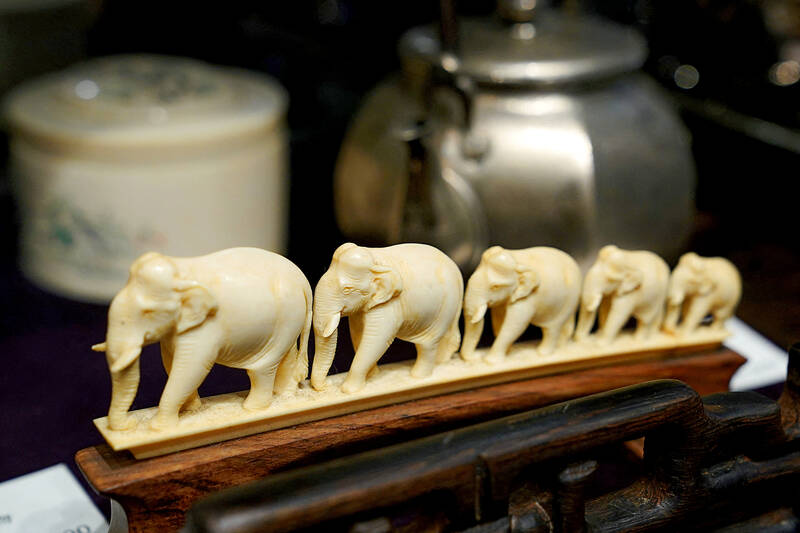
Photo: AFP
But conservationists warn Japan’s ivory often leaks overseas, fueling black market trade, while driving demand and undermining bans in countries like China.
Sasaki’s shop displays pamphlets in Chinese and English explaining that ivory cannot be taken abroad, but he still “receives many Chinese customers,” he said.
“Tourists give up buying ivory when I explain you can’t bring it outside Japan,” said the softly-spoken 69-year-old.
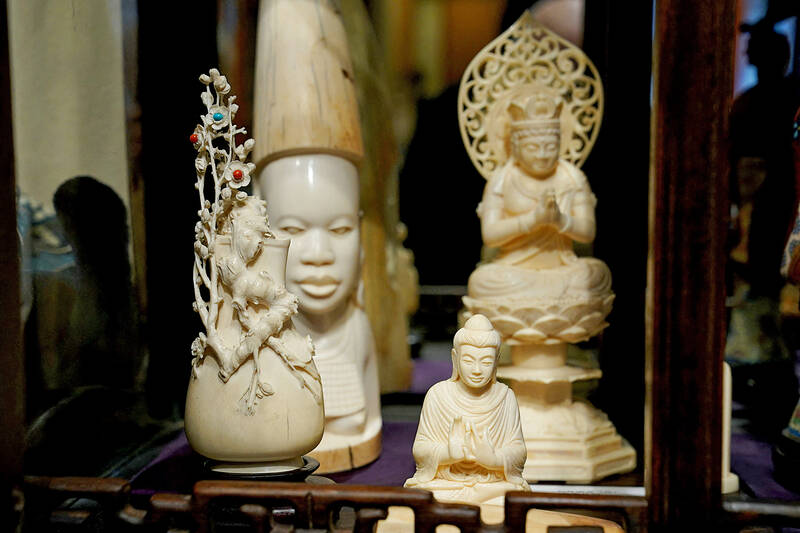
Photo: AFP
Conservationists estimate between 10,000 and 15,000 elephants from the two African species are killed for their tusks each year.
And seizure data suggests ivory is leaving Japan’s domestic market.
Since 2008, more than 3,600 kilograms of ivory linked to Japan has been seized by authorities around the world, according to data presented at a recent global wildlife trade meeting in Uzbekistan.
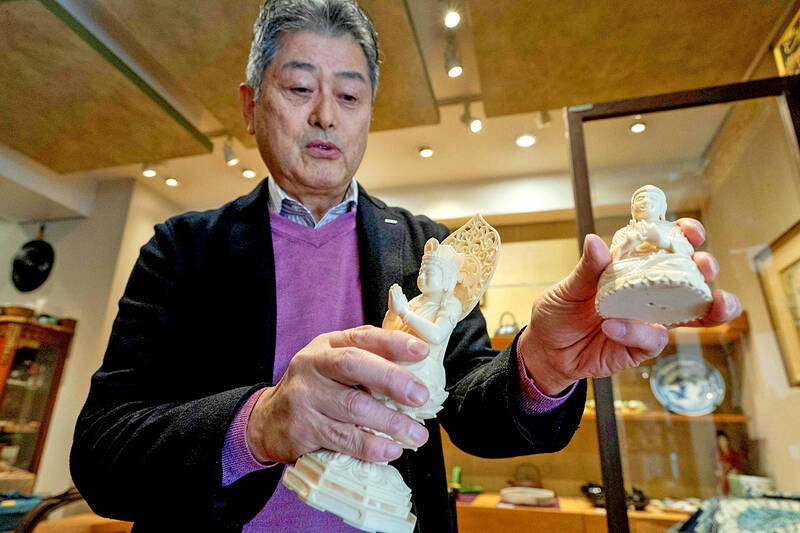
Photo: AFP
Dozens of interceptions were destined for China, according to the document presented at the meeting of the Convention on International Trade in Endangered Species of Wild Fauna and Flora (CITES).
The data suggests “some weakness in Japan’s law enforcement”, the document warned.
‘ORGANIZED CRIMINALS’
In 2023, a shipment reportedly bound for Thailand carrying 710 pieces was intercepted, another CITES document said.
Shipments of that size “suggest organized criminals are also involved,” said Matt Collis, senior policy director at the International Fund for Animal Welfare (IFAW).
At the CITES meeting, four African nations unsuccessfully urged adoption of a document that would have called for the closure of all remaining domestic ivory markets.
And Japan fiercely denies that its national market impacts elephant conservation.
It disputed the interpretation of the data presented at CITES, and said it continues to “implement strict control measures” to prevent leakage.
Japan’s alleged leakage problem is particularly problematic for China, once the world’s biggest market for ivory, which banned the trade in 2017 — around the same time as the US.
“China is doing their best to enforce their domestic ivory ban and to change public perceptions,” Collis said. “But you have a neighboring country that is undermining these efforts by not enforcing controls and perpetuating demand.”
Ivory was once widely used in Japan for personal seals and musical instruments. Today the country has a 250-tonne stockpile, boosted by two CITES-approved auctions in 1999 and 2008. At Sasaki’s shop, shelves are lined with exquisitely-carved ornaments. A Buddha statue worth more than US$1,500 is safely housed inside a gold-painted cabinet.
But there is little demand.
Sasaki says he has just one or two buyers a month, mostly older Japanese. That is partly due to growing awareness of the ivory trade’s devastating impact, said Masayuki Sakamoto, director of the Japan Tiger and Elephant Fund (JTEF).
“So inventory in Japan is piling up, and demand from China and other countries persists,” he said.
‘SUSTAINABLE USE’
Although China’s ban has tamped down interest somewhat, ivory carvings, jewelry and trinkets remain highly prized in Asia’s largest economy.
“Given the size of China, even lower levels of demand can provide powerful incentives for traffickers to seek to get ivory into China’s black market,” Collis said.
Experts also question Japan’s system for tracking its domestic ivory, which is based mostly on tracing whole tusks, even though trade is primarily in small, derivative products.
Japan has shown little interest in curtailing domestic sales, and supported a proposal by Namibia at CITES that would have allowed a one-off government auction of the African country’s ivory stocks to other governments.
The bid was defeated, to the relief of conservationists who argue further sales will only fuel demand. But Sasaki said he felt the tusks should be sold to help conservation efforts, echoing the Tokyo Ivory and Crafts Association, which says it backs “sustainable use” of ivory, as a “form of conservation.”
“Smuggling is bad,” Sasaki said.
“But I think reusing elephant tusks would be better (than disposing of them), and generate income.”

Following the rollercoaster ride of 2025, next year is already shaping up to be dramatic. The ongoing constitutional crises and the nine-in-one local elections are already dominating the landscape. The constitutional crises are the ones to lose sleep over. Though much business is still being conducted, crucial items such as next year’s budget, civil servant pensions and the proposed eight-year NT$1.25 trillion (approx US$40 billion) special defense budget are still being contested. There are, however, two glimmers of hope. One is that the legally contested move by five of the eight grand justices on the Constitutional Court’s ad hoc move

Stepping off the busy through-road at Yongan Market Station, lights flashing, horns honking, I turn down a small side street and into the warm embrace of my favorite hole-in-the-wall gem, the Hoi An Banh Mi shop (越南會安麵包), red flags and yellow lanterns waving outside. “Little sister, we were wondering where you’ve been, we haven’t seen you in ages!” the owners call out with a smile. It’s been seven days. The restaurant is run by Huang Jin-chuan (黃錦泉), who is married to a local, and her little sister Eva, who helps out on weekends, having also moved to New Taipei

The Directorate-General of Budget, Accounting and Statistics (DGBAS) told legislators last week that because the Chinese Nationalist Party (KMT) and Taiwan People’s Party (TPP) are continuing to block next year’s budget from passing, the nation could lose 1.5 percent of its GDP growth next year. According to the DGBAS report, officials presented to the legislature, the 2026 budget proposal includes NT$299.2 billion in funding for new projects and funding increases for various government functions. This funding only becomes available when the legislature approves it. The DGBAS estimates that every NT$10 billion in government money not spent shaves 0.05 percent off
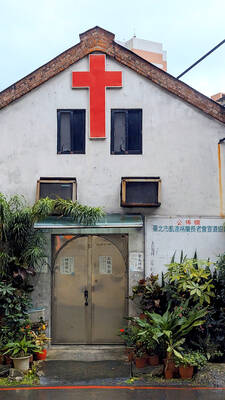
Dec. 29 to Jan. 4 Like the Taoist Baode Temple (保德宮) featured in last week’s column, there’s little at first glance to suggest that Taipei’s Independence Presbyterian Church in Xinbeitou (自立長老會新北投教會) has Indigenous roots. One hint is a small sign on the facade reading “Ketagalan Presbyterian Mission Association” — Ketagalan being an collective term for the Pingpu (plains Indigenous) groups who once inhabited much of northern Taiwan. Inside, a display on the back wall introduces the congregation’s founder Pan Shui-tu (潘水土), a member of the Pingpu settlement of Kipatauw, and provides information about the Ketagalan and their early involvement with Christianity. Most


 RSS
RSS