


The second floor of an unassuming office building in central Bangkok is a strange place to encounter the world’s largest rodent. Yet here, inside a small enclosure with a shallow pool, three capybaras are at the disposal of dozens of paying customers, all clamoring for a selfie. As people eagerly thrust leafy snacks toward the nonchalant-looking animals, few seem to consider the underlying peculiarity: how did this South American rodent end up over 10,000 miles from home, in a bustling Asian metropolis?
Capybara cafes have been cropping up across the continent in recent years, driven by the animal’s growing internet fame. The semi-aquatic animals feature in more than 600,000 TikTok posts. In Bangkok, cafe customers pay 400 baht (NT$389) for a 30-minute petting session with them, along with a few meerkats and Chinese bamboo rats. Doors are open 12 hours a day, seven days a week.
“They’re just so weird,” Elizabeth Congdon, a capybara biologist at Bethune-Cookman University in Florida, said, mulling over the rodent’s sudden appeal. “And then you combine that weirdness factor with how docile they are, how easy they are to keep in zoos and how social they are.”
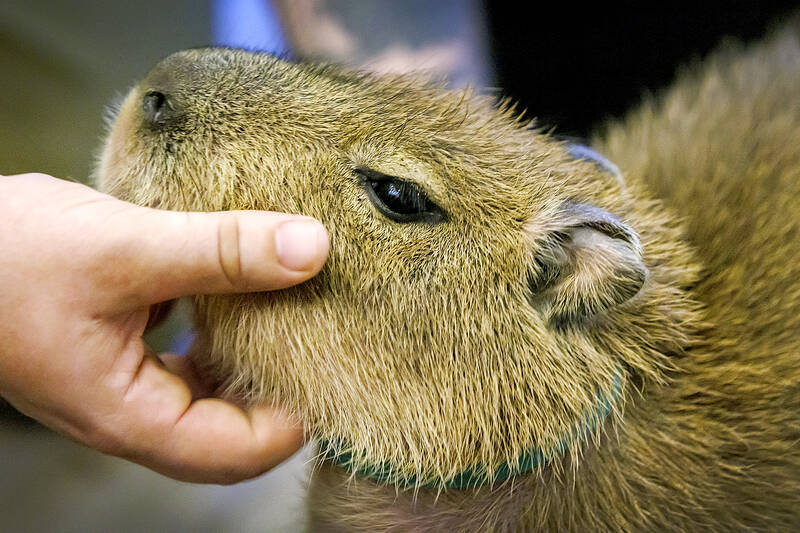
Photo: EPA
But the newfound popularity, experts say, is tied to a troubling boom in exotic animal cafes across Asia. Taiwan was the first place to allow cafe patrons to rendezvous with cats, in 1998. Japan and South Korea later popularised mingling with wilder animals, from owls to raccoons. Last year, the latter cracked down on exotic animal cafes, introducing laws that would stop cafes displaying wild animals unless they were registered as zoos or aquariums. But in some of Asia’s other large cities, from Ho Chi Minh in Vietnam to Guangzhou, China, animal cafes are more popular than ever.
CONSERVATION CONCERNS
“The amount of diversity and the number of animals — and, in particular, quite a few threatened animals — is very concerning,” Timothy Bonebrake, a conservation biologist at the University of Hong Kong who has studied the growth of exotic animal cafes in Asia, said.

Photo: EPA
Even a cursory online search yields capybara cafes in places such as Jakarta, Qingdao and Hanoi. The rodents are not classified as endangered — they range from northern Colombia down to northern Argentina, with an estimated 1.2 million roaming Brazil’s wetlands and cities. But, “the reason they are not endangered is because they are abundant in Brazil where they are protected,” Congdon said, adding that in Venezuela and Colombia they live mostly in protected areas.
The international trade in capybaras is not regulated by the Convention on International Trade in Endangered Species of Wild Fauna and Flora (CITES), though exporting native wild capybaras remains illegal in many South American countries, such as Brazil, Argentina and Peru. Experts say the rodents’ movement from South America to Asia is often linked to the illegal pet trade, with the same people moving species across international borders.
“Legal and illegal supply chains for live animals converge at multiple points, and are often controlled by the same people and companies,” Scott Roberton, executive director of a team countering wildlife trafficking at the Wildlife Conservation Society (WCS), said.

Photo: EPA
The capybaras at the Bangkok cafe are “from ethic[al] farms in Thailand. We don’t import them from their original country,” a small sign in the animals’ enclosure said. However, Roberton said: “Laundering of illegally caught animals into legal supply chains is very common, with those animals often then used to establish or supplement breeding stock.”
EXPLOITING THE ENDANGERED
Species at risk of extinction have also been swept up in the pet trade for exotic animal cafes. This year, a study linked small-clawed otters found in Japanese animal cafes to two poaching hotspots in southern Thailand — violating a ban on the commercial trade of the vulnerable species.
Concerns about the growth in the illegal pet trade, including for animal cafes, prompted members of the International Union for the Conservation of Nature (IUCN) to adopt a motion targeted at curbing the illegal pet trade at its October congress meeting.
“The global pet trade is really out of control, from a conservation perspective,” Sue Lieberman, vice-president of international policy at WCS, said. “In the past five years, we have seen much more pet trade in Asia. We used to talk about the food trade in China, but now the pet trade in China is increasing with all these pet cafes.”
A survey of one of China’s largest databases on corporations, Qichacha, reveals that the number of businesses listed as petting zoos, which includes animal cafes, shot up from fewer than 100 in 2020 to more than 1,800 in 2025. And while private pet ownership in China increased by 50 percent over the past five years, pet cafes have been growing at 200 percent annually.
A comprehensive analysis of recent growth in the number of exotic animal cafes across the whole of Asia is lacking, but one study co-authored by Bonebrake in the journal Conservation Letters found there were 406 animal cafes across Asia in 2019, just over a quarter of which contained exotic species. And of the more than 250 exotic species recorded, nearly half were threatened with extinction or had a decreasing population in the wild.
Even in the absence of conservation concerns about imported species, some countries are worried about the movement of exotic animals for cafes. In May, police seized five capybaras from traffickers in Costa Rica, where their trading is illegal due to fears they could escape and flourish in the wild. Capybaras breed rapidly, can withstand a wide range of temperatures and have a flexible diet of grasses and aquatic plants. “There is a high risk for them to be invasive,” Congdon says.
The impact of pet cafes on the illegal wildlife trade isn’t just limited to the animals moving through a venue’s doors, Roberton said, but how they may stimulate demand. “Suddenly, you’re encouraging people that there is this cool, big exotic animal that you can pet and feed. How many people leave that cafe and go, ‘I want a baby capybara’?”

Taiwan’s overtaking of South Korea in GDP per capita is not a temporary anomaly, but the result of deeper structural problems in the South Korean economy says Chang Young-chul, the former CEO of Korea Asset Management Corp. Chang says that while it reflects Taiwan’s own gains, it also highlights weakening growth momentum in South Korea. As design and foundry capabilities become more important in the AI era, Seoul risks losing competitiveness if it relies too heavily on memory chips. IMF forecasts showing Taiwan widening its lead over South Korea have fueled debate in Seoul over memory chip dependence, industrial policy and

“China wants to unify with Taiwan at the lowest possible cost, and it currently believes that unification will become easier and less costly as time passes,” wrote Amanda Hsiao (蕭嫣然) and Bonnie Glaser in Foreign Affairs (“Why China Waits”) this month, describing how the People’s Republic of China (PRC) is playing the long game in its quest to seize Taiwan. This has been a favorite claim of many writers over the years, easy to argue because it is so trite. Very obviously, if the PRC isn’t attacking Taiwan, it is waiting. But for what? Hsiao and Glaser’s main point is trivial,

May 18 to May 24 Gathered on Yangtou Mountain (羊頭山) on Dec. 5, 1972, Taiwan’s hiking enthusiasts formally declared the formation of the “100 Peaks Club” (百岳俱樂部) and unveiled the final list of mountains. Famed mountaineer Lin Wen-an (林文安) led this effort for the Chinese Alpine Association (中華山岳協會). Working with other experienced climbers, he chose 100 peaks above 10,000 feet (3,048m) that featured triangulation points and varied in difficulty and character. The list sparked an alpine hiking craze, inspiring many to take up mountaineering and competing to “conquer” the summits. A common misconception is that the 100 Peaks represent Taiwan’s 100 tallest

The Chinese Nationalist Party (KMT), alongside their smaller allies the Taiwan People’s Party (TPP), are often accused of acting on behalf of the Chinese Communist Party (CCP). Some go so far as to call them “traitors.” It is not hard to see why. They regularly pass legislation to stymie the normal functioning of the ruling Democratic Progressive Party’s (DPP) administration, and they have yet to pass this year’s annual budget. They slashed key elements of the government’s proposed NT$1.25 trillion (US$40 billion) special military budget, and in the smaller NT$780 billion package they did pass, it is riddled with provisions that


 RSS
RSS