


As longtime residents and would-be immigrants, many foreigners are watching the developments around the cases of citizens of the People’s Republic of China (PRC) holding office in Taiwan with great interest and equally great resentment. At present PRC citizens are the only foreigners who can hold office in Taiwan. The rest of us have to give up our nationality, attain Taiwan nationality and wait 10 years before we can run for office. This makes the PRC officeholders a double issue. While the public discussion has focused on their nationality, it has ignored discussion of the 10-year rule (Deng in any case satisfied that requirement). Yet that rule means that foreigners who give up their nationality to become Taiwanese acquire a second-class citizenship.
SLAP IN THE FACE
The debate was triggered back in August. PRC spouse Deng Wanhua (鄧萬華), then warden of Syuetian Village (學田) in Hualien County’s Fuli Township (富里), was removed from her post on Aug. 1 after she could not produce evidence that she had renounced her Chinese nationality. The Hualien County Government ruled in her favor after she appealed the ruling. Local media said she was the first PRC citizen to lose an office because of her failure to carry out the paperwork demanded of every foreign national who naturalizes. Further, Taiwanese citizens who are dual nationals have given up their foreign citizenship to run for and hold office in Taiwan. The Hualien government ruling is a slap in their face as well.
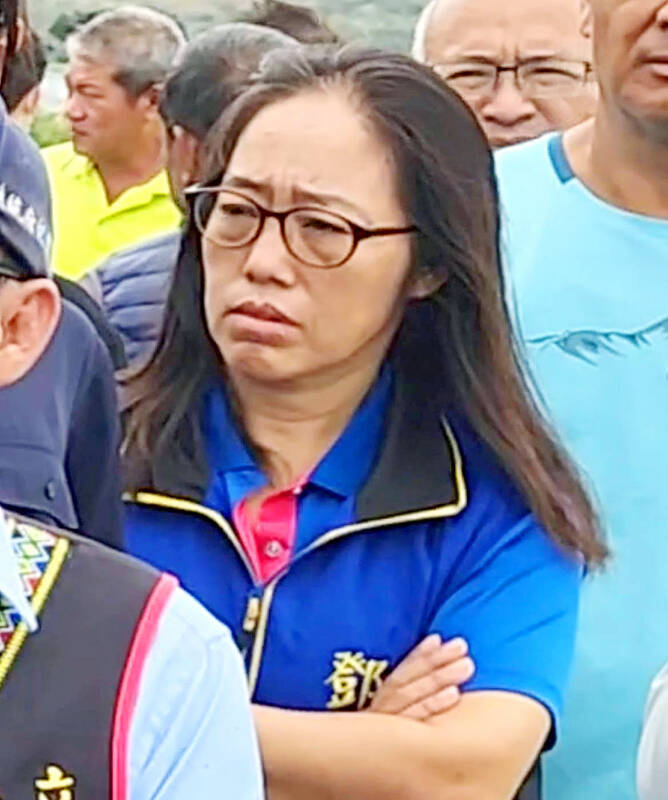
Photo: Hua Meng-ching, Taipei Times
Long-established global PRC policy is to use local governments to subvert central government policy.
PRC law also requires its citizens to perform espionage and other activities on Beijing’s behalf. This law automatically defines every PRC citizen as an agent of the PRC government.
The issue here is not just that Deng illegally holds office. The Hualien County government then subverted Taiwan’s national policies on who can hold office to install a PRC citizen in its own local government. Hualien County is headed by the wife of legislator Fu Kun-chi (傅崐萁), the “king of Hualien,” who runs the county as his own fiefdom. He frequently travels to the PRC and meets with officials there (raising the question of why a legislator is permitted to have his own foreign policy). An opinion piece in the Liberty Times last week thundered that “creating such chaos in the legal order is a crucial part of the ‘united front’ strategy to ‘divide’ Taiwan.”
ADVANCING PRC INTERESTS
Strangely, Interior Minister Liu Shyh-fang (劉世芳) also said last week that Hualien county had not forwarded any official documents from its Oct. 29 decision on Deng’s successful appeal, to the Ministry of the Interior. Hence, it cannot verify the information. Again, though the focus of the public debate has been on Deng’s failure to obey regulations, questions should be asked about how a local government (a township!) can overrule national government policy on a topic as critical as citizenship and public office holding. What does that suggest about other national policies that local governments headed by pro-PRC officials would like to ignore?
In response to the controversy, the pro-China parties in the legislature immediately moved to advance PRC interests in Taiwan, as usual. Both the Chinese Nationalist Party (KMT) and Taiwan People’s Party (TPP) said they would offer amendments to exempt PRC spouses married to Taiwanese from the restrictions of Article 20 of the Nationality Act (國籍法). Minister Liu, noting that the Nationality Act requires allegiance to a single country, said: “If someone were to amend the law to carve out one particular country or region, that would essentially be a form of labeling,” Liu said.
The KMT also seeks to change the naturalization period for PRC spouses to 4 years from the current six.
Since PRC citizenship cannot be given up, PRC spouses simply renounce their household registration. The government accepts this in lieu of renouncing citizenship. The government’s real but never-stated goal in doing that is to prevent the emergence of some form of dual citizenship for naturalizing foreigners that could become a legal precedent.
This position has backfired by creating an effective dual citizenship for citizens of a state dedicated to the elimination of the Republic of China (ROC). Meanwhile, for citizens of states committed to helping Taiwan in a PRC invasion, the government’s position is that they are good enough to die for Taiwan, but not to be dual citizens.
CONSTITUTIONAL CRISIS
The pro-KMT papers immediately published arguments from pro-China scholars to rebut the central government’s legal position, an example of the chaos engendered by PRC “united front” operations. United Daily News (UDN) wrote up a Facebook post by Luo Shih-hung (羅世宏) of Chengchung University contending that Article 20 of the Nationality Act does not apply to the PRC because it is not a foreign country under the law.
The act that governs relations between Taiwan and China is a special act that takes precedence over general government laws, Luo said, adding that PRC citizens are from a country that is not defined as a “foreign” country under the constitution. Luo’s argument hinges on the old KMT True Believer claim that the ROC Constitution defines Taiwan and the PRC as one country, though it has not since 1993. At present, because the pro-China parties in the legislature have systematically gutted governmental oversight bodies, Taiwan’s highest court cannot muster a quorum to hear constitutional cases.
Make no mistake: the existence of PRC citizens in local government positions signals a slow-motion security and constitutional crisis, created, in part, by the central government’s desperate dodges to prevent the emergence of dual citizenship. The pro-Taiwan parties, who controlled the legislature for eight years during the previous administration, have failed the nation in this regard. If Taiwan possessed a simple path to dual citizenship for all long-term foreign residents also governing applications from PRC citizens, this issue would not have arisen. PRC spouses could hold Taiwan passports, but would be barred from holding office since they retain citizenship in a foreign state.
Moreover, if the issue of PRC spouses were removed from the special law governing relations with the PRC — or that law and the exceptions it creates were all eliminated — it would strengthen the appearance that the ROC is an independent state in its own right. It is a bruise on ROC sovereignty that there are special rules governing the nation’s relation with a particular, hostile foreign state.
From that perspective, Deng and other officials still holding PRC citizenship should be seen for what they truly are: “gray zone” operations, chipping away at Taiwan’s sovereignty and territory.
Notes from Central Taiwan is a column written by long-term resident Michael Turton, who provides incisive commentary informed by three decades of living in and writing about his adoptive country. The views expressed here are his own.

Ajay Verma, a consultant gastroenterologist at Kettering general hospital in Northamptonshire, says our gut is a “complex machine.” “It is constantly providing us with the nutrition we need, initially to grow and develop, and then for us to survive, thrive and repair from injury and illness.” How can we keep it functioning well? Put simply: “Make sure what you put into it is balanced, and that you clear out its waste products adequately,” Verma says. “In a general gastroenterology clinic, the most common conditions we see are irritable bowel syndrome (IBS), gastroesophageal reflux disease, inflammatory bowel disease and constipation,” says Nisha
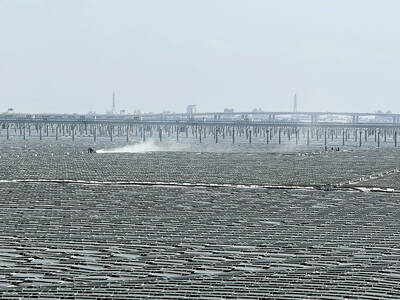
The arithmetic is straightforward and uncomfortable. By the end of 2025, Taiwan had committed itself to a 50-30-20 electricity mix — half natural gas, 30 per cent coal, 20 per cent renewables. The Ministry of Economic Affairs’s (MOEA) own monthly energy reports tell a different story. Natural gas reached 47.8 per cent of generation last year. Coal stood at 35.4 per cent, comfortably above its target ceiling. Renewables came in at 13.1 per cent, well short of the 20 per cent Taipei had pledged a decade earlier. Installed renewable capacity reached roughly half of the 12 gigawatts (GW) the government

Last week US President Donald Trump was asked by a reporter whether he would speak on the phone to the President of Taiwan. “l’ll speak to him. I speak to everybody. We have that situation very well in hand,” Trump said. This marked the second time in a couple of weeks he had said he would talk to the President of Taiwan. In 2016 he famously took a call from then-president Tsai Ing-wen (蔡英文), when he was president-elect. Despite warnings that the apocalypse was nigh because of a phone call, the world quickly forgot about the conversation between two democratically-elected presidents.

May 25 to May 31 Few believed that apples could be cultivated on a commercial scale in Taiwan’s high mountains. When horticulturalist Cheng Chao-hsiung (程兆熊) first proposed the idea in 1955, both American and Taiwanese colleagues dismissed it as implausible, arguing that temperate fruit could not be reliably grown on a subtropical island, especially on rugged terrain. However, it was this terrain in the Central Mountain Range where many Chinese Civil War veterans were resettled in the late 1950s. With limited job prospects and no family in Taiwan, they were placed on cooperative farms aimed toward self-sufficiency. Some say the conditions


 RSS
RSS