


The first thing to understand about eating spicy food is that it really isn’t a matter of taste. Capsaicin, the active chemical in capsicum plants that are a key ingredient in anything you’d think of as “spicy,” evolved as an irritant to stop mammals from chewing and destroying plant seeds. It acts on the nervous system directly through receptors in the tongue, throat and skin — no taste buds required — and, in theory, tells our bodies that the thing we’ve just ingested is something to get rid of as soon as possible. The obvious question, then, is: why do some of us like the sensation so much?
To start to understand that, it’s helpful to know a bit more about what’s going on in the body.
“Think of an engineering brief where we have to detect irritants in a system and clear them rapidly,” says Liam Browne, an associate professor at UCL who specializes in the neuroscience of sensory perception and pain. “Capsaicin binds to a receptor in the body called TRPV1, which is found in a specialised class of neurons called nociceptors that usually detect things that are potentially damaging to the body.”
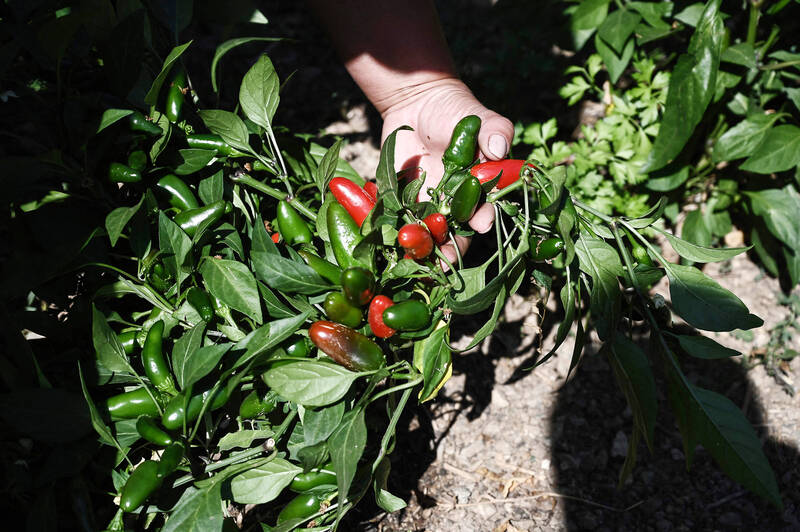
Photo: AFP
When that happens, it’s like a little fire alarm goes off and activates parts of the autonomic nervous system, which regulates various involuntary bodily functions without conscious control.
“That’s what leads to all these physiological effects like tearing up, sweating, or your nose running,” says Browne. “It’s your body trying to get rid of the irritant.”
TRPV1 (pronounced trip-vee-one, if you’re explaining this to someone over a delicious curry) is also activated by other things, like your body’s temperature rising above 42C — the point where heat becomes tissue-damaging – and piperine, the main active component in black pepper, which gives a much more mild response. Other hot (but not exactly spicy) foods activate different receptors — mustard, wasabi and radishes are handled by TRPA1, while TRPM8 is mostly responsible for cold temperatures and menthol.
“You can actually find other chemicals that have a far more potent effect than capsaicin on TRPV1,” says Browne. “There’s one plant, Euphorbia resinifera, that’s known as ‘resin spurge’ because of its associations with the idea of purging. It contains resiniferatoxin, a capsaicin-like compound that’s often described as around 1,000 times more potent, and is genuinely dangerous.”
Yes, a YouTube creator has tried it.
So how are we enjoying any of this? After all, it’s not a recent development. The first evidence of people eating chilies comes from around 7000BC in Mexico and Central America, with similar plants being cultivated roughly 1,000 years later. Peppers weren’t introduced to Europe until about the 16th century, but they’ve boomed in popularity since: the global hot sauce market is projected to be worth US$5 billion (£3.8 billion) by 2030, up from just over $3bn two years ago. Who really likes crying out irritants and quaffing milk that much?
Firstly, some people have different variants of the TRPV1 gene, which change how easily it switches on and turns off after activation (interestingly, the gene is present but insensitive to capsaicin in all birds and one species of tree-shrew, letting them eat spicy seeds with impunity). But the receptors also become less sensitive over time, so it’s entirely possible to develop a relative immunity to moderately spicy foods — or deliberately cultivate one.
As for why we like it, that might be because of the sensation it causes.
“Research is still ongoing into how human brains learn what is and isn’t safe, including which foods are safe for consumption,” says Browne. “Recent work emphasizes prediction, context and controllability. The idea is that when you eat something spicy, you get an initial alarm-like ‘heat’ signal. With repeated exposure the peripheral response desensitizes, and the brain learns the cue is safe and under control. That shift in prediction and certainty is a large part of why the experience becomes tolerable — and then rewarding.”
The more spice you eat, the theory goes, the less intense the first painful part becomes, and the more relief you get afterwards.
“There’s also the idea of reappraisal, or the fact that through exposure and experience, we reframe the meaning of what the pain represents and that it’s actually safe for us,” says Browne. “That sense of control and mastery matters — on top of the social and cultural component of doing this with your family or friends. It’s the same logic as watching scary films or going on rollercoasters, sometimes called ‘benign masochism.’ Importantly, these learning and revaluation mechanisms also tell us something useful about pain more broadly: when a stimulus is mislabeled as threatening, reframing and restoring a sense of control can reduce its impact.”
Like other initially unpleasant experiences — think running, cold showers or hot saunas — pushing on through the initial pain also coaxes the body into releasing endorphins, transforming those Korean chicken wings into a mild sort of high.
But what do you do if you’ve been invited out for wings and you’re not feeling up to it? The first thing to remember is that capsaicin is fat-soluble and hydrophobic: this means that if you drink water it will stay where it is, while milk will dissolve the capsaicin and then bind to it, ultimately carrying it away.
Alcohol, in case you’re wondering, can dilute capsaicin, but won’t bind to it — and will only do the job if it’s present in high percentages, meaning that beer is unlikely to help. Yogurt, if you’ve got a little pot on the side, will do the same job as milk — but there’s an even tastier option.
“Mint ice-cream provides the fat and protein to carry capsaicin away but will also trigger your TRPM8 receptors, which signal coolness and can take the edge off TRPV1’s ‘heat pain,’” says Browne.
Keep a tub on hand next time you invite people over for a jalfrezi — and remind everyone that it’s a cultural ritual with deep historical resonances.

Just after 6am, I walked up to the ticket gate at Taipei Main Station and entered the Taiwan Railway platform without scanning any ticket; instead, I flashed the Sanrio Fun Rail pass on my phone to the gate worker and was admitted. I found my train and prepared to board. My destination? This very same station. I was embarking on a 13-hour journey on one of two round-the-island trains operated by ezTravel. They run each day, one counterclockwise around the island and one clockwise. They differ in a number of ways from an ordinary Taiwan Railway train and can make for

Jason Han says that the e-arrival card spat between South Korea and Taiwan shows that Seoul is signaling adherence to its “one-China” policy, while Taiwan’s response reflects a reciprocal approach. “Attempts to alter the diplomatic status quo often lead to tit-for-tat responses,” the analyst on international affairs tells the Taipei Times, adding that Taiwan may become more cautious in its dealings with South Korea going forward. Taipei has called on Seoul to correct its electronic entry system, which currently lists Taiwan as “China (Taiwan),” warning that reciprocal measures may follow if the wording is not changed before March 31. As of yesterday,

The Portuguese never established a presence on Taiwan, but they must have traded with the indigenous people because later traders reported that the locals referred to parts of deer using Portuguese words. What goods might the Portuguese have offered their indigenous trade partners? Among them must have been slaves, for the Portuguese dealt slaves across Asia. Though we often speak of “Portuguese” ships, imagining them as picturesque vessels manned by pointy-bearded Iberians, in Asia Portuguese shipping between local destinations was crewed by Asian seamen, with a handful of white or Eurasian officers. “Even the great carracks of 1,000-2,000 tons which plied

On Thursday, former Taipei mayor and founder of the Taiwan People’s Party (TPP) Ko Wen-je (柯文哲) was sentenced to 17 years in prison and had his civil rights suspended for six years over corruption, embezzlement and other charges. Seven others related to the case were also handed prison sentences, while two were found not guilty. It has been a bad week for the TPP. On Tuesday, prosecutors charged Chinese immigrant Xu Chunying (徐春鶯) with suspicion of taking part in Beijing-directed election interference. Xu has strong links to the TPP, which once offered her a party list legislator nomination. Tuesday also


 RSS
RSS