


As a popular tattoo artist in South Korea, Song Jae-min is fully booked weeks in advance and highly respected by his clients, some of whom come from abroad to see him. But each time Song inks someone, he commits a crime since it is illegal to give tattoos without a medical license in South Korea.
“I began this even though I knew it was illegal, but I was confident that legal restrictions would be eased and things would change,” Song, 28, said in a recent interview at his studio in Goyang near Seoul. “Many tattoo artists think we are not doing illegal things and there is just no law for us.”
Song’s prediction could soon become reality. South Korea’s National Assembly is expected to pass a landmark bill soon that would allow non-medical personnel to give tattoos.
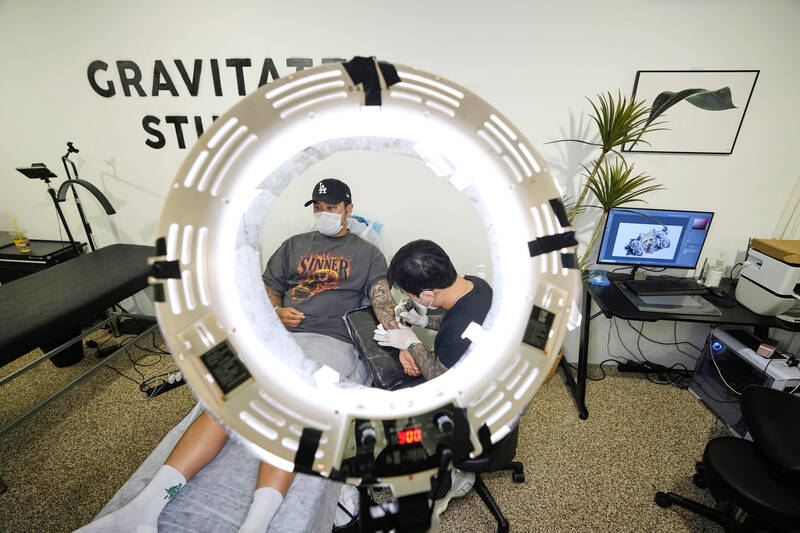
Photo: AP
The passing of the Tattooist Act would mark a victory for tens of thousands of tattooists in South Korea, who have used rallies, constitutional appeals and other means in their bid to nullify a decades-long ban on their work. Their fight has gained strength as public sentiment toward tattoos has evolved.
“I think I’ll shed tears, as it would take a long-accumulated load off my mind,” said Kim Sho-yun, 45, who runs a cosmetic tattoo studio in Hanam city.
CONTROVERSIAL BAN
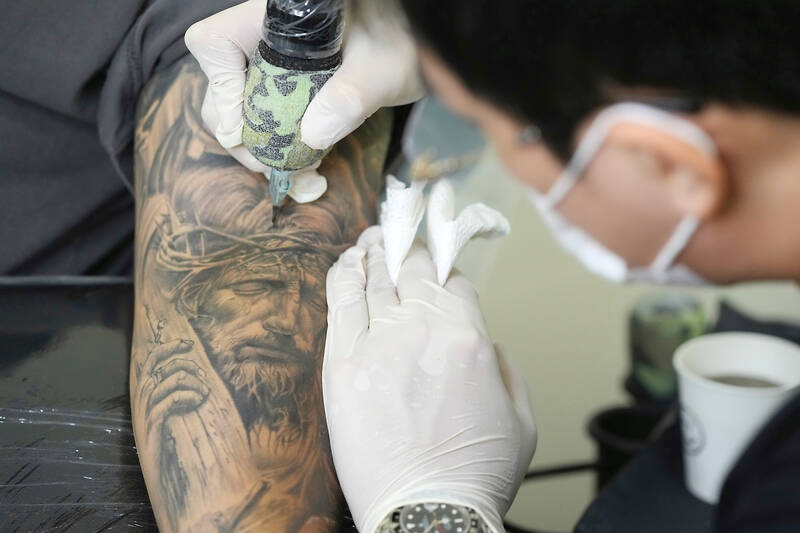
Photo: AP
In South Korea, tattoos in the past were associated with gangsters and criminals but have been gradually accepted as a form of self-expression. Now, it’s easy to find people from all walks of life with tattoos, including K-pop stars like BTS’s Jungkook, TWICE’s Chaeyoung and BigBang’s G-Dragon.
Experts estimate that millions of South Koreans have tattoos, about 70 percent of them as semi-permanent cosmetic tattoos on their eyebrows, eyelines, lips or scalps.
Despite the widespread adoption of tattoos, South Korea still only officially allows licensed doctors to give them in line with a 1992 Supreme Court ruling that viewed tattooing as a medical treatment, citing potential health risks caused by tattoo needles and inks.
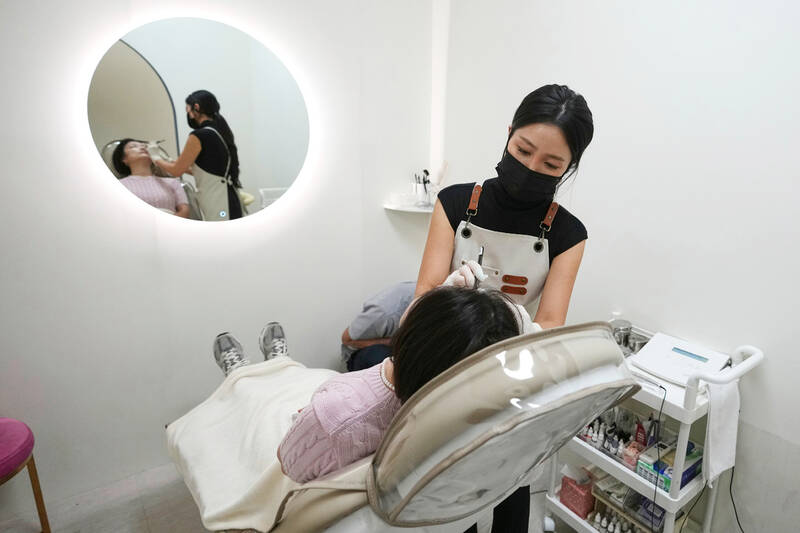
Photo: AP
South Korea remains the only country in the developed world with such a regulation. Tattoo artists face up to five years in prison and 50 million won (US$35,740) in fines if they are caught inking people. However, the government doesn’t aggressively enforce these rules, allowing tattooists to thrive in the shadows. A 2023 Health Ministry survey found that only 1.4 percent of respondents with personal tattoos and 6.8 percent of those with cosmetic tattoos said they were inked in hospitals.
“I think it’s nonsensical ... Lawmakers, entertainers and so many people around me have tattoos. But if it’s really illegal, am I a lawbreaker?” asked Kim Soyoung, 54, a customer at Kim Sho-yun’s studio.
Song, who won a top prize in a 2023 domestic tattoo competition, said his clients include police officers, civil servants, soldiers and US troops stationed in South Korea. He said some of his clients have traveled from China, the UK, Malaysia and Iraq.
FEAR OF PUNISHMENT
In recent years, judges have increasingly ruled in favor of tattoo artists or issued deferred rulings as a way to protect them, but some tattooists have been punished with fines. Lim Bo-ran, leader of the Korea Tattoo Federation, said she urges tattoo artists to appeal financial penalties to higher courts in a bid to step up their fight.
Tattoo artists fear that someone might report the illicit nature of their business to officials, forcing them to investigate. Some tattooists subsequently put up with customers behaving badly or run studios without signs. Some have also moved abroad for work.
Kim said she was “truly terrified” when a person close to her threatened to report her business to authorities and “destroy all I have” after they fought over something unrelated six years ago. She said the dispute was eventually resolved, but she still remembers the panic that seized her.
Lim said some female tattooists have suffered sexual assaults but did not report them to authorities because they worried about losing their jobs.
TATTOOIST ACT
The Tattooist Act, which would take effect following a two-year grace period, centers on the introduction of official licenses for tattoo artists. The process would require tattooists to take hygiene education courses at government-designated places every year.
Lim said the law would be a welcome development but that it would also burden tattoo artists by putting them under government supervision.
There is bipartisan support for the act, which has already been approved in the assembly’s health and judiciary committees. The Health Ministry says it supports the act, while opposition from doctors has weakened. Observers say the earliest possible date for the act’s passage is Thursday, when a plenary session is scheduled.
MEANINGFUL WORKS
Kim said she feels a sense of accomplishment when her customers are satisfied with her work to make them look better or prettier. She said memorable clients include cancer patients who received eyebrow tattoos before chemotherapy, which could cause them to lose their eyebrows.
Song said he feels “tremendous pride” in putting his work on people’s bodies that they will carry for their entire lives. He said meaningful tattoos at his studio have included works depicting clients’ late loved ones.
“There is no limit in tattoos. Whatever you draw on paper, carbon paper, walls or elsewhere, we can also do the same on human bodies. There are really unlimited tattoo styles and artists,” Song said.
When Associated Press journalists visited Song’s studio, he was putting the final touches on a months-long work of the image of Jesus Christ on the forearm of Lee Byong-joo, 37, who already has many other tattoos including a tiger, whale, clouds and words longing for his late grandmother.
“I feel good as I can have pictures that I like on my body for good,” Lee said. “But I can’t have more tattoos after this because my wife told me to stop getting new ones.”

Ajay Verma, a consultant gastroenterologist at Kettering general hospital in Northamptonshire, says our gut is a “complex machine.” “It is constantly providing us with the nutrition we need, initially to grow and develop, and then for us to survive, thrive and repair from injury and illness.” How can we keep it functioning well? Put simply: “Make sure what you put into it is balanced, and that you clear out its waste products adequately,” Verma says. “In a general gastroenterology clinic, the most common conditions we see are irritable bowel syndrome (IBS), gastroesophageal reflux disease, inflammatory bowel disease and constipation,” says Nisha
The arithmetic is straightforward and uncomfortable. By the end of 2025, Taiwan had committed itself to a 50-30-20 electricity mix — half natural gas, 30 per cent coal, 20 per cent renewables. The Ministry of Economic Affairs’s (MOEA) own monthly energy reports tell a different story. Natural gas reached 47.8 per cent of generation last year. Coal stood at 35.4 per cent, comfortably above its target ceiling. Renewables came in at 13.1 per cent, well short of the 20 per cent Taipei had pledged a decade earlier. Installed renewable capacity reached roughly half of the 12 gigawatts (GW) the government
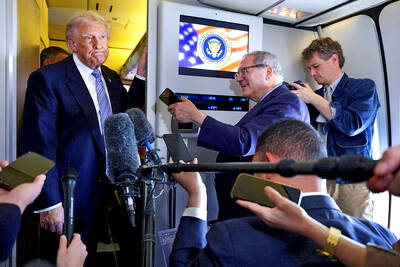
Last week US President Donald Trump was asked by a reporter whether he would speak on the phone to the President of Taiwan. “l’ll speak to him. I speak to everybody. We have that situation very well in hand,” Trump said. This marked the second time in a couple of weeks he had said he would talk to the President of Taiwan. In 2016 he famously took a call from then-president Tsai Ing-wen (蔡英文), when he was president-elect. Despite warnings that the apocalypse was nigh because of a phone call, the world quickly forgot about the conversation between two democratically-elected presidents.
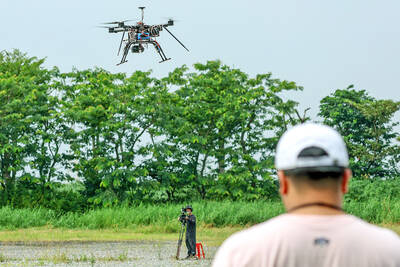
Taiwan’s drone exports are taking off, fuelled by the war in Ukraine, as Taiwanese companies seek a stake in the fast-growing global market for unmanned aerial vehicles (UAV). Low-cost drones used for reconnaissance and strikes are in high demand as governments around the world boost defense spending in the face of intensifying conflicts. A relative new player in the increasingly competitive industry, Taiwan’s pitch is to be an “Asian hub” for the production of UAVs and components free of Chinese materials, or “non-red.” That means its UAVs can be up to three times more expensive than their Chinese competitors, like the world’s biggest


 RSS
RSS