


Take one very large shark, a boat (we’re gonna need a bigger one of those) and a movie that ran way over budget and you’ve got all the ingredients of a career-making film for one of Hollywood’s most successful directors.
Now fans of Jaws — Steven Spielberg’s terrifying thriller about a man-eating shark — can re-live the movie as it celebrates its 50th anniversary in an exhibition at the Academy Museum in Los Angeles.
“The film certainly cost me a pound of flesh, but gave me a ton of career,” Spielberg told reporters as he toured exhibits of props and memorabilia from the movie that propelled him to the top ranks of Hollywood directors.
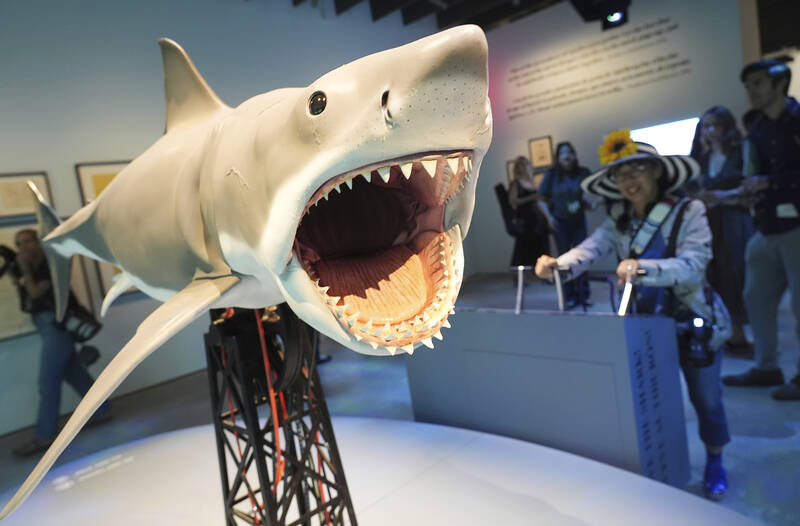
Photo: AP
“I thought my career was virtually over halfway through production on Jaws, because everybody was saying to me: ‘You are never going to get hired again. This film is way over budget and way over schedule, and you are a real liability as a director.’”
History had different ideas. Jaws, starring Roy Scheider, Richard Dreyfuss and Robert Shaw, established a benchmark for thrillers, winning three Oscars and spawning three sequels as it catapulted Spielberg to stardom.
With more than 200 artifacts spread across several galleries, “Jaws: The Exhibition” is the largest display dedicated to a single film at the Academy Museum. They join Bruce, a life-size model of a shark that is on permanent display at the museum, and the only one that was ever actually on set (Spielberg named the model after his lawyer.)

Photo: AFP
Production notes, stills, costume pieces and original set items from collectors — and from the director’s personal archive — were all tracked down for the exhibition.
“It really was a cinematic treasure hunt,” curator Jenny He said.
Museum staff focused on finding objects “that would put the story of Jaws together for our visitors in a tangible, physical way,” He said.
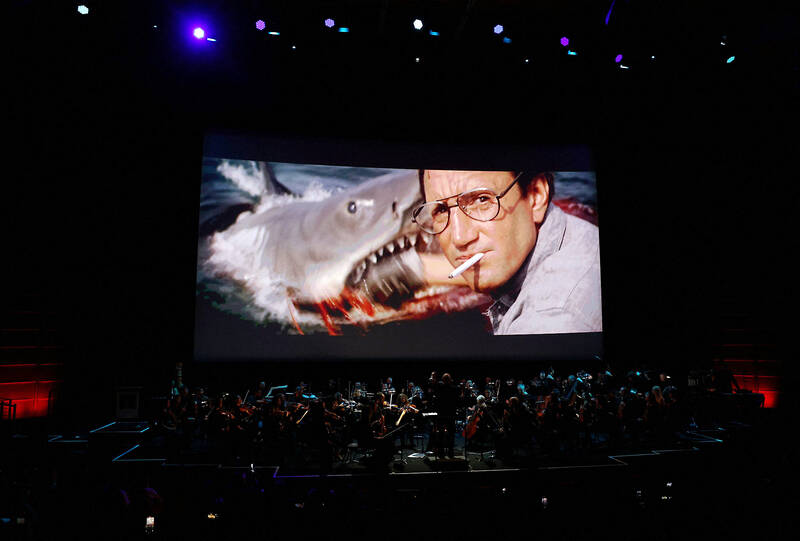
Photo: Reuters
In addition to seeing behind-the-scenes footage of the production, the public will also be able try their hand at reproducing the menacing, unmistakable “da-dum-da-dum” music that announces the arrival of the predator — music that earned composer John Williams an Oscar.
They will also be able to handle a replica of the shark used in the film. Spielberg said the exhibition was a wonderful showcase of work by collectors “who somehow knew something that I didn’t.”
“When we shot the opening scene of Chrissie Watkins being taken by the shark and we had a buoy floating in the water, how did anybody know to take the buoy and take it home and sit on it for 50 years?”
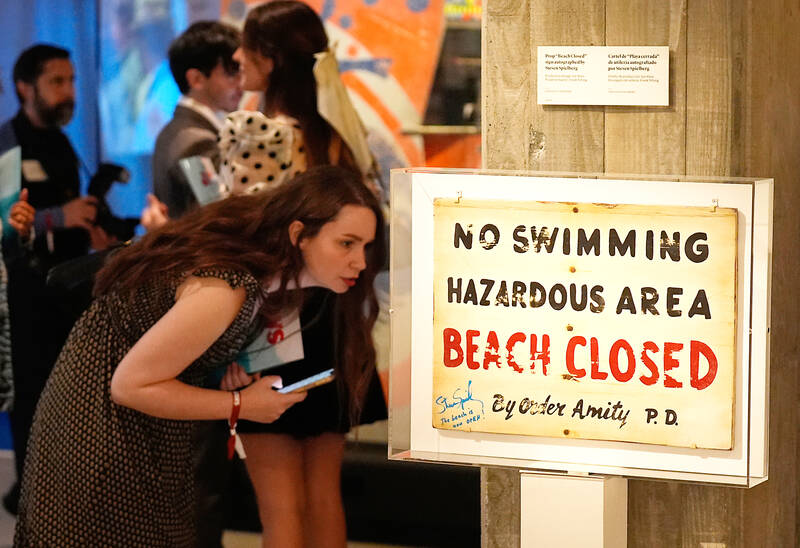
Photo: AP
The exhibition is currently open to the public.
If one asks Taiwanese why house prices are so high or why the nation is so built up or why certain policies cannot be carried out, one common answer is that “Taiwan is too small.” This is actually true, though not in the way people think. The National Property Administration (NPA), responsible for tracking and managing the government’s real estate assets, maintains statistics on how much land the government owns. As of the end of last year, land for official use constituted 293,655 hectares, for public use 1,732,513 hectares, for non-public use 216,972 hectares and for state enterprises 34 hectares, yielding

The small platform at Duoliang Train Station in Taitung County’s Taimali Township (太麻里) served villagers from 1992 to 2006, but was eventually shut down due to lack of use. Just 10 years later, the abandoned train station had become widely known as the most beautiful station in Taiwan, and visitors were so frequent that the village had to start restricting traffic. Nowadays, Duoliang Village (多良) is known as a bit of a tourist trap, with a mandatory, albeit modest, admission fee of NT$10 giving access to a crowded lane of vendors with a mediocre view of the ocean and the trains

For many people, Bilingual Nation 2030 begins and ends in the classroom. Since the policy was launched in 2018, the debate has centered on students, teachers and the pressure placed on schools. Yet the policy was never solely about English education. The government’s official plan also calls for bilingualization in Taiwan’s government services, laws and regulations, and living environment. The goal is to make Taiwan more inclusive and accessible to international enterprises and talent and better prepared for global economic and trade conditions. After eight years, that grand vision is due for a pulse check. RULES THAT CAN BE READ For Harper Chen (陳虹宇), an adviser

Traditionally, indigenous people in Taiwan’s mountains practice swidden cultivation, or “slash and burn” agriculture, a practice common in human history. According to a 2016 research article in the International Journal of Environmental Sustainability, among the Atayal people, this began with a search for suitable forested slopeland. The trees are burnt for fertilizer and the land cleared of stones. The stones and wood are then piled up to make fences, while both dead and standing trees are retained on the plot. The fences are used to grow climbing crops like squash and beans. The plot itself supports farming for three years.


 RSS
RSS