


China’s annual major political event gets underway this week, bringing together the nation’s top leaders and thousands of provincial leaders to endorse decisions already made by the all-powerful Chinese Communist Party.
The meetings and gathering during the National People’s Congress, expected to last for about a week, are still important. The rubber-stamp parliament retains an important function: to signal the priorities of the government for the coming year and to disseminate instructions to party members and officials across the country.
The messaging from leadership appears unchanged from previous years — stay the course on fostering innovation while also spurring domestic consumption.
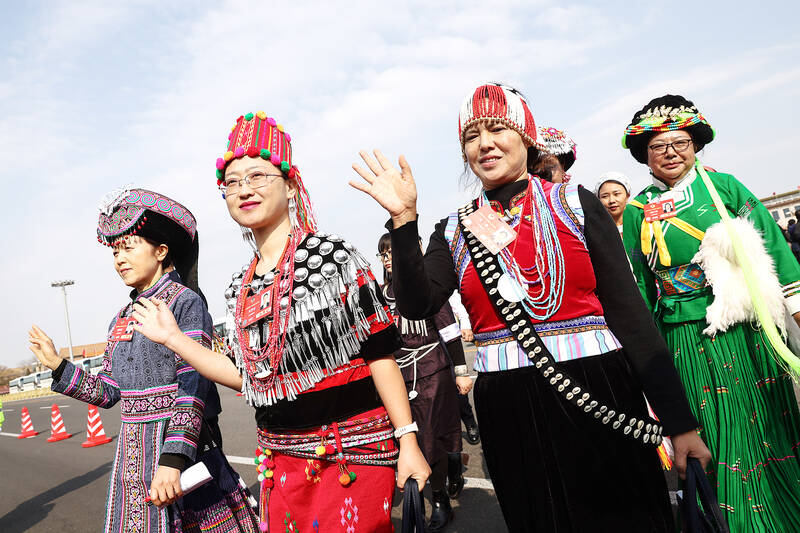
Photo: EPA-EFE
The question will be how they balance those two goals, and will it be enough to reinvigorate the economy? And to what extent will the government buffer the impact of what might be another phase in the US-China trade war?
This year also marks the end of China’s current 5-year plan, and experts will be looking for clues on the government’s priorities for the next, 2026 to 2030 plan.
Here is what to watch for at this year’s event:
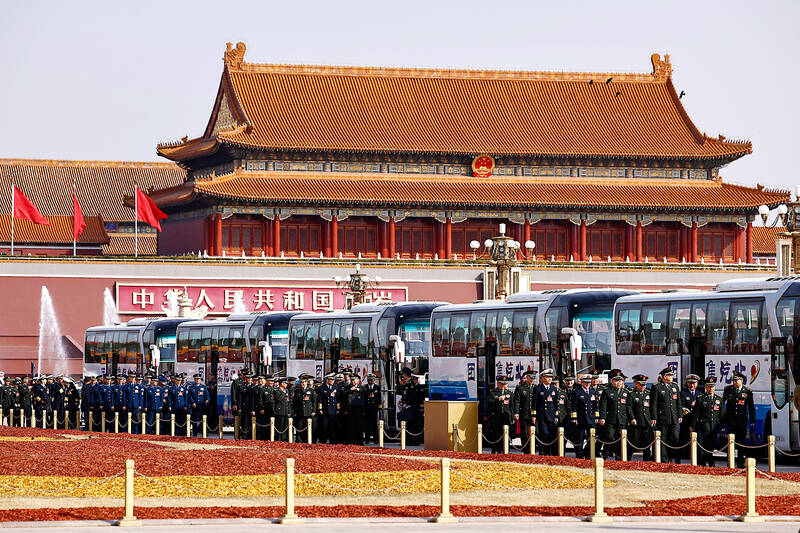
Photo: Reuters
What is China’s economic growth target?
The National People’s Congress kicks off on Wednesday, with Premier Li Qiang (李強), China’s top economic official, announcing the economic growth target for the year.
Analysts expect it to come in at around 5 percent — holding the same target as the previous two years, and slightly lower than the 5.5 percent target in 2022. This would be no small feat considering China is still grappling with a sluggish real estate sector and lackluster consumer spending.
Another uncertainty is trade tensions with the US under President Donald Trump, who last month slapped a 10 percent tariff on Chinese imports while an additional 10 percent comes into effect on Tuesday. Forecasters at the International Monetary Fund are projecting a lower 4.6 percent growth rate this year.
What are the government’s priorities?
A commentary last Friday from the official Xinhua News Agency indicated that priority would be placed on boosting domestic demand and promoting innovation in science and technology.
There’s also anticipation of more government support for the private sector to fuel growth.
Chinese President Xi Jinping (習近平) met last month with business leaders, including Alibaba founder Jack Ma (馬雲) and Huawei CEO Ren Zhengfei (任正非), signaling support for the private sector at the highest level of leadership. A draft bill is also to be deliberated during the Congress over making a fairer and more equitable business environment for the private sector.
China has already released a slew of measures to prop up the economy. Much of these have fallen short of hopes for a bigger stimulus, and analysts are tempering expectations on what to expect from the Congress.
“I would not expect anything ... to come out that will really meaningfully shift that policy away from industrial policy and towards boosting consumption in meaningful, sufficient ways,” said Jacob Gunter, lead analyst for the economics research team at the Mercator Institute for China Studies.
Instead, experts say leaders are staying the course on pushing for innovation that would boost China’s self-reliance.
The purpose of the economy is no longer to improve household incomes and expand the middle class, Gunter said.
“This is not a development-oriented economy,” he said. “It’s a geopolitically oriented economy, and technology and industry are way more important for that.”
Where is China’s diplomacy headed?
Li is expected to touch on foreign policy and Taiwan, but more attention will likely be on Foreign Minister Wang Yi (王毅).
His annual news conference, to be held later in the week, will be closely watched to decipher China’s stance on US-China relations under Trump. After the first 10 percent tariffs last month, China retaliated with a 15 percent tariff on American coal and liquefied natural gas, as well as 10 percent on crude oil, agriculture machinery and large-engine cars.
“Beijing’s response to Trump’s initial 10 percent tariffs was measured — restrained enough to signal openness to negotiations yet firm enough to demonstrate its willingness to escalate if necessary,” Neil Thomas and Jing Qian wrote in a report for the Asia Society Policy Institute.
They note that China’s president might use speeches in closed-door meetings during the Congress to send signals on bilateral relations, as he did two years ago when Xi named the US as leading “containment encirclement and suppressions” against China.
Also closely watched will be China’s relations with Russia and its position on the Ukraine war. At a recent Group of 20 foreign minister’s meeting in South Africa, Wang said a “window for peace is opening” in Ukraine, and that China supported “all efforts committed to peace, including the recent consensus reached by the United States and Russia.”
What does the National People’s Congress do?
The legislature is made up of nearly 3,000 delegates from China’s provinces, ministries, People’s Liberation Army, party organizations and various groups that represent workers and other interests.
Their role is largely ceremonial in that the body does not have any real power to decide on legislation. Any vote is usually unanimous or near-unanimous to formalize decisions already taken by Communist Party leaders behind closed doors.
Still, the Congress is a rare opportunity to see what the central government’s sees as priorities and goals, and the reports and speeches during it can give indications of the future direction of government policy.
An advisory body, the Chinese People’s Political Consultative Conference, will meet at the same time. Members include business leaders, athletes, academics, religious leaders and representatives of ethnic groups. The concurrent meetings of the two bodies are known as the Two Sessions.

Ajay Verma, a consultant gastroenterologist at Kettering general hospital in Northamptonshire, says our gut is a “complex machine.” “It is constantly providing us with the nutrition we need, initially to grow and develop, and then for us to survive, thrive and repair from injury and illness.” How can we keep it functioning well? Put simply: “Make sure what you put into it is balanced, and that you clear out its waste products adequately,” Verma says. “In a general gastroenterology clinic, the most common conditions we see are irritable bowel syndrome (IBS), gastroesophageal reflux disease, inflammatory bowel disease and constipation,” says Nisha
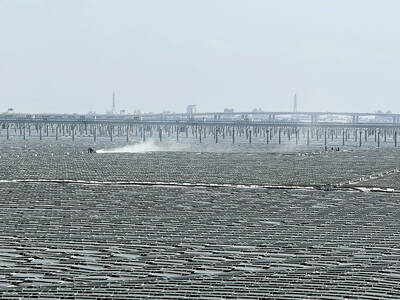
The arithmetic is straightforward and uncomfortable. By the end of 2025, Taiwan had committed itself to a 50-30-20 electricity mix — half natural gas, 30 per cent coal, 20 per cent renewables. The Ministry of Economic Affairs’s (MOEA) own monthly energy reports tell a different story. Natural gas reached 47.8 per cent of generation last year. Coal stood at 35.4 per cent, comfortably above its target ceiling. Renewables came in at 13.1 per cent, well short of the 20 per cent Taipei had pledged a decade earlier. Installed renewable capacity reached roughly half of the 12 gigawatts (GW) the government

Last week US President Donald Trump was asked by a reporter whether he would speak on the phone to the President of Taiwan. “l’ll speak to him. I speak to everybody. We have that situation very well in hand,” Trump said. This marked the second time in a couple of weeks he had said he would talk to the President of Taiwan. In 2016 he famously took a call from then-president Tsai Ing-wen (蔡英文), when he was president-elect. Despite warnings that the apocalypse was nigh because of a phone call, the world quickly forgot about the conversation between two democratically-elected presidents.

May 25 to May 31 Few believed that apples could be cultivated on a commercial scale in Taiwan’s high mountains. When horticulturalist Cheng Chao-hsiung (程兆熊) first proposed the idea in 1955, both American and Taiwanese colleagues dismissed it as implausible, arguing that temperate fruit could not be reliably grown on a subtropical island, especially on rugged terrain. However, it was this terrain in the Central Mountain Range where many Chinese Civil War veterans were resettled in the late 1950s. With limited job prospects and no family in Taiwan, they were placed on cooperative farms aimed toward self-sufficiency. Some say the conditions


 RSS
RSS