


When I bought a copy of John Copper’s best-known book in 2003, it was in its fourth edition since the initial 1990 printing. My relative ignorance of Taiwan’s history made me undiscerning when I read Taiwan: Nation State or Province? The title was a giveaway.
The title of Copper’s latest offering is bizarre. “The Majestic Six?” a fellow hack queried. “What is this — a Western?”
Still, the adjective suggested that all Taiwan’s leaders were worthy of respect. However, the majesty in question is of a functional sort: the authority that accompanies leadership rather than an indication of regal glory.
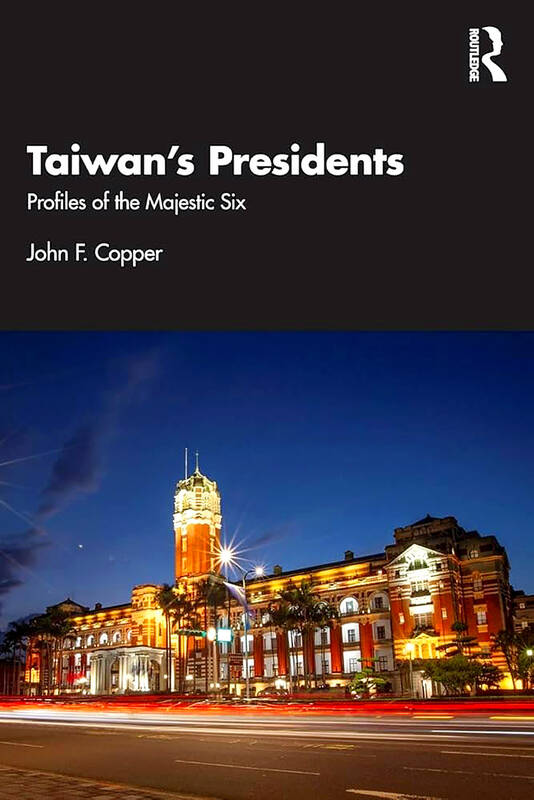
That said, while stressing that Chiang Kai-shek (蔣介石) was “a self-made man,” and “not of royal birth,” Copper admits that Taiwan’s first president “looked and acted like royalty.”
Copper even attributes Chiang’s personality cult partly to the man himself. This does not stop the author from apotheosizing Chiang in places.
In assessing Chiang’s achievement’s, Copper says the Generalissimo “certainly had faults,” but that, judged by the appropriate metrics — performance, accomplishments and precedents — he ranks top of the superlative sextet. Blame for Chiang’s shortcomings is invariably shifted to underlings: The 228 Incident and its aftermath are pinned on Taiwan’s first Chinese Nationalist Party (KMT) governor-general Chen Yi (陳儀), with Chiang admonished for bad judgment.
Not only is this rubbish, it’s rubbish that was long ago consigned to the historical dustbin, where it would have degraded, were it not for the efforts of the KMT and other pan-Blue revisionists and their proxies to recycle it.
But let’s give Chiang the benefit of the doubt — something he doesn’t deserve — and say he was oblivious. What of the next three decades, when thousands of Taiwanese were arrested, tortured, executed and terrorized by a state security apparatus, overseen by Chiang’s son and successor Chiang Ching-kuo (蔣經國), about whom Copper is even more fawning? (Based on “popularity,” Copper adjudges Chiang, Jr Taiwan’s best leader. Incidentally, Yan Chia-kan (嚴家淦) who served out Chiang, Senior’s last two years after the latter died, is understandably not assessed.)
Are we to believe the elder Chiang, who infamously preferred to “mistakenly kill 1,000 innocent people than allow one communist to escape,” was failed by overzealous minions there, too?
Such fatuous thought experiments deserve short shrift; they are insulting to all Taiwanese who suffered.
CONFUSED REASONING
And this is the problem: Copper seems uninterested in Taiwanese interests. His view of Taiwan as lacking agency in a Great Power struggle between Washington and Beijing is not uncommon. Perhaps it is right.
But whether Taiwanese can influence their future is a different question from whether they should have the chance to and what they want that future to be. Throughout, Copper treats Taiwanese identity as the imaginary friend of a petulant youngster. Irritated by its influence, he finds it an enigmatic nuisance.
At times, his reasoning is confused. Having, to his credit, noted that approval ratings of president number five, Ma Ying-jeou (馬英九) dropped below those of his predecessor Chen Shui-bian (陳水扁), Copper blames Ma’s China policy.
Yet, while acknowledging that Ma misread public sentiment, and that even Taiwanese business was offside, Copper is irritated by the paradox: With their dependence on Chinese trade, why are Taiwanese so obstinate? Answer: People can appreciate economic benefits while fearing political consequences.
From the outset, Copper chooses “to focus on politics rather than other matters.” This follows “approaches used to evaluate Western leaders,” particularly US presidents. The import here is vague, but — given what follows — it seems a way of avoiding the more uncomfortable of those “other matters.”
QUALIFIED WORKFORCE
How does one separate the politics of the Republic of China (ROC) under the KMT from the repression that underpinned its rule? Touting KMT stewardship of the “economic miracle” while ignoring the postwar looting, expropriation and turmoil that set Taiwan back by years, doesn’t wash.
Despite the wartime damage to infrastructure, when the KMT arrived, Taiwan remained more advanced than anywhere in China. As books such as A Century of Development in Taiwan (reviewed in Taipei Times, Nov. 9, 2023) and Good Wife, Wise Mother (reviewed in Taipei Times Nov. 21, 2024) show, an educated, well-trained workforce was available, with skills that even top KMT technocrats lacked. Many of these professionals were sidelined or worse.
Taking over Japanese state monopolies and expropriating Taiwanese businesses, the KMT stuffed them with veterans and unqualified lackeys, retaining Japanese experts for decades while railing against the “dwarf pirates” and calling Taiwanese “race traitors.”
We don’t know what might have happened had the Taiwanese been allowed to govern themselves. In the 1920s and 1930s, the home-rule movement in Taiwan, which was influenced by revolutionary groups in China and parliamentary politics in Japan, had gained experience of political organization and a desire for democracy that was alien and disturbing to KMT top brass.
BLACK GOLD POLITICS
Some argue such hypotheticals are irrelevant. Not if you’re casting the KMT’s leadership as necessary, rather than sufficient to Taiwan’s success. Praising an authoritarian party that took half a century to permit direct presidential elections for its inculcation of democracy through painfully slow reforms is ridiculous.
The KMT’s excuses for repression started with “restoring order” after the post-228 chaos they created, followed by the so-called Temporary Provisions that suspended the constitution in the name of combating communism. Crediting the party’s presidents for fostering democracy is like thanking a kidnapper for “granting” freedom to an abductee.
The insincerity of Copper’s pledge to stick to politics is exposed in the passages on Chen, who the author eviscerates for his venality, concluding that A-bian was “at heart, not of good character” and that “the reasons for his bad deeds cannot be wiped away.” This contrasts with the two Chiangs, who, Copper suggests, were personally spotless.
Even if true, we will never know the extent of official corruption under martial law. The idea that it was much worse under Chen, who faced a free and still overwhelmingly KMT-owned or friendly press is absurd.
While Copper touches on graft under Lee Teng-hui (李登輝), he ranks Chen’s predecessor second among the six. But hejin (黑金, black gold), which still plagues Taiwan’s politics, peaked under Lee. Why does “Mr. Taiwan” get a pass?
DECADES OF DISCRIMINATION
Then there is Chen’s stoking of ethnic tensions ahead of the 2004 election (which, predictably, glosses over the subsequent social unrest and incitement to insurrection by pan-Blue politicians). This is not wrong, but — again — completely one-sided and devoid of context. There is no mention of the decades of discrimination that ethnic “Fujianese” (as Copper refers to Hoklo Taiwanese) suffered, which unlike the discomfort Chen’s rabble rousing inflicted on the “Mainlanders,” was an existential threat, or that the animosity it engendered facilitated Chen’s tactics.
This review has eschewed the trees for the wood, as there is just too much nonsense to list. With page after page of jaw-dropping statements, including repeated claims that US lefty liberals are responsible for the elder Chiang’s continued bad rap and that even pro-Taiwan historians now accept he was a great president, one wonders which Taiwanese Copper talks to and what he reads. Based on his footnotes, mainly his own works. Hopefully there won’t be many more of them.

The Lee (李) family migrated to Taiwan in trickles many decades ago. Born in Myanmar, they are ethnically Chinese and their first language is Yunnanese, from China’s Yunnan Province. Today, they run a cozy little restaurant in Taipei’s student stomping ground, near National Taiwan University (NTU), serving up a daily pre-selected menu that pays homage to their blended Yunnan-Burmese heritage, where lemongrass and curry leaves sit beside century egg and pickled woodear mushrooms. Wu Yun (巫雲) is more akin to a family home that has set up tables and chairs and welcomed strangers to cozy up and share a meal
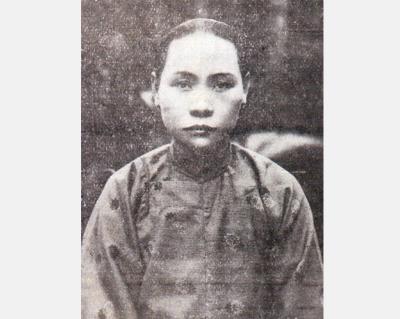
Dec. 8 to Dec. 14 Chang-Lee Te-ho (張李德和) had her father’s words etched into stone as her personal motto: “Even as a woman, you should master at least one art.” She went on to excel in seven — classical poetry, lyrical poetry, calligraphy, painting, music, chess and embroidery — and was also a respected educator, charity organizer and provincial assemblywoman. Among her many monikers was “Poetry Mother” (詩媽). While her father Lee Chao-yuan’s (李昭元) phrasing reflected the social norms of the 1890s, it was relatively progressive for the time. He personally taught Chang-Lee the Chinese classics until she entered public

Last week writer Wei Lingling (魏玲靈) unloaded a remarkably conventional pro-China column in the Wall Street Journal (“From Bush’s Rebuke to Trump’s Whisper: Navigating a Geopolitical Flashpoint,” Dec 2, 2025). Wei alleged that in a phone call, US President Donald Trump advised Japanese Prime Minister Sanae Takaichi not to provoke the People’s Republic of China (PRC) over Taiwan. Wei’s claim was categorically denied by Japanese government sources. Trump’s call to Takaichi, Wei said, was just like the moment in 2003 when former US president George Bush stood next to former Chinese premier Wen Jia-bao (溫家寶) and criticized former president Chen

President William Lai (賴清德) has proposed a NT$1.25 trillion (US$40 billion) special eight-year budget that intends to bolster Taiwan’s national defense, with a “T-Dome” plan to create “an unassailable Taiwan, safeguarded by innovation and technology” as its centerpiece. This is an interesting test for the Chinese Nationalist Party (KMT), and how they handle it will likely provide some answers as to where the party currently stands. Naturally, the Lai administration and his Democratic Progressive Party (DPP) are for it, as are the Americans. The Chinese Communist Party (CCP) is not. The interests and agendas of those three are clear, but


 RSS
RSS