


Angelina Jolie glides through the final days of Maria Callas’ short life in Pablo Larrain’s Maria, a dramatic, evocative elegy to the famed soprano. It’s an affair that’s at turns melancholy, biting and grandly theatrical, an aria for a once in a generation star.
Reality is of little consequence on the stage and in Maria. It’s all about the raw feeling, which serves the movie well, more dream than history lesson about La Callas. Early on, she pops some Mandrax and tells her devoted butler Ferruccio (a simply wonderful Pierfrancesco Favino) that a television crew is on the way. Are they real, he wonders.
“As of this morning, what is real and what is not real is my business,” she says calmly and definitively, making a feast out of Steven Knight’s sharp script. It’s one of many great lines and moments for Jolie, whose intensity and resolve belie her fragile appearance. And it’s a signal to the audience as well: Don’t fret about dull facts or that Jolie doesn’t really resemble Callas all that much. This is a biopic as opera — an emotional journey fitting of the great diva, full of flair, beauty, betrayal, revelations and sorrow.
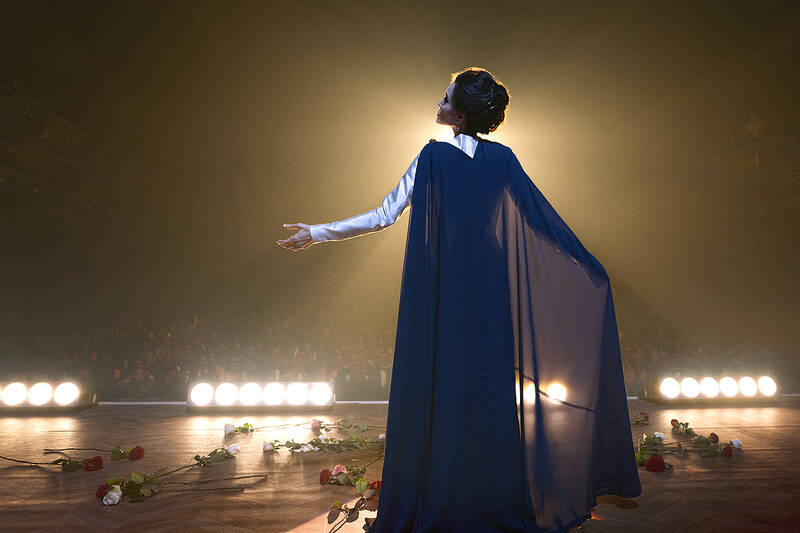
Photos: AP
In Maria, we are the companion to a protagonist with an ever-loosening grip on reality, walking with her through Paris, and her life, for one week in September 1977.
The images from cinematographer Ed Lachman, playfully shifting in form and style, take us on a scattershot journey through her triumphs on stage, her scandalous romance with Aristotle Onassis (Haluk Bilginer) and her traumatic youth. In the present, at age 53, she sleeps till midday, drinks the minimal calories she ingests, goes to restaurants where the waiters know her name looking for adulation and has visions of performances staged just for her all around the city.
Callas is always immaculately dressed and assured, whether reflecting to the imagined news crew (led by Kodi Smit-McPhee) or attempting to find her voice again. Her instrument had famously diminished, leaving her wondering what’s left to live for. The only consistent praise she gets is from her obedient housemaid Bruna (Alba Rohrwacher). It’s no secret that the destination is death. And you suspect that she knows quite well that everything will be a bit dimmer when her spotlight is turned off.
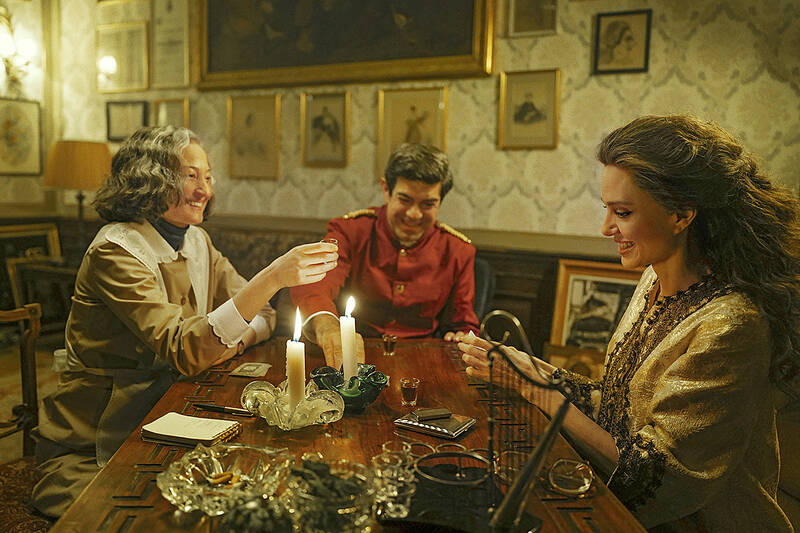
Photo: AP
Larrain has made a lasting mark on cinema with his unofficial trilogy about these famous women with tragic narratives. With Jackie, Spencer and now Maria, his films are also an unintentional antidote to Ryan Murphy’s stranglehold of the grand dames of recent history, which are all style and scandal and little substance. And yet Larrain’s films are not for everyone. If Jackie and Spencer did not speak to you, did not show those women as you hoped they would, Maria will not turn you into a believer. Three movies in, it seems that audiences are either very on board with his vision or not. There is little room for an in between.
And yet it’s hard to deny that his films are incredible showcases for actors. Jolie as a movie star is somehow both omnipresent and elusive, and lately she chooses to step in front of the camera all too infrequently. Sometimes you wish she could just follow in Nicole Kidman’s footsteps, for whom quantity does not seem to ever jeopardize quality, and she seems to be having fun doing it all, all the time. Perhaps it’s because performances like Jolie’s in Maria look so all-consuming.
In the film, Maria scolds a fan for daring to question that she faked sickness to miss a performance. He doesn’t understand the total commitment of body and soul required to make it look effortless, which is probably true. Jolie is not so dramatic, at least publicly, about what it takes to create art. But here the lines blur: Character and actor blend so seamlessly, so ferociously, that you leave not just with heightened empathy for La Callas but Jolie as well.

Photo: AP
In one of the film’s few regrettable scenes, she’s put face to face with John F. Kennedy (no fault of Caspar Phillipson), whose wife has caught the greedy eye of Onassis. As a testament to the power of Jolie and the script, you almost forgive yet another JFK impersonation for giving her one of the great brushoffs to utter, romantic and withering all at once. Is it all a little much? Of course, but that’s kind of the point of Maria.

Just after 6am, I walked up to the ticket gate at Taipei Main Station and entered the Taiwan Railway platform without scanning any ticket; instead, I flashed the Sanrio Fun Rail pass on my phone to the gate worker and was admitted. I found my train and prepared to board. My destination? This very same station. I was embarking on a 13-hour journey on one of two round-the-island trains operated by ezTravel. They run each day, one counterclockwise around the island and one clockwise. They differ in a number of ways from an ordinary Taiwan Railway train and can make for

Jason Han says that the e-arrival card spat between South Korea and Taiwan shows that Seoul is signaling adherence to its “one-China” policy, while Taiwan’s response reflects a reciprocal approach. “Attempts to alter the diplomatic status quo often lead to tit-for-tat responses,” the analyst on international affairs tells the Taipei Times, adding that Taiwan may become more cautious in its dealings with South Korea going forward. Taipei has called on Seoul to correct its electronic entry system, which currently lists Taiwan as “China (Taiwan),” warning that reciprocal measures may follow if the wording is not changed before March 31. As of yesterday,
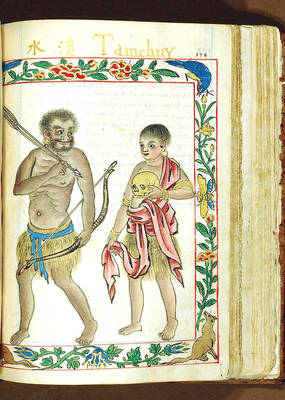
The Portuguese never established a presence on Taiwan, but they must have traded with the indigenous people because later traders reported that the locals referred to parts of deer using Portuguese words. What goods might the Portuguese have offered their indigenous trade partners? Among them must have been slaves, for the Portuguese dealt slaves across Asia. Though we often speak of “Portuguese” ships, imagining them as picturesque vessels manned by pointy-bearded Iberians, in Asia Portuguese shipping between local destinations was crewed by Asian seamen, with a handful of white or Eurasian officers. “Even the great carracks of 1,000-2,000 tons which plied

On Thursday, former Taipei mayor and founder of the Taiwan People’s Party (TPP) Ko Wen-je (柯文哲) was sentenced to 17 years in prison and had his civil rights suspended for six years over corruption, embezzlement and other charges. Seven others related to the case were also handed prison sentences, while two were found not guilty. It has been a bad week for the TPP. On Tuesday, prosecutors charged Chinese immigrant Xu Chunying (徐春鶯) with suspicion of taking part in Beijing-directed election interference. Xu has strong links to the TPP, which once offered her a party list legislator nomination. Tuesday also


 RSS
RSS