


Public allegations of sexual harassment are rare in China. Swift responses to punish the accused are rarer still. So a recent case at one of China’s top universities, in which a student posted a video online accusing her supervisor of sexually harassing her, leading to his sacking, has created shockwaves.
On 21 July, a woman who identified herself as Wang Di posted an hour-long video on Weibo, in which she accused her PhD supervisor at Renmin University in Beijing, Wang Guiyuan, of physically and verbally abusing her for more than two years. The professor, a former Chinese Communist party representative at the university, threatened to block her graduation prospects, Wang Di said.
Her video included an audio recording of one encounter in which a man is asking to kiss a woman, who repeatedly refuses. “I am reporting my professor, Wang Guiyuan … for sexually harassing and forcibly molesting me, and requesting to have a sexual relationship with me,” Wang Di said. The audio could not be independently verified.
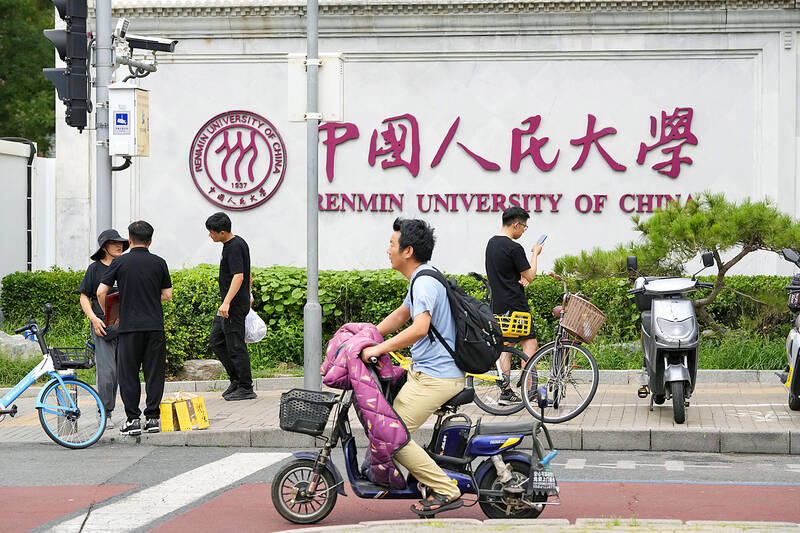
Photo: AP
By the following evening, the student’s video had received more than 2 million likes and prompted an outpouring of supportive comments. A related hashtag soon surpassed 110 million views. Within a day, the university said that after an investigation, the allegations were proven to be true, although the university’s statement referred to “moral misconduct,” not sexual harassment. Wang Guiyuan was fired from the university and expelled from the CCP. Local police said they were investigating the claims. Wang Guiyuan did not respond to a request for comment.
But the speed at which the Renmin case was dealt with masks the facts that allegations of sexual harassment and abuse are often dismissed or downplayed if made privately, and that women face enormous risks in speaking out, Chinese feminists and legal experts say.
The Renmin case demonstrates the consequences of a university lacking a proper internal procedure for handling complaints, said Feng Yuan, who founded a helpline for victims of domestic violence.
“It is assumed that the victim must reveal his or her identity and speak out in this way,” she says.
On Weibo, Zhou Xiaoxuan, a screenwriter who goes by the pen name Xianzi, wrote: “Universities systematically cover up teachers’ behavior and systematically ignore the situation of students. Only a very small number of students who can’t stand it, risking slut-shaming and cyberbullying, seek help from public opinion.”
In 2018, Zhou discovered her own uneasy fame after she publicly accused a famous television presenter, Zhu Jun, of forcibly kissing and groping her during an internship. Her lawsuit against him ultimately failed because of insufficient evidence. Sexual harassment cases in China often require “smoking gun” evidence such as audio or video recordings of the alleged abuse.
Other women have come forward on social media with their own accounts of campus harassment. “Thank you sister for speaking out. I too was sexually assaulted by my post-doctoral professor 3 years ago and still have no outcome after calling the police and reporting it,” one user wrote on Weibo.
On 24 July, Shaanxi normal university said that it had suspended a professor accused of “violating teacher ethics” in 2017, adding that it had “zero tolerance” for misconduct.
The statement didn’t provide details about the nature of the allegation: sending explicit photographs to female students.
Feminists have pointed out that Chinese institutions — schools, courts, the police — tend to avoid naming sexual abuse directly, preferring instead to treat the matter as a misunderstanding or moral failing between two people. Such a strategy is a way of dealing with gender-based violence “in a way that does not touch the essence of the problem,” Feng said.
Organized feminist activity has largely been squashed in China, with activists facing severe punishments. Sophia Huang Xueqin, a journalist who reported on China’s nascent #MeToo movement, was jailed last month for five years for inciting state subversion.
Feminism in China has been forced to become “very decentralized and individualized,” said Li Maizi, a veteran activist who is now based in the US. That means that women who speak out against abuse by people in positions of authority shoulder all the risks themselves.
One of those risks is being sued — by the alleged harasser. In May, a court in Beijing heard a defamation case filed by Li Songwei, a celebrity counselor, against a woman who accused him on social media of engaging in an inappropriate sexual relationship with her when she was his client.
And Xianzi, the screenwriter, was sued by Zhu for defamation after she made her MeToo accusation against him (he dropped his lawsuit due to poor health last year).
Research by Darius Longarino, Wei Changhao and Yixin Ren of the Paul Tsai China Center at Yale Law School suggests that only 8 percent of civil lawsuits relating to sexual harassment are cases in which an alleged victim is suing an alleged perpetrator. The majority of lawsuits are lodged by the accused, often for defamation.
But despite the risks, some women will continue to speak out publicly, Li predicts, “because where there’s repression there’s resistance.”

Just after 6am, I walked up to the ticket gate at Taipei Main Station and entered the Taiwan Railway platform without scanning any ticket; instead, I flashed the Sanrio Fun Rail pass on my phone to the gate worker and was admitted. I found my train and prepared to board. My destination? This very same station. I was embarking on a 13-hour journey on one of two round-the-island trains operated by ezTravel. They run each day, one counterclockwise around the island and one clockwise. They differ in a number of ways from an ordinary Taiwan Railway train and can make for
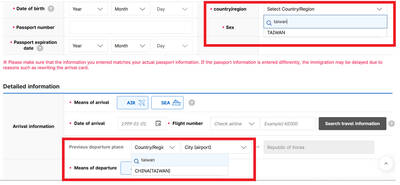
Jason Han says that the e-arrival card spat between South Korea and Taiwan shows that Seoul is signaling adherence to its “one-China” policy, while Taiwan’s response reflects a reciprocal approach. “Attempts to alter the diplomatic status quo often lead to tit-for-tat responses,” the analyst on international affairs tells the Taipei Times, adding that Taiwan may become more cautious in its dealings with South Korea going forward. Taipei has called on Seoul to correct its electronic entry system, which currently lists Taiwan as “China (Taiwan),” warning that reciprocal measures may follow if the wording is not changed before March 31. As of yesterday,

The Portuguese never established a presence on Taiwan, but they must have traded with the indigenous people because later traders reported that the locals referred to parts of deer using Portuguese words. What goods might the Portuguese have offered their indigenous trade partners? Among them must have been slaves, for the Portuguese dealt slaves across Asia. Though we often speak of “Portuguese” ships, imagining them as picturesque vessels manned by pointy-bearded Iberians, in Asia Portuguese shipping between local destinations was crewed by Asian seamen, with a handful of white or Eurasian officers. “Even the great carracks of 1,000-2,000 tons which plied

On Thursday, former Taipei mayor and founder of the Taiwan People’s Party (TPP) Ko Wen-je (柯文哲) was sentenced to 17 years in prison and had his civil rights suspended for six years over corruption, embezzlement and other charges. Seven others related to the case were also handed prison sentences, while two were found not guilty. It has been a bad week for the TPP. On Tuesday, prosecutors charged Chinese immigrant Xu Chunying (徐春鶯) with suspicion of taking part in Beijing-directed election interference. Xu has strong links to the TPP, which once offered her a party list legislator nomination. Tuesday also


 RSS
RSS