


Salon-worthy manicures at home and expert skin care advice from artificial intelligence: the beauty industry is counting on tech to get consumers pampered like the rich and famous.
The Nimble manicure salon calls itself the world’s first device to combine AI and complex robotics to paint nails flawlessly — without the hassle of making an appointment.
Resembling a heavyset printer, Nimble can varnish all ten fingernails and dry them in just 25 minutes.
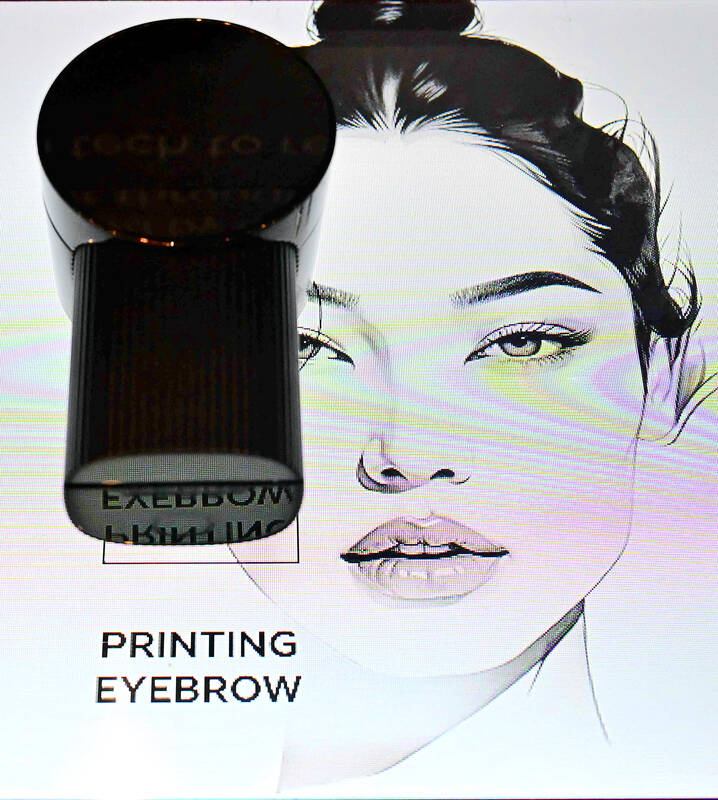
Photo: AFP
The device, an eight-kilo white box with a special door for the hand, is on display this week at the Las Vegas Consumer Electronics Show (CES), the tech industry’s annual hub.
According to its creators, the device uses high-resolution micro-cameras and 3-D imaging to determine nail shape, size and curvature. Then a small robotic arm, guided by AI algorithms, applies the requisite three coats, with a blow dry after each applied layer.
When it goes on sale in March, more than 30 colors will be available in capsules costing US$10 each. The unit costs US$599.
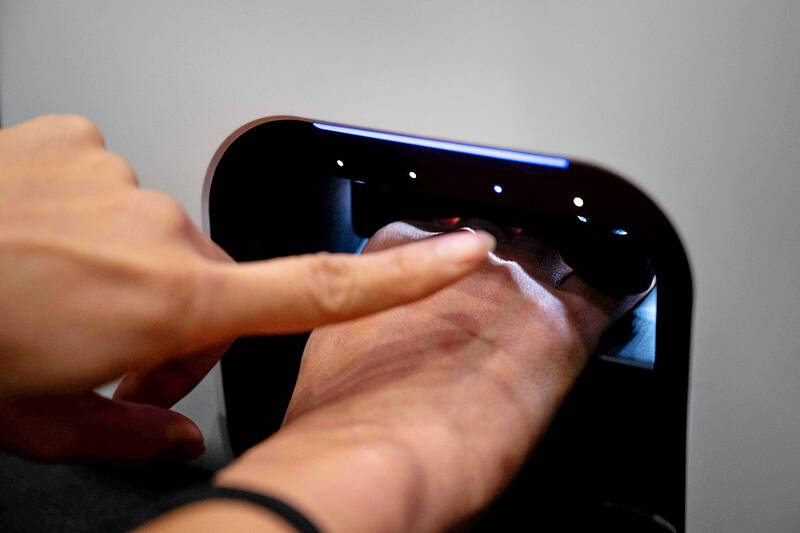
Photo: AFP
In a study published in May, consulting firm McKinsey put the global beauty industry — which includes skin and hair care, perfume and make-up — at US$430 billion in 2022 and forecast it to reach US$580 billion by 2027. The industry’s Internet sales almost quadrupled between 2015 and 2022.
AI, a term often deployed as the latest catchphrase for anything tech, has also infiltrated beauty products such as make-up and skincare, including from industry giants.
The free Beauty Genius app, presented by L’Oreal, is intended to be an AI-supported “virtual personal advisor.”
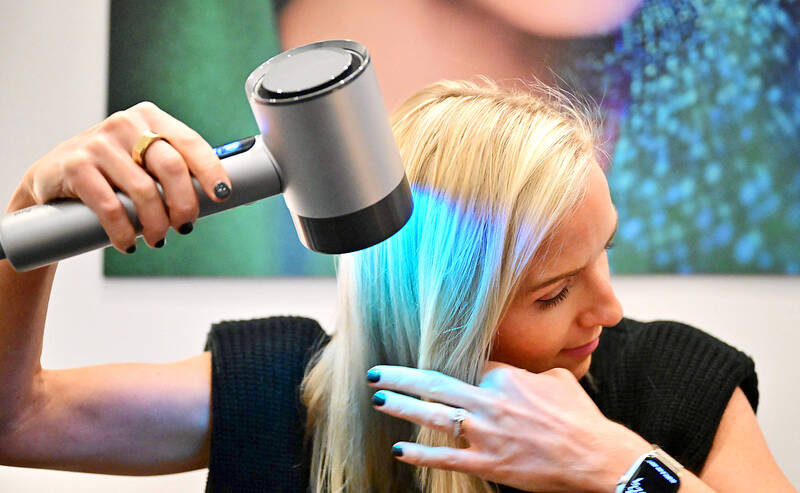
Photo: AFP
It recommends skincare and make-up products according to skin type, gives tips on techniques and answers questions about problems such as acne and hair loss. Users can also try out the products virtually, guiding customers who are overwhelmed by a physical shop’s rows of foundations with similar shades and varied textures, or creams with seemingly endless specificities.
This is also the aim of the program Beautiful AI, created by Perfect Corp, which combines generative AI and virtual reality to perform live skin analyses, 3-D hairstyle or jewelry trials and make recommendations.
Korea’s Prinker, a specialist in ephemeral, customizable tattoos for skin and hair, is unveiling a similar product that will apply make-up this year. The device will also put AI to work with a biometric 3-D scanner to map facial features and then recommend the right contours, “printing” the corresponding powders to the face.
INFRARED HAIR BLOWER
Companies are also bringing beauty personalization tech to hair care. This week, L’Oreal presents the world premiere of a connected hairdryer that can be customized via an app, taking hair type into account and automatically adapting power and heat distribution. The Airlight Pro uses infrared light to dry the hair, allowing it to preserve the hair’s moisture, said Adrien Chretien, head of augmented beauty development at L’Oreal.
Due to go on sale in April, it also offers energy savings of 31 percent compared with a conventional appliance, he added. Another product scheduled for launch later this year is Colorsonic, a brush-like hair coloring device that uses cartridges and that L’Oreal says has been in development for nine years.
Ajay Verma, a consultant gastroenterologist at Kettering general hospital in Northamptonshire, says our gut is a “complex machine.” “It is constantly providing us with the nutrition we need, initially to grow and develop, and then for us to survive, thrive and repair from injury and illness.” How can we keep it functioning well? Put simply: “Make sure what you put into it is balanced, and that you clear out its waste products adequately,” Verma says. “In a general gastroenterology clinic, the most common conditions we see are irritable bowel syndrome (IBS), gastroesophageal reflux disease, inflammatory bowel disease and constipation,” says Nisha
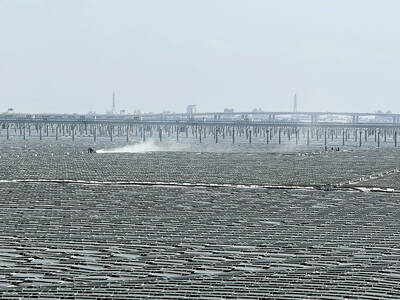
The arithmetic is straightforward and uncomfortable. By the end of 2025, Taiwan had committed itself to a 50-30-20 electricity mix — half natural gas, 30 per cent coal, 20 per cent renewables. The Ministry of Economic Affairs’s (MOEA) own monthly energy reports tell a different story. Natural gas reached 47.8 per cent of generation last year. Coal stood at 35.4 per cent, comfortably above its target ceiling. Renewables came in at 13.1 per cent, well short of the 20 per cent Taipei had pledged a decade earlier. Installed renewable capacity reached roughly half of the 12 gigawatts (GW) the government
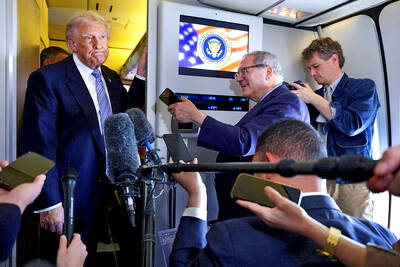
Last week US President Donald Trump was asked by a reporter whether he would speak on the phone to the President of Taiwan. “l’ll speak to him. I speak to everybody. We have that situation very well in hand,” Trump said. This marked the second time in a couple of weeks he had said he would talk to the President of Taiwan. In 2016 he famously took a call from then-president Tsai Ing-wen (蔡英文), when he was president-elect. Despite warnings that the apocalypse was nigh because of a phone call, the world quickly forgot about the conversation between two democratically-elected presidents.
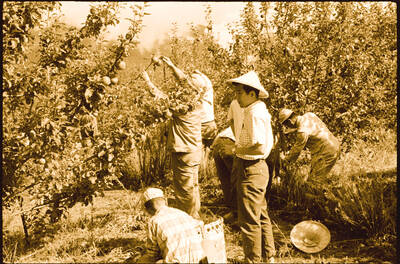
May 25 to May 31 Few believed that apples could be cultivated on a commercial scale in Taiwan’s high mountains. When horticulturalist Cheng Chao-hsiung (程兆熊) first proposed the idea in 1955, both American and Taiwanese colleagues dismissed it as implausible, arguing that temperate fruit could not be reliably grown on a subtropical island, especially on rugged terrain. However, it was this terrain in the Central Mountain Range where many Chinese Civil War veterans were resettled in the late 1950s. With limited job prospects and no family in Taiwan, they were placed on cooperative farms aimed toward self-sufficiency. Some say the conditions


 RSS
RSS