


Elon Musk may want to send “tweet” back to the birds, but the ubiquitous term for posting on the site he now calls X is here to stay — at least for now.
For one, the word is still plastered all over the site formerly known as Twitter. Write a post, you still need to press a blue button that says “tweet” to publish it. To repost it, you still tap “retweet.”
But it’s more than that.
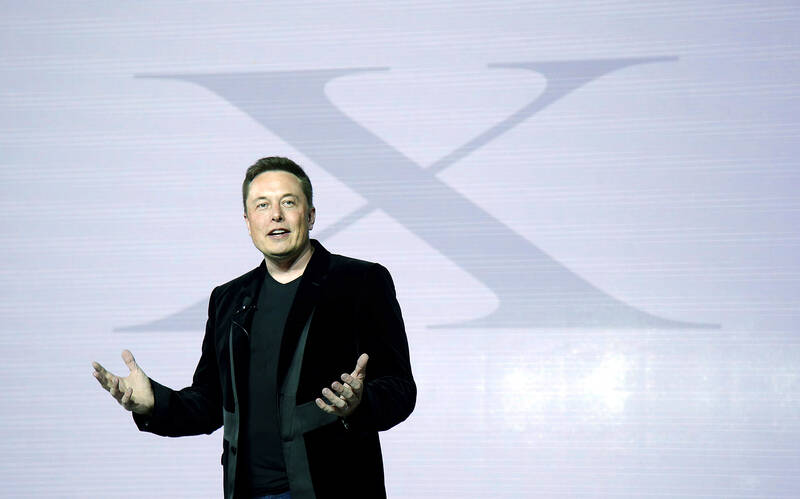
Photo: AP
With “tweets,” Twitter accomplished in just a few years something few companies have done in a lifetime: It became a verb and implanted itself into the lexicon of America and the world. Upending that takes more than a top-down declaration, even if it is from the owner of Twitter-turned-X, who also happens to be one of the world’s richest men.
“Language has always come from the people that use it on a day-to-day basis. And it can’t be controlled, it can’t created, it can’t be morphed. You don’t get to decide it,” said Nick Bilton, the author of Hatching Twitter: A True Story of Money, Power, Friendship, and Betrayal about Twitter’s origins.
INTO THE DICTIONARY
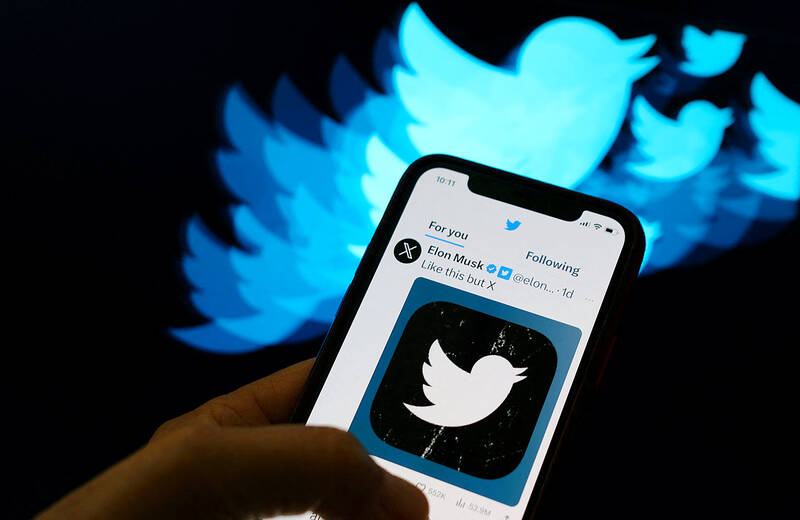
Photo: AFP
Twitter didn’t start out as Twitter. It was “twttr” — without vowels, which was the trend in 2006 when the platform launched and SMS texting was wildly popular. The iPhone only came out in 2007.
Twitter co-founder Evan Williams “went one day and purchased the vowels, two vowels for essentially US$7,500 each,” when he bought the URL for twitter.com from a bird enthusiast, Bilton said.
At the beginning, people didn’t “tweet” — it was “I’m going to twitter this,” Bilton recalled. But “twittered” doesn’t roll off the tongue and “tweet” soon took over, first in the Twitter office, then San Francisco, then everywhere.
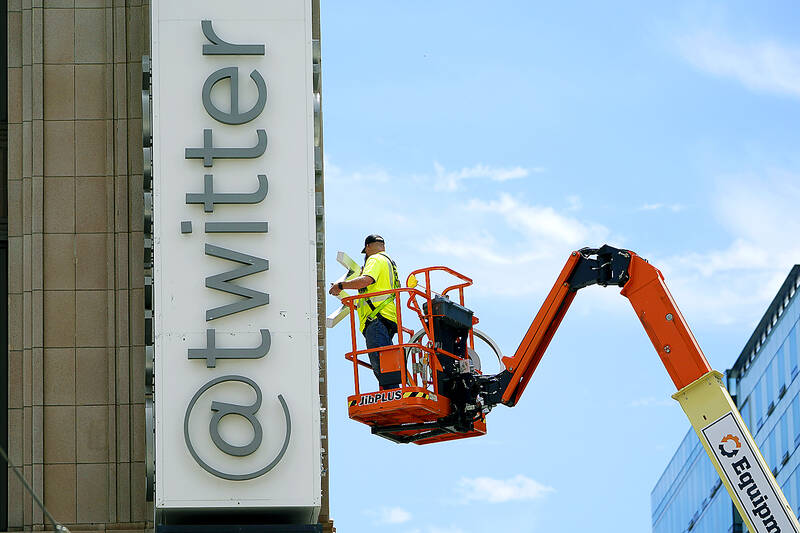
Photo: AP
We’ve been tweeting for well over a decade. World leaders, celebrities and athletes, dissidents in repressive regimes, propaganda trolls, sex workers and religious icons, meme queens and actual queens. Former president Donald Trump’s incendiary use of the bird app quickly punted “tweet” into near-constant headlines during his presidency. People who never signed up for Twitter knew what the word meant.
For now, we still tweet, retweet and quote tweet, and sometimes — perhaps not often enough — delete tweets. News sites embed tweets in their stories and TV programs scroll them. No other social network has a word for posting that’s entered the vernacular like “tweet” — though Google did the same for “googling.”
The Oxford English Dictionary added “tweet” in 2011. Merriam-Webster followed in 2013. The Associated Press Stylebook entered it in 2010.
“Getting into the dictionary is an indication that people are already using it,” said Jack Lynch, a Rutgers University English professor who studies the history of language. “Dictionaries are usually pretty tentative or cautious about letting new words in, especially for new phenomena, because they don’t want things to be just a flash in the pan.”
FRIENDLY LOGO
As Twitter grew into a global communications platform and struggled with misinformation, trolls and hate speech, its friendly brand image remained. The blue bird icon evokes a smile, like the Amazon up-turned-arrow smile — in contrast to the X that Musk has imposed.
Martin Grasser was two years out of art school when Twitter hired him for the logo redesign in 2011. His wasn’t the first bird logo for Twitter, but it would be the most enduring.
“They knew they wanted a bird. So we weren’t starting completely over, but they wanted it to be on par with Apple and Nike. That was really the brief,” he said.
Twitter launched Grasser’s design in May 2012; the company went public on Wall Street later that year.
One early in-house design shown to Grasser looked like “a flying goose with a tail. It looked kind of like a dragon. It was crazy,” he said. Jack Dorsey, another co-founder (and twice-CEO) wanted something simpler.
The bird represented a vision of Twitter as a friendly place “where everyone can weigh in and chat,” Grasser said.
“The round form evokes a sense of optimism, the bird even being sort of turned upward, as corny as that sounds, I think is different than a bird flying down or flat,” he said. “We wanted to give it this idea of like soaring.”
The word “Twitter” itself is playful, as is “tweet.” This was no accident, Bilton said.
Other names that floated as the platform started out included “Status” and “Friend Stalker.”
It was Noah Glass, another co-founder who never quite got the credit he deserved for his role in hatching Twitter, who had the winning idea.
Glass, Bilton said, “had been thinking about like heartbeats and emotions. He was going through a divorce and he literally went through the dictionary word by word until he came across the word twitter. And he just knew instantly that was it.”
“He was one of the four founders who had the emotional intelligence to be able to understand that this was about connecting with humans,” Bilton said. “It was inviting, it was emotional. It was about connecting with humans and your friends and your loved ones.”
MASSIVE OVERHAUL
Musk began his quest erasing Twitter’s corporate culture and image in favor of his own vision as soon as he took over the company in October last year. He lost three-quarters of the company’s staff through firings, layoffs and voluntary departures, auctioned off furniture and decor, and upended policies on hate speech and misinformation. The rebranding to X was no surprise.
Twitter’s rebranding is rooted in ambition that Musk began to pursue nearly a quarter century ago after he sold his first startup, Zip2, to Compaq Computer. He set out to create a one-stop digital shop for finance called X.com — an “everything” service that would provide bank accounts, process payments, make loans and handle investments.
He has not given up on the dream. Twitter is now X, falling in line with Musk’s other X-named brands, SpaceX and Tesla’s Model X. Not to mention his young son, whom he calls “X.”
His goal for X is to turn it into an “everything” app — for video, photos, messaging, payments and other services, although he has given few details. For now, X.com is still, essentially Twitter.com, even as the blue bird and other playful tidbits start to disappear.
“There used to be a saying inside Twitter that Twitter was the company that couldn’t kill itself. I think that still rings true, whether it’s called Twitter or X,” Bilton said.
“I think that it’s kind of become a fabric of society. And even Elon Musk may not be able to break it.”
Paul Thomas Anderson’s “One Battle After Another” was crowned best picture at the 98th Academy Awards, handing Hollywood’s top honor to a comic, multi-generational American saga of political resistance. The ceremony Sunday, which also saw Michael B. Jordan win best actor and “Sinners” cinematographer Autumn Durald Arkapaw make Oscar history as the first female director of photography to win the award, was a long-in-coming coronation for Anderson, a San Fernando Valley native who made his first short at age 18 and has been one of America’s most lionized filmmakers for decades. Before Sunday, Anderson had never won an Oscar. But “One Battle
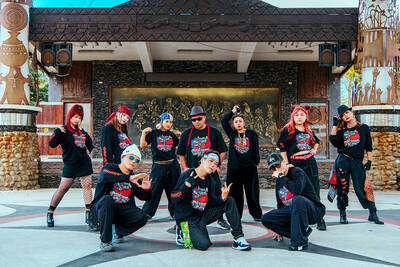
In Kaohsiung’s Indigenous People’s Park (原住民主題公園), the dance group Push Hands is training. All its members are from Taiwan’s indigenous community, but their vibe is closer to that of a modern, urban hip-hop posse. MIXING CULTURES “The name Push Hands comes from the idea of pushing away tradition to expand our culture,” says Ljakuon (洪濬嚴), the 44-year-old founder and main teacher of the dance group. This is what makes Push Hands unique: while retaining their Aboriginal roots, and even reconnecting with them, they are adamant about doing something modern. Ljakuon started the group 20 years ago, initially with the sole intention of doing hip-hop dancing.

What was the population of Taiwan when the first Negritos arrived? In 500BC? The 1st century? The 18th? These questions are important, because they can contextualize the number of babies born last month, 6,523, to all the people on Taiwan, indigenous and colonial alike. That figure represents a year on year drop of 3,884 babies, prefiguring total births under 90,000 for the year. It also represents the 26th straight month of deaths exceeding births. Why isn’t this a bigger crisis? Because we don’t experience it. Instead, what we experience is a growing and more diverse population. POPULATION What is Taiwan’s actual population?

You would never believe Yancheng District (鹽埕) used to be a salt field. Today, it is a bustling, artsy, Kowloon-ish “old town” of Kaohsiung — full of neon lights, small shops, scooters and street food. Two hundred years ago, before Japanese occupiers developed a shipping powerhouse around it, Yancheng was a flat triangle where seawater was captured and dried to collect salt. This is what local art galleries are revealing during the first edition of the Yancheng Arts Festival. Shen Yu-rung (沈裕融), the main curator, says: “We chose the connection with salt as a theme. The ocean is still very near, just a


 RSS
RSS