


In a Japanese city once famous for forging samurai swords, craftsmen sharpen and polish kitchen knives, but even at full tilt their small factory can’t keep up with global demand.
The export value of knives and other bladed tools like scissors hit a record high in Japan last year, partly thanks to a home-cooking boom sparked by the pandemic.
Japanese knives are also winning more converts among aspiring and professional chefs, who prize their delicate precision, sleek finish and long lifespan.
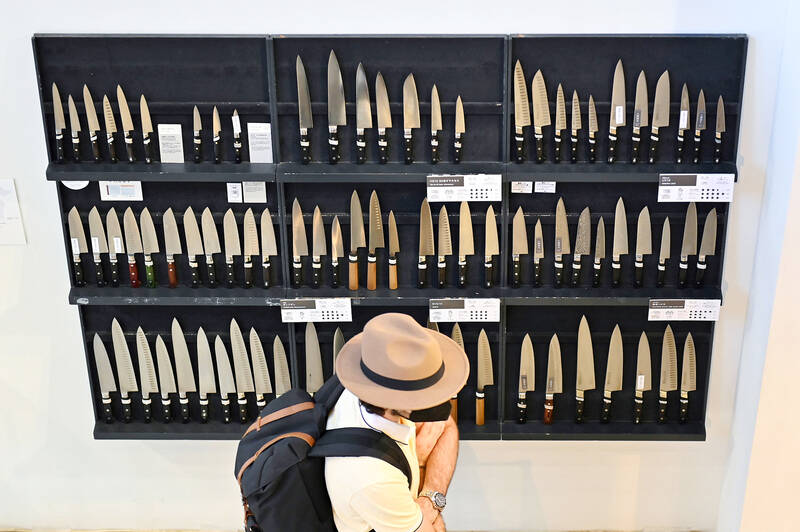
Photo: AFP
Katsumi Sumikama, head of Sumikama Cutlery in the central city of Seki, puts the popularity down to a “combination of technology and traditional craftsmanship.”
To achieve the formidably sharp edge needed to make perfect sushi or cut precise slices of Wagyu beef, the company uses machines that guarantee accuracy to one-thousandth of a millimeter, then artisans finish the job by hand.
But even at full capacity, “we can’t keep up,” Sumikama said.
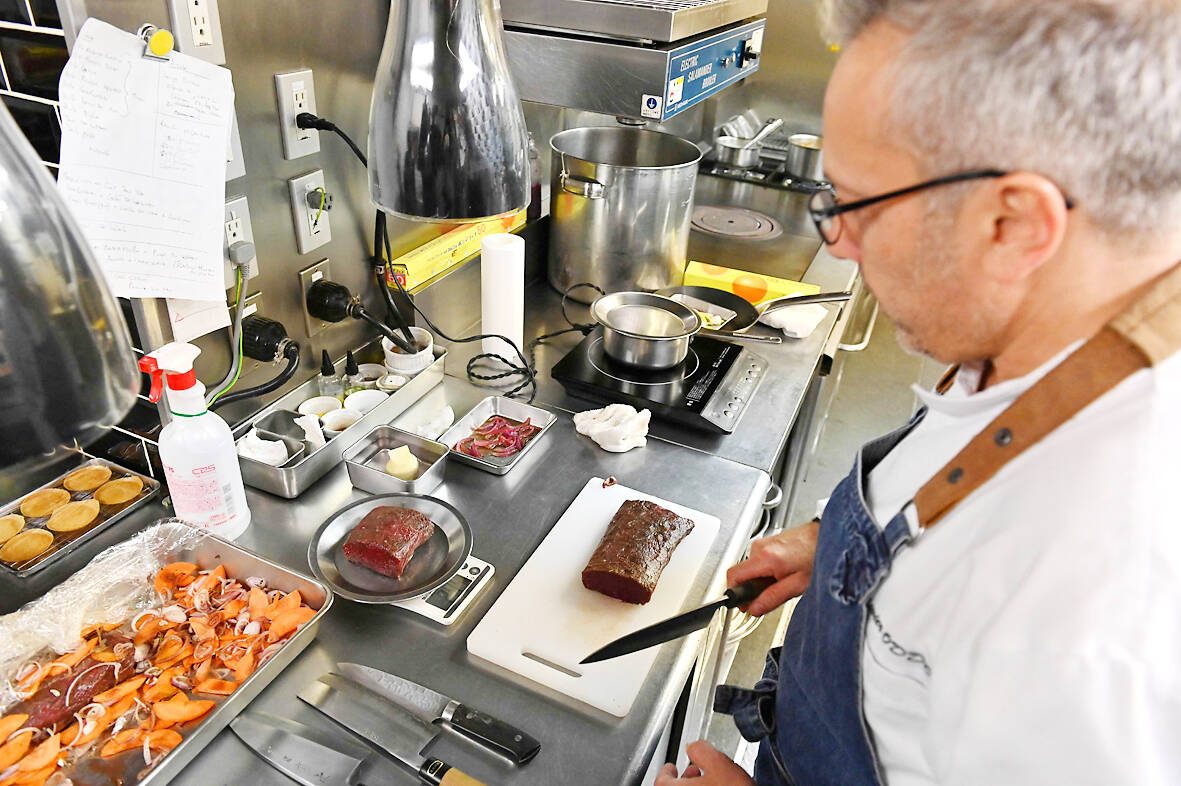
Photo: AFP
“We’re seeing demand stronger than pre-pandemic levels in all countries.”
Seki’s renowned blade expertise dates back to the 14th century, when the city became a major producer of swords thanks to its rich natural environment.
“The clean water, charcoal and raw materials were ideal for sword-making,” Sumikama said.
High-quality iron made from ironsand was forged into a tough sword by folding red-hot metal multiple times, and molded into a curved shape by plunging it into cool water.
When samurai were ordered to abandon their swords in 1876, the industry faltered, but after World War II the city began producing pocket knives for export.
Business boomed at first, with the fixed yen-to-dollar rate a boon for mass exports to the US.
But when that policy ended in the 1970s and China began making cheaper products, Japan could no longer compete.
‘TRULY WORLDWIDE’
“There were difficult times,” Sumikama said.
“Seki’s blade-makers decided they needed a new direction.”
At the time, German products, including knives by Zwilling, dominated the market for high-end knifeware, and luxury Japanese offerings were few and far between.
In the 1990s, Sumikama went all in — launching a full line-up of top-of-the-range kitchen knives that cost up to several hundred dollars each.
To emphasize their made-in-Japan pedigree, his company adds a wavy two-tone finish to the metal that evokes the traditional appearance of samurai blades, and a kanji-character logo.
Despite their elegant appearance, Sumikara said he faced skepticism from both within and outside the company that his expensive knives would sell.
“We were trapped in the idea that Japanese products... would not be accepted by consumers unless they were cheaper than German products,” he said.
But the line was a success and the company now sells their luxury knives in more than 50 countries.
The export value of kitchen bladed tools hit a record 12 billion yen (US$90 million) in 2021, a 30 percent jump from around nine billion yen the previous year, according to Japan Customs.
French chef Olivier Oddos, whose Tokyo restaurant boasted a Michelin star between 2014 and 2021, has been a devotee for more than two decades.
Japanese kitchen knives now have a “truly worldwide” reputation, he said in his restaurant’s small kitchen.
“I know a lot of French chefs who have come to Japan, and every time they buy Japanese knives. Sometimes they even buy them for their whole team,” he said.
‘ESSENCE OF THE KNIFE’
Oddos says the formidable sharpness of the Japanese blades makes all the difference.
“It cuts perfectly. It cuts straight. It’s regular,” he said, adding it “changes the quality of the cooking.”
Japanese knives have to be maintained regularly with sharpening stones, but “if you take good care of them, they have a pretty exceptional lifespan,” Oddos said.
Daisuke Kumazawa owns Kama-Asa, a shop that has operated on Tokyo’s famous Kappabashi kitchenware street for over a century.
He says Japanese knives have exploded in popularity overseas in the last decade along with a growing interest in Japanese food.
Chefs want quality blades to do “delicate work,” he said.
The products are so popular that he opened a Paris branch four years ago.
But he has also noted a pandemic rise in interest.
“Probably because they were at home more often, more people wanted to take time to cook, and cook better,” he said.
At Kama-Asa, assistants explain dozens of different knives to a steady stream of Japanese and foreign customers.
Kumazawa wants buyers to think about Japanese knives as more than a simple kitchen tool.
“We want them to know why they are good — the essence of the knife, the thoughts of the craftspeople behind the knife.”
Taiwan’s overtaking of South Korea in GDP per capita is not a temporary anomaly, but the result of deeper structural problems in the South Korean economy says Chang Young-chul, the former CEO of Korea Asset Management Corp. Chang says that while it reflects Taiwan’s own gains, it also highlights weakening growth momentum in South Korea. As design and foundry capabilities become more important in the AI era, Seoul risks losing competitiveness if it relies too heavily on memory chips. IMF forecasts showing Taiwan widening its lead over South Korea have fueled debate in Seoul over memory chip dependence, industrial policy and
“China wants to unify with Taiwan at the lowest possible cost, and it currently believes that unification will become easier and less costly as time passes,” wrote Amanda Hsiao (蕭嫣然) and Bonnie Glaser in Foreign Affairs (“Why China Waits”) this month, describing how the People’s Republic of China (PRC) is playing the long game in its quest to seize Taiwan. This has been a favorite claim of many writers over the years, easy to argue because it is so trite. Very obviously, if the PRC isn’t attacking Taiwan, it is waiting. But for what? Hsiao and Glaser’s main point is trivial,
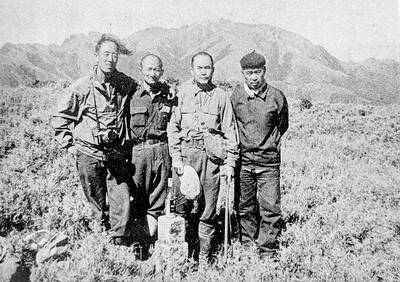
May 18 to May 24 Gathered on Yangtou Mountain (羊頭山) on Dec. 5, 1972, Taiwan’s hiking enthusiasts formally declared the formation of the “100 Peaks Club” (百岳俱樂部) and unveiled the final list of mountains. Famed mountaineer Lin Wen-an (林文安) led this effort for the Chinese Alpine Association (中華山岳協會). Working with other experienced climbers, he chose 100 peaks above 10,000 feet (3,048m) that featured triangulation points and varied in difficulty and character. The list sparked an alpine hiking craze, inspiring many to take up mountaineering and competing to “conquer” the summits. A common misconception is that the 100 Peaks represent Taiwan’s 100 tallest
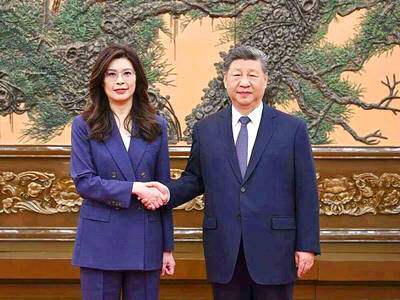
The Chinese Nationalist Party (KMT), alongside their smaller allies the Taiwan People’s Party (TPP), are often accused of acting on behalf of the Chinese Communist Party (CCP). Some go so far as to call them “traitors.” It is not hard to see why. They regularly pass legislation to stymie the normal functioning of the ruling Democratic Progressive Party’s (DPP) administration, and they have yet to pass this year’s annual budget. They slashed key elements of the government’s proposed NT$1.25 trillion (US$40 billion) special military budget, and in the smaller NT$780 billion package they did pass, it is riddled with provisions that


 RSS
RSS