


Civil wars over semicolons and heated debate over the word “looms” would not, on the face of it, seem like the stuff of a gripping big-screen movie.
But make no mistake about it, Turn Every Page, about the half-century relationship between author Robert Caro and his longtime editor, Robert Gottlieb, is as much a rock ’em, sock ’em clash of heavyweights as found in any blockbuster — just one where the protagonists happen to quote from King Lear and Homer’s Iliad. The search for a sharpened pencil is about the most pressing issue at hand.
“He does the work. I do the cleanup. Then we fight,” neatly summarizes Gottlieb in the profoundly charming new documentary directed by his daughter, Lizzie Gottlieb.
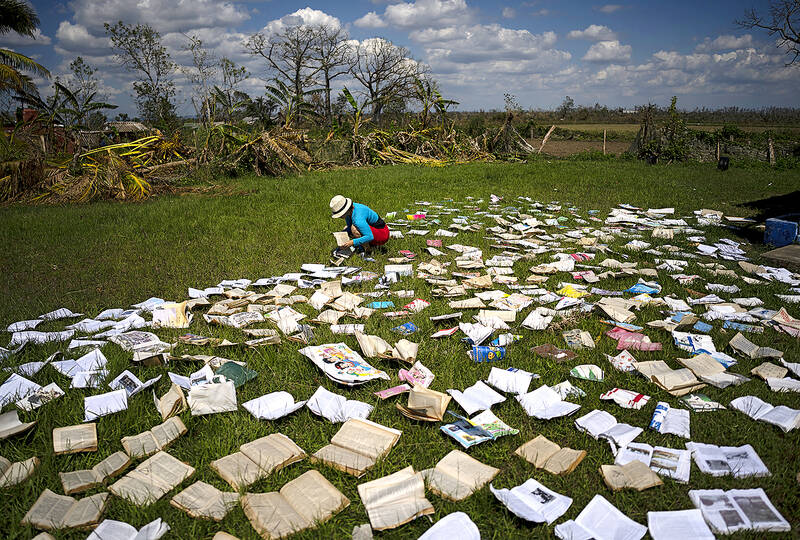
Photo: AP
Gottlieb, who has edited Toni Morrison, Charles Portis, Salman Rushdie and many others, is exaggerating, of course. Turn Every Page is not about foes, though it’s harder to say if it’s about friends.
Since Caro’s seminal Robert Moses history The Power Broker, they have been locked in a relationship of mutual dedication. Dedication to literature and history, but dedication, above all, to the details. Their journey together more or less started in 1973, when Caro dropped a million-word manuscript on Gottlieb, who knew, 15 pages in, that it was a masterpiece.
Turn Every Page is one of the finest films you’ll see about the craft of editing — not that there are so many of those. Gottlieb, warmly erudite, describes what he does as “a service job” of finding “what will be helpful, what will serve” the text and the writer. But it should be with a strong opinion, he says: “There has to be an equality.”
On Caro’s request, they aren’t interviewed together in Turn Every Page, and each even initially refused Lizzie’s interest in filming them. But as she toggles between each subject, her film leans on their similarities and parallel courses, sustaining the balance of writer-editor back-and-forth.
They are both Manhattan men of letters with considerable longevity (Caro is 87, Gottlieb 91). They are each authorities on the power centers of New York — Caro in his investigation of Moses, and Gottlieb as the former chief of Alfred A. Knopf, Simon & Schuster and The New Yorker.
And they are each driven by obsession. Caro can’t help researching every scrap of paper on Lyndon B. Johnson. (He remains at work on the fifth and final volume of The Years of Lyndon Johnson ). Gottlieb, a voracious reader (“It had never occurred to me to be anything except a reader,” he says) who has a hobby collecting women’s handbags, for reasons that mystify his wife, Maria Tucci.
Caro’s fifth LBJ volume is to be their last book together. The question of whether they’ll both live to see it finished, you could say, looms over Turn Every Page, as do past battles over the overuse of some of Caro’s favored dramatic words. Disagreements about semicolons are spoken of like Union generals recalling Antietam.
It is, undeniably, delicious stuff to listen to these war stories, just as it is sometimes chastening to hear of their battle wounds. There may be no more haunting scene in movies this year than Caro describing the pain of cutting 350,000 words — enough for two or three more books — from The Power Broker. You believe him, absolutely, when he says it was the hardest thing he’s ever gone through in his life, just as you grasp the immense toil behind his sprawling histories when Caro says, “Writing, for me, anyway, is hard.” That Gottlieb deeply understands and respects this struggle is surely part of his bond with Caro or any writer.
For Caro, those words have all, naturally, been pecked out on a typewriter. In one moment, he shows the running tally inside the door to his coat closet tracking how many words he managed each day. Caro, private in his work to the point of paranoid prickliness, quickly realizes some of his notes might be too revealing and closes the door. When Caro later gets out a step stool to show the cupboard above the fridge where he nightly stores his carbon ribbons, it feels almost like Kane allowing a glimpse of Rosebud.
In the film’s sweet finale, Caro and Gottlieb finally let Lizzie film them working together — with a pencil — over a manuscript. But (again by Caro’s request) she’s not allowed to record any sound of their conversation. Their interaction passes like a dance — not as dazzling, perhaps, as one of Gene Kelly and Debbie Reynolds’ routines, but, in its humble way, just as stirring.

By global standards, the traffic congestion that afflicts Taiwan’s urban areas isn’t horrific. But nor is it something the country can be proud of. According to TomTom, a Dutch developer of location and navigation technologies, last year Taiwan was the sixth most congested country in Asia. Of the 492 towns and cities included in its rankings last year, Taipei was the 74th most congested. Taoyuan ranked 105th, while Hsinchu County (121st), Taichung (142nd), Tainan (173rd), New Taipei City (227th), Kaohsiung (241st) and Keelung (302nd) also featured on the list. Four Japanese cities have slower traffic than Taipei. (Seoul, which has some

In our discussions of tourism in Taiwan we often criticize the government’s addiction to promoting food and shopping, while ignoring Taiwan’s underdeveloped trekking and adventure travel opportunities. This discussion, however, is decidedly land-focused. When was the last time a port entered into it? Last week I encountered journalist and travel writer Cameron Dueck, who had sailed to Taiwan in 2023-24, and was full of tales. Like everyone who visits, he and his partner Fiona Ching loved our island nation and had nothing but wonderful experiences on land. But he had little positive to say about the way Taiwan has organized its
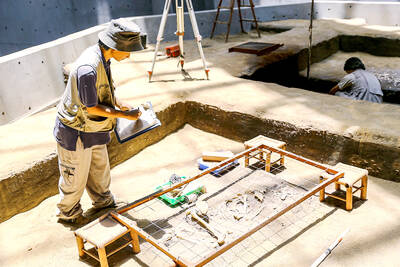
Writing of the finds at the ancient iron-working site of Shihsanhang (十 三行) in New Taipei City’s Bali District (八里), archaeologist Tsang Cheng-hwa (臧振華) of the Academia Sinica’s Institute of History and Philology observes: “One bronze bowl gilded with gold, together with copper coins and fragments of Tang and Song ceramics, were also found. These provide evidence for early contact between Taiwan aborigines and Chinese.” The Shihsanhang Web site from the Ministry of Culture says of the finds: “They were evidence that the residents of the area had a close trading relation with Chinese civilians, as the coins can be

Michael slides a sequin glove over the pop star’s tarnished legacy, shrouding Michael Jackson’s complications with a conventional biopic that, if you cover your ears, sounds great. Antoine Fuqua’s movie is sanctioned by Jackson’s estate and its producers include the estate’s executors. So it is, by its nature, a narrow, authorized perspective on Jackson. The film ends before the flood of allegations of sexual abuse of children, or Jackson’s own acknowledgment of sleeping alongside kids. Jackson and his estate have long maintained his innocence. In his only criminal trial, in 2005, Jackson was acquitted. Michael doesn’t even subtly nod to these facts.


 RSS
RSS