


They’re your run-of-the-mill Japanese “salarymen,” hard-working, pot-bellied, friendly and, well, rather regular.
But the chief executive and general manager at a tiny Japanese security company are among the nation’s biggest TikTok stars, drawing 2.7 million followers and 54 million likes, and honored with awards as a trend-setter on the video-sharing app.
Daikyo Security Co.’s account, which gathers goofy dances, gobbled instant noodles and other everyday fare, is the brainchild of the company president.
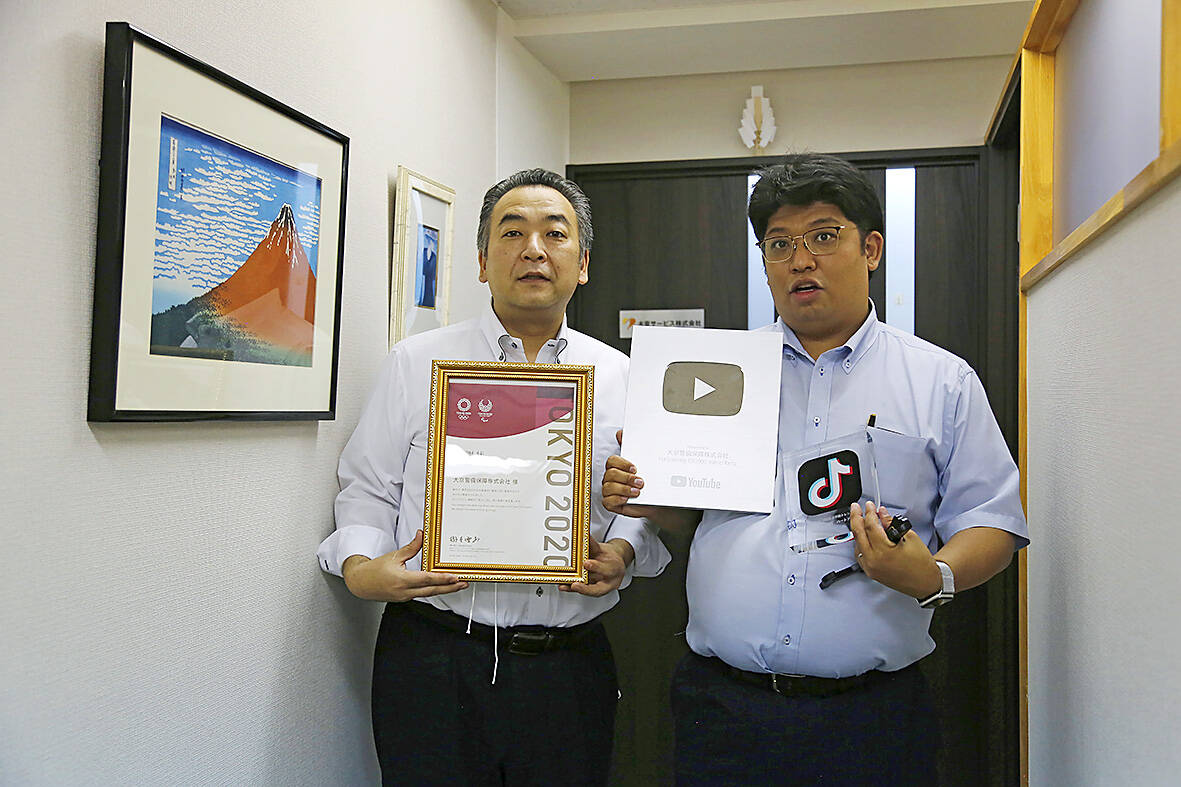
Photo: AP
Despite his unpretentious demeanor, Daisuke Sakurai is dead serious about not only enhancing brand power but also recruiting young people to his company, a challenge he sees as a matter of survival.
Founded in 1967, Daikyo has 85 employees, 10 of them working at the headquarters office, tucked away on the second floor of an obscure building in a downtown Tokyo alley.
“Our job is among those labeled ‘Three-K’ in Japan,” Sakurai said, referring to kitsui, kitanai, kiken, meaning, “hard, dirty and dangerous.” A common job for Daikyo guards is to work at construction sites, directing traffic with a flashing stick, making sure the trucks come and go safely without running over pedestrians.
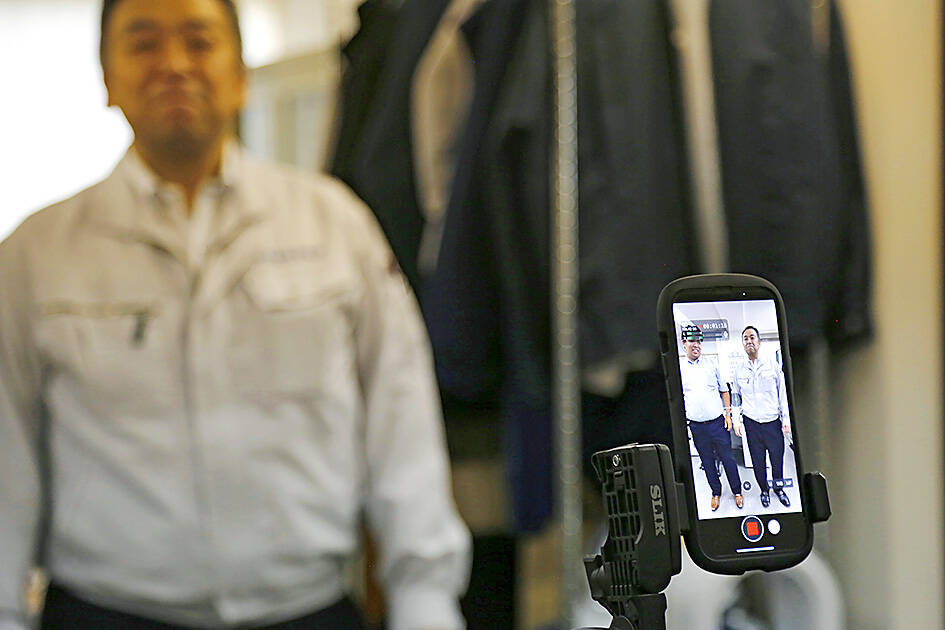
Photo: AP
It’s not a job that requires overly special skills, but no one wants to stand around outdoors for hours. As many as 99 security companies are fighting over every recruit, in contrast to two potential employers for office clerks, Sakurai said. And this is in rapidly aging Japan, where every sector is suffering a labor shortage.
So why not turn to social media, the place where youngsters supposedly flock? Sakurai started posting on Twitter and Instagram. But it was when he went on TikTok that things went viral.
In a hit segment, General Manager Tomohiko Kojima slaps, with a flip of his hand, gel sheets, each decorated with the eyes of various comic-book characters, on his boss’s face, right over his eyes.
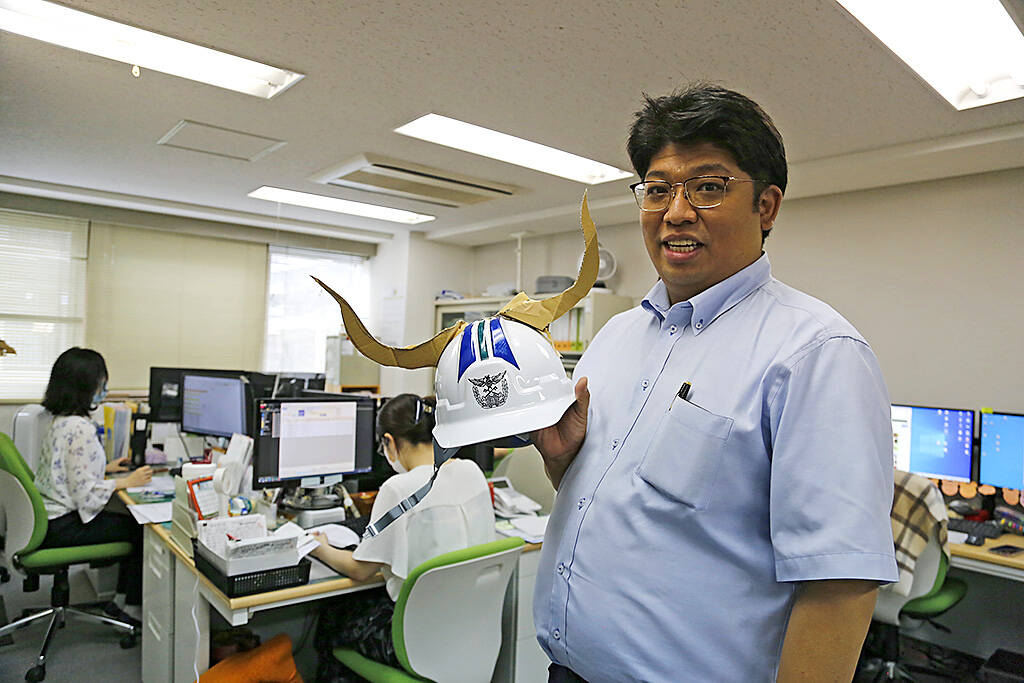
Photo: AP
“What is this character?” the subtitles ask in English.
No cuts are used, they say proudly. Kojima had to keep trying until the strip landed just right. “I don’t practice during my work hours,” he said with a laugh.
The clips have a clear message: They defy the stereotype of rigidly hierarchical, perhaps even oppressive, Japanese companies. At Daikyo, a worker gets to slap gel sheets on the CEO.
Before TikTok, the number of people applying for jobs at Daikyo was zero. After TikTok, the company is getting dozens of applicants, including those of people who want to work on the videos.
Some of the videos, such as one in which the workers cook up a scrumptious omelet, unfold to the sounds of snappy songs, like World’s Smallest Violin by American pop trio AJR.
They all depict the happy yet humble life of uniformed men and women at work who don’t take themselves too seriously.
They are Japan’s good guys. And it’s clear they like each other very much.
Their success contrasts with the image of Japan Inc. as falling behind in digital technology, especially of older men who are fixed in their ways and unable to embrace new technology.
These days, TikTok is flooded with businesses seeking attention, from izakaya pubs and hair salons to taxi companies.
Sakurai has his eyes on global influence now, hoping to draw workers from places like Vietnam and Indonesia, and allowing them to work in English.
And so a recent video features gel sheets with various nations’ flags on them, a clip that has drawn thousands of comments and millions of views.
Slap a flag from Mongolia, and viewers from Mongolia comment in gratitude. Others request their favorite flags, be it Lithuania or Lebanon. It’s a sign TikTok has helped Daikyo overcome language and cultural barriers by simply hamming it up and getting a laugh.
“What makes my job worthwhile is that it’s about people,” Kojima said. “What draws me are people, not things.”

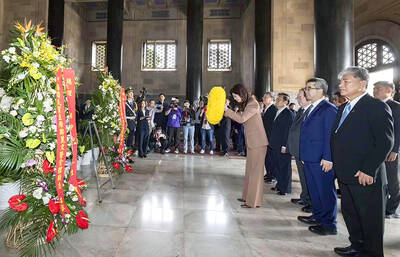
The problem with Marx’s famous remark that history repeats itself, first as tragedy, the second time as farce, is that the first time is usually farce as well. This week Chinese Nationalist Party (KMT) Chair Cheng Li-wun (鄭麗文) made a pilgrimage to the People’s Republic of China (PRC) “to confer, converse and otherwise hob-nob” with Chinese Communist Party (CCP) officials. The visit was an instant international media hit, with major media reporting almost entirely shorn of context. “Taiwan’s main opposition leader landed in China Tuesday for a rare visit aimed at cross-strait ‘peace’”, crowed Agence-France Presse (AFP) from Shanghai. Rare!
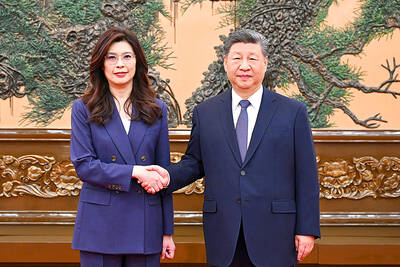
What is the importance within the Chinese Nationalist Party (KMT) of the meeting between Xi Jinping (習近平), the leader Chinese Communist Party (CCP), and Cheng Li-wun (鄭麗文), the leader of the KMT? Local media is an excellent guide to determine how important — or unimportant — a news event is to the public. Taiwan has a vast online media ecosystem, and if a news item is gaining traction among readers, editors shift resources in near real time to boost coverage to meet the demand and drive up traffic. Cheng’s China trip is among the top headlines, but by no means

A recent report from the Environmental Management Administration of the Ministry of Environment highlights a perennial problem: illegal dumping of construction waste. In Taoyuan’s Yangmei District (楊梅) and Hsinchu’s Longtan District (龍潭) criminals leased 10,000 square meters of farmland, saying they were going to engage in horticulture. They then accepted between 40,000 and 50,000 cubic meters of construction waste from sites in northern Taiwan, charging less than the going rate for disposal, and dumped the waste concrete, tile, metal and glass onto the leased land. Taoyuan District prosecutors charged 33 individuals from seven companies with numerous violations of the law. This
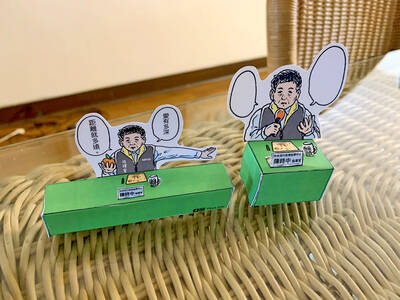
Sunflower movement superstar Lin Fei-fan (林飛帆) once quipped that the Democratic Progressive Party (DPP) could nominate a watermelon to run for Tainan mayor and win. Conversely, the DPP could run a living saint for mayor in Taipei and still lose. In 2022, the DPP ran with the closest thing to a living saint they could find: former Minister of Health and Welfare Chen Shih-chung (陳時中). During the pandemic, his polling was astronomically high, with the approval of his performance reaching as high as 91 percent in one TVBS poll. He was such a phenomenon that people printed out pop-up cartoon


 RSS
RSS