


From making algae-sequin dresses, dyeing clothes with bacteria to planting trackable pigments in cotton, an emerging tide of technological innovations offers the fashion industry a chance to clean up its woeful environmental record.
Change is urgently needed, since the industry consumes 93 billion cubic meters of water per year, dumps 500,000 tonnes of plastic microfibers into the ocean, and accounts for 10 percent of global carbon emissions, according to the Ellen MacArthur Foundation. The growing demands for change have generated ingenious responses, such as New York designer Charlotte McCurdy’s seaweed raincoat.
The shimmering algae-plastic she concocted in a lab made for a striking (and carbon-free) garment, even more so when she teamed up with fashion designer Phillip Lim to make a sequin dress.
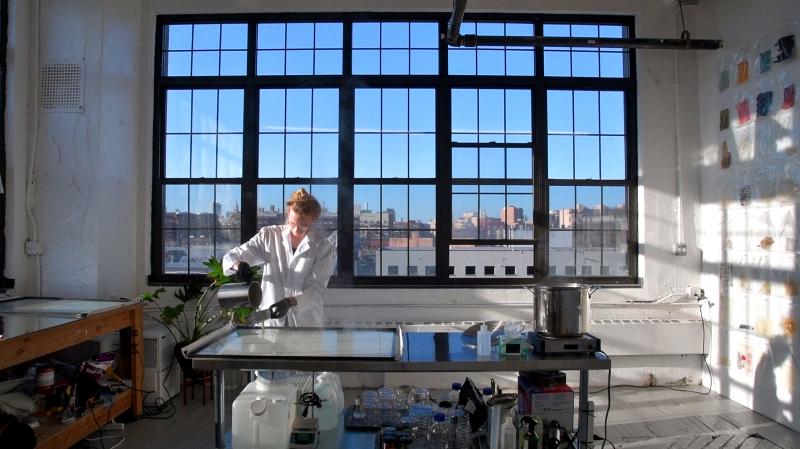
Photo: AFP
They are unlikely to show up in department stores. She sees them more as a way to demonstrate that decarbonized clothes are possible. “I’m not trying to monetize it. I just want to plant a seed,” said McCurdy, whose focus now is on forming an innovation and outreach hub. “Material development is so slow and it’s so hard to compete with cellphone apps for funding. Frankly, I take climate change seriously and I don’t have time.”
BACTERIAL COLORS
Others, like Dutch designers Laura Luchtman and Ilfa Siebenhaar of Living Colour, are finding ways to reduce the toxic chemicals and intensive water consumption of dyeing clothes.
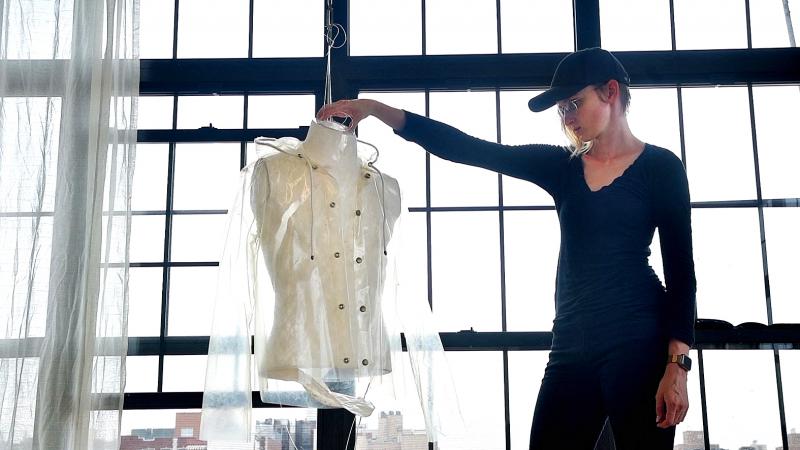
Photo: AFP
They found an unlikely ally in bacteria. Certain micro-organisms release natural pigments as they multiply, and by deploying them on fabric, they dye clothes in striking colors and patterns.
The research is published freely online and the pair have no interest in mass-production.
Luchtman, who previously worked in fast-fashion, saw “up close the negative impact of that industry in terms of exploiting people and ecological problems” and is determined to stay small-scale.
Others, however, hope such ideas can infiltrate big business.
Californian start-up Bolt Threads recently teamed with Adidas, Lululemon, Kering and Stella McCartney to build production facilities for Mylo, a leather made from mushroom roots. McCartney displayed her first Mylo collection in March, and Adidas has promised a Mylo sneaker by the end of the year.
Some experts are skeptical that such initiatives can lead to large-scale transformation.
“Maybe some of these things will get a foothold in the industry, but the bar is very high for new approaches,” warns Mark Sumner, a sustainability expert at the University of Leeds School of Design. “It’s an incredibly diverse industry with thousands of factories and operators all doing different things. It’s not like the car industry where you only have to convince six or seven major companies to try something new.”
Sumner sees the biggest impact coming from improving rather than replacing the existing systems and says pressure from consumers and NGOs means this is already happening.
“Among responsible brands and retailers, this has genuinely moved away from being a fad. They are now considering sustainability as a business imperative,” he said.
Not that there are any right or wrong answers. The sustainability movement’s strength comes from many actors pulling in the same direction.
“Many different strategies need to run together,” said Celine Semaan, founder of the Slow Factory Foundation which supports multiple social and environmental justice initiatives around fashion, including McCurdy’s algae-sequin dress. “Technology won’t resolve the issues on its own. It needs policy, culture, ethics,” Semaan said.
COTTON TRACING
One area many see as a priority, however, is transparency, and here technology has a clear role to play.
Such is the complexity of supply chains that “many companies have no idea where their garments are made, where fabrics come from, who provides their raw materials,” said Delphine Williot, policy coordinator for Fashion Revolution, a campaign group.
Recent uproar over reports that cotton from China’s Xinjiang region was picked by forced labor was compounded by the difficulty of knowing where this cotton ended up. Beijing denies the allegations.
Fibretrace, which won a sustainability award from Drapers magazine this year, offers a possible solution. It implants an indestructible bioluminescent pigment into threads. Any resulting garment can then be scanned like a barcode to find its origins.
“You can’t find the environmental impact of anything unless you know where it was made,” Andrew Olah, Fibretrace’s sales director, said.
Combined with data sites like SourceMap and Open Apparel Registry that give companies unprecedented clarity on their supply chains, it has become increasingly hard to plead ignorance. “When you don’t share your supply chain, you either do it because you’re hiding something or you’re stupid,” said Olah. “There’s a lot of work to do,” he added. “But I’m very optimistic.”

The problem with Marx’s famous remark that history repeats itself, first as tragedy, the second time as farce, is that the first time is usually farce as well. This week Chinese Nationalist Party (KMT) Chair Cheng Li-wun (鄭麗文) made a pilgrimage to the People’s Republic of China (PRC) “to confer, converse and otherwise hob-nob” with Chinese Communist Party (CCP) officials. The visit was an instant international media hit, with major media reporting almost entirely shorn of context. “Taiwan’s main opposition leader landed in China Tuesday for a rare visit aimed at cross-strait ‘peace’”, crowed Agence-France Presse (AFP) from Shanghai. Rare!

What is the importance within the Chinese Nationalist Party (KMT) of the meeting between Xi Jinping (習近平), the leader Chinese Communist Party (CCP), and Cheng Li-wun (鄭麗文), the leader of the KMT? Local media is an excellent guide to determine how important — or unimportant — a news event is to the public. Taiwan has a vast online media ecosystem, and if a news item is gaining traction among readers, editors shift resources in near real time to boost coverage to meet the demand and drive up traffic. Cheng’s China trip is among the top headlines, but by no means

A recent report from the Environmental Management Administration of the Ministry of Environment highlights a perennial problem: illegal dumping of construction waste. In Taoyuan’s Yangmei District (楊梅) and Hsinchu’s Longtan District (龍潭) criminals leased 10,000 square meters of farmland, saying they were going to engage in horticulture. They then accepted between 40,000 and 50,000 cubic meters of construction waste from sites in northern Taiwan, charging less than the going rate for disposal, and dumped the waste concrete, tile, metal and glass onto the leased land. Taoyuan District prosecutors charged 33 individuals from seven companies with numerous violations of the law. This

Sunflower movement superstar Lin Fei-fan (林飛帆) once quipped that the Democratic Progressive Party (DPP) could nominate a watermelon to run for Tainan mayor and win. Conversely, the DPP could run a living saint for mayor in Taipei and still lose. In 2022, the DPP ran with the closest thing to a living saint they could find: former Minister of Health and Welfare Chen Shih-chung (陳時中). During the pandemic, his polling was astronomically high, with the approval of his performance reaching as high as 91 percent in one TVBS poll. He was such a phenomenon that people printed out pop-up cartoon


 RSS
RSS