


Four years ago, doctors presented Leo Huang (黃博煒) with a life-or-death scenario: he could succumb to his injuries, or choose to amputate both legs and his right arm for a five percent chance of survival.
Huang, who suffered over 90 percent burns to his body in a dust explosion at the Formosa Fun Coast (八仙海岸) water park, chose amputation because of his desire to live and his sense of responsibility toward loved ones to treat his life preciously. Yet after his story appeared in the media, he was criticized by the public for making a selfish choice.
“Many people thought that once I became [an amputee], I would become a burden to my family, and I would rely on people for the rest of my life,” Huang, now 27, tells the Taipei Times.
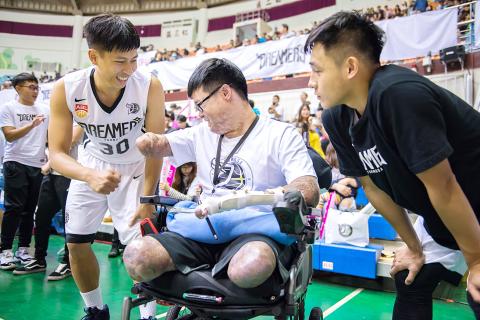
Photo courtesy of Leo Huang
On June 27, 2015, Huang was at a party at the water park in New Taipei City when colored cornstarch that organizers were spraying on the crowd erupted in flames. The blaze claimed 15 lives and injured 484 people.
Those lucky enough to survive the explosion have lifelong journeys of rehabilitation and reintegration ahead of them. But compared to other burn victims, survivors of the Formosa Fun Coast disaster bear a unique and additional burden — of social stigma and victim-blaming.
Survivors are treated “like they’ve committed a sin” because of the perception that they were idle youths intent on partying, says Lai Hsiu-wen (賴秀雯), social worker and director of a rehabilitation center run by the Sunshine Social Welfare Foundation for burn victims, which assisted 403 survivors of the blast.

Photo: Davina Tham, Taipei Times
“The public places a huge label on them. They think that anyway, since you like to play, you deserve [to get injured],” Lai elaborates.
This prejudice manifests in abusive comments online as well as in person. The stigma is so strong that during job interviews, some survivors avoid mentioning their connection to the Formosa Fun Coast disaster in order not to hurt their chances of getting hired.
Seizing a new lease on life, survivors must summon an iron will to overcome social barriers and adapt to their changed bodies.
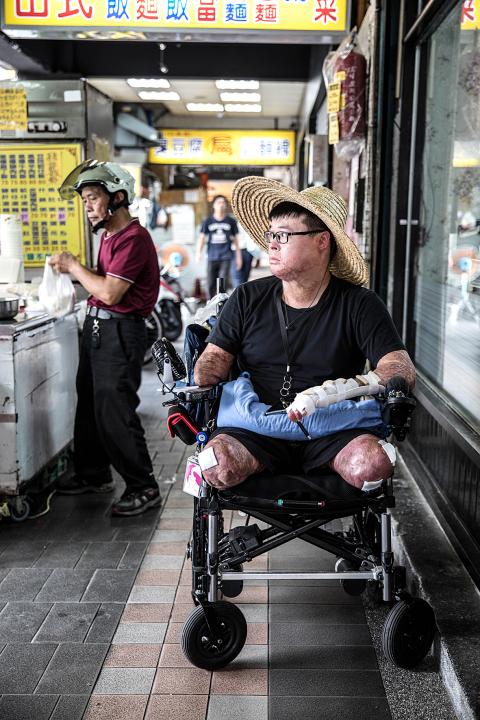
Photo: Chen Chu-jui
A CYNICAL SOCIETY
Aside from accusations of feckless partying, the public has found other ways to vilify victims and their families.
In November 2017, the families of 10 people killed in the explosion filed for government compensation of NT$12 million (US$385,662) for each death.
The lawsuit followed a May 2016 report by the Control Yuan that criticized the Tourism Bureau, New Taipei City Government and National Property Administration for lapses in management of the water park prior to the disaster.
Victims and families have yet to receive any compensation from either Lu Chung-chi (呂忠吉) — the event organizer now serving a five-year prison sentence for negligence — or the state. But many detractors took the opportunity to accuse survivors of trying to enrich themselves from public coffers.
When Chen Po-an (陳柏安) was arrested for taking ketamine and fighting, media reports and online commenters fixated on his status as a survivor of the explosion, insinuating that people who go on to do bad things might as well be left to die.
“Our society is very strange, we use a single label of ‘Formosa Fun Coast’ to encompass all. So when one person does something wrong, then it’s, ‘Ah, it’s one of you,’” Lai says.
Each anniversary of the disaster tends to renew media attention toward survivors. Yet because of past abusive comments from the public, many now refuse interview requests.
Some survivors even deliberately skip town during the anniversary to avoid getting sucked into a toxic cycle, says Paula Liao (廖姝婷), communications manager at Sunshine Social Welfare Foundation.
“They feel that once the media reports come out, they’re followed by a barrage of comments from people saying some not very nice things,” Liao explains. “They do not want to be drawn into waves of emotional upheaval again.”
While many young people were injured in the water park that day, it takes a cynical leap of logic to conclude that they were chronic, irresponsible partygoers.
Like most people on a Saturday evening, the victims were ordinary men and women on a fleeting break from busy lives. And they have shown a remarkable ability to harness strength in unfortunate circumstances.
SURVIVORS WHO THRIVE
A high school graduation trip with friends was what brought Megan Loy to Formosa Fun Coast that summer.
“We just thought it’d be fun, because we’d never been to this kind of party before,” the Singaporean says. It was supposed to be an opportunity for the studious teenager to “step out of [her] comfort zone” after months of hard work for exams.
Loy suffered burns on 40 to 50 percent of her body. After a medical evacuation home, she remained in the hospital for four months — a period she now calls her “four-month hospital internship.”
Loy, now 22, credits that experience with giving her the conviction to pursue a career in medicine. The aspiring doctor had already submitted applications to medical school before the incident, but was lacking a sense of vocation.
In the hospital, Loy saw up-close what a physician’s job entailed and pestered hers with questions. But what made the biggest impression was experiencing firsthand “how precious the doctor-patient relationship was.”
“You don’t really know how happy your patient is to see you as a doctor, or how much trust they put in you,” Loy says. “I felt so much joy. Every morning I would wake myself out of bed just to wait [for them].”
Despite being told that it would be five years before she could go back to school, Loy stubbornly restarted her college applications not long before her discharge.
A lingering effect of the blaze are the scars on Loy’s hands, which she and her physicians have managed so that she may retain the dexterity to perform surgeries in the future.
Coming full circle, the third-year medical student hopes to become a burns specialist, and even chose to carry out her overseas clinical rotation at the National Taiwan University Hospital this year.
Living outside of Taiwan, Loy was insulated from most media coverage and public commentary on the explosion and its survivors.
Not so for Huang, one of the few survivors who continues to speak to media about the disaster. The former engineer is unfazed by critics, whose insults are puny compared to the effort he has exerted to get to where he is today.
In addition to the amputations, Huang has lost almost all function in his remaining left arm. He gets around on a motorized wheelchair most days, and retains scars on his face, neck, arms and legs.
While queueing at his favorite fried chicken stall, another customer once asked Huang to go away so that her child wouldn’t be frightened by his appearance. Huang thought about it, and replied that he would be on his way as soon as he collected his food.
If this sounds like resignation, that’s because Huang chooses a different response to incivility and ignorance, and he applies it equally online.
“Do I really need to reply to these comments on the Internet?” Huang asks. “If I handle myself well... it will shut them up. I don’t need to argue directly with them.”
After relearning how to type, Huang wrote a book about his experience, titled Alive (但我想活) and published in 2017. He is carving out a career as an author and motivational speaker, with another book in the works.
He craves independence, and his goal this year is to start living on his own. Huang has already moved out of his family home and is working on reducing his reliance on a domestic helper to the barest of household chores.
He believes that this determination to live his best possible life is what will have a lasting impact on his detractors.
About a year ago, someone who used to attack Huang online sent him a private message on social media to apologize.
After watching a report on Huang’s story, the attacker told Huang he “felt he should not have hurled abuse at us based on prejudice, when there are actually so many [survivors] working hard and even living so well now.”
The person added that if he ever came across another survivor, “he would not go straight to insults, but would choose to first understand.”
“It felt like I had imperceptibily changed another person, that even if I did not make any response, I could convince others by just quietly doing my own thing,” Huang says.

By global standards, the traffic congestion that afflicts Taiwan’s urban areas isn’t horrific. But nor is it something the country can be proud of. According to TomTom, a Dutch developer of location and navigation technologies, last year Taiwan was the sixth most congested country in Asia. Of the 492 towns and cities included in its rankings last year, Taipei was the 74th most congested. Taoyuan ranked 105th, while Hsinchu County (121st), Taichung (142nd), Tainan (173rd), New Taipei City (227th), Kaohsiung (241st) and Keelung (302nd) also featured on the list. Four Japanese cities have slower traffic than Taipei. (Seoul, which has some

In our discussions of tourism in Taiwan we often criticize the government’s addiction to promoting food and shopping, while ignoring Taiwan’s underdeveloped trekking and adventure travel opportunities. This discussion, however, is decidedly land-focused. When was the last time a port entered into it? Last week I encountered journalist and travel writer Cameron Dueck, who had sailed to Taiwan in 2023-24, and was full of tales. Like everyone who visits, he and his partner Fiona Ching loved our island nation and had nothing but wonderful experiences on land. But he had little positive to say about the way Taiwan has organized its

Michael slides a sequin glove over the pop star’s tarnished legacy, shrouding Michael Jackson’s complications with a conventional biopic that, if you cover your ears, sounds great. Antoine Fuqua’s movie is sanctioned by Jackson’s estate and its producers include the estate’s executors. So it is, by its nature, a narrow, authorized perspective on Jackson. The film ends before the flood of allegations of sexual abuse of children, or Jackson’s own acknowledgment of sleeping alongside kids. Jackson and his estate have long maintained his innocence. In his only criminal trial, in 2005, Jackson was acquitted. Michael doesn’t even subtly nod to these facts.
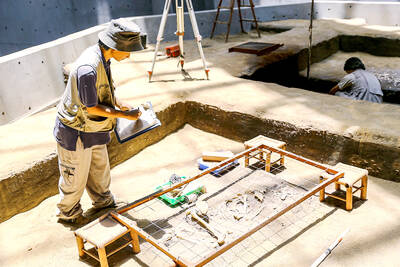
Writing of the finds at the ancient iron-working site of Shihsanhang (十 三行) in New Taipei City’s Bali District (八里), archaeologist Tsang Cheng-hwa (臧振華) of the Academia Sinica’s Institute of History and Philology observes: “One bronze bowl gilded with gold, together with copper coins and fragments of Tang and Song ceramics, were also found. These provide evidence for early contact between Taiwan aborigines and Chinese.” The Shihsanhang Web site from the Ministry of Culture says of the finds: “They were evidence that the residents of the area had a close trading relation with Chinese civilians, as the coins can be


 RSS
RSS