


At the multi-storey Karaoke Kan in the Shimbashi district of Tokyo, it doesn’t matter if you fail to hit the right notes during your rendition of Danny Boy or Never Gonna Give You Up. Likewise, there’s no need to reassure your friends when they murder a classic hit.
That’s because Karaoke Kan is one of a growing number of Japanese businesses catering to ohitorisama, or the solo customer. Inside your karaoke booth for one, no one can hear you scream.
More than a third of Japan’s 53 million households are now occupied by a single person, according to the National Institute of Population and Social Security Research, with the proportion expected to rise to around 40 percent by 2040.
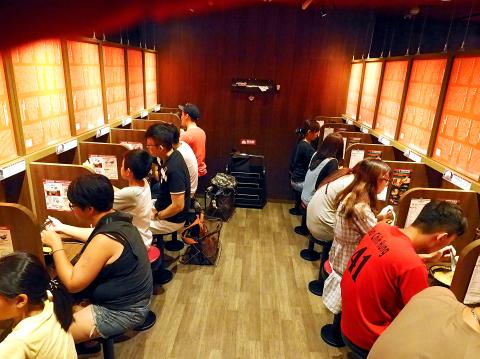
Photo: EPA
The rise of singledom has spawned its own industry — catering not just for the 18 million Japanese living alone, but also for married and cohabiting people who crave time away from their partners, workers who want to escape from colleagues during their lunch break and, yes, amateur crooners struggling with their falsetto.
All are united by the desire for temporary liberation from peer pressure that, according to some experts, has been exacerbated by the demands of social media.
“Our data shows sociable individuals tend to seek solo activities,” Motoko Matsushita, a senior consultant at the Nomura Research Institute, told AFP.
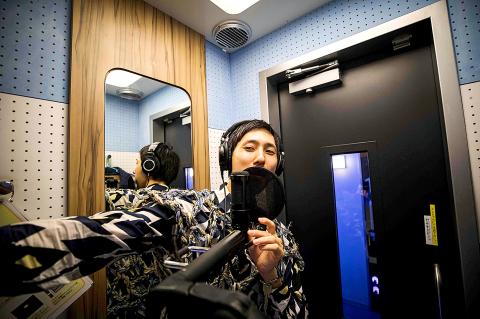
Photo: AFP
The trend is being fueled in part by changes in Japanese society created by the decline of the traditional family unit, in which two, and often three, generations lived under the same roof.
Government data shows the ratio of households with parents and children is gradually shrinking as fewer adults form long-term relationships. In 1980, just one in 50 Japanese men had never been married by their 50th birthday, and one in 22 women. Now that status applies to one in four men and one in seven women.
Few places in Tokyo encapsulate the solo lifestyle more than Ichiran, a chain of ramen restaurants where diners eat alone, largely uninterrupted by staff and out of sight of their fellow diners.
At the restaurant’s Shimbashi branch, interaction with other humans was kept to a minimum when the Guardian visited.
The first step was to buy a ticket for a portion of ramen from a vending machine. Then, a flashing blue light indicated a seat had become available at the far end of a counter divided into 10 booths by wooden partitions. A member of staff appeared, placed a bowl of steaming noodles on the table and lowered a slatted blind as he walked away. With just enough elbow room either side to manipulate the chopsticks, customers ate in near-isolation.
The ohitorisama phenomenon isn’t confined to dining out and singing karaoke. An array of businesses, from bowling alleys to travel agencies, now welcome solo customers in settings that traditionally cater to groups. They can reserve partitioned seats at cinemas and jump the queue for popular rides at theme parks.
“Businesses are offering various goods and services in response to the trend for people to enjoy activities alone,” Matsushita said. “The depth and range of these services is a reflection of the expanding nature of that trend.”
At Karaoke Kan, there was time for one last song before the hour-long session ended. The Guardian settled on the 1970s Eric Carmen hit — All by Myself — but soon realized that something wasn’t quite right; because for one precious hour on a freezing afternoon in a city of almost 14 million people, the song’s chorus, “don’t wanna be all by myself,” couldn’t have been further from the truth.
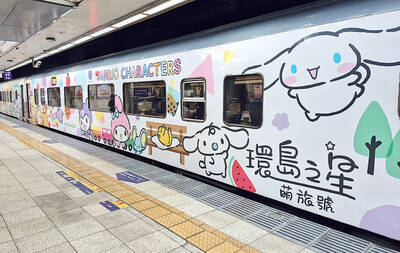
Just after 6am, I walked up to the ticket gate at Taipei Main Station and entered the Taiwan Railway platform without scanning any ticket; instead, I flashed the Sanrio Fun Rail pass on my phone to the gate worker and was admitted. I found my train and prepared to board. My destination? This very same station. I was embarking on a 13-hour journey on one of two round-the-island trains operated by ezTravel. They run each day, one counterclockwise around the island and one clockwise. They differ in a number of ways from an ordinary Taiwan Railway train and can make for
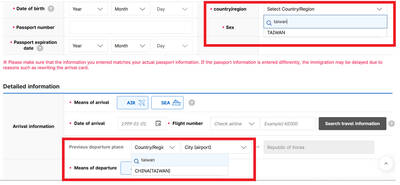
Jason Han says that the e-arrival card spat between South Korea and Taiwan shows that Seoul is signaling adherence to its “one-China” policy, while Taiwan’s response reflects a reciprocal approach. “Attempts to alter the diplomatic status quo often lead to tit-for-tat responses,” the analyst on international affairs tells the Taipei Times, adding that Taiwan may become more cautious in its dealings with South Korea going forward. Taipei has called on Seoul to correct its electronic entry system, which currently lists Taiwan as “China (Taiwan),” warning that reciprocal measures may follow if the wording is not changed before March 31. As of yesterday,

The Portuguese never established a presence on Taiwan, but they must have traded with the indigenous people because later traders reported that the locals referred to parts of deer using Portuguese words. What goods might the Portuguese have offered their indigenous trade partners? Among them must have been slaves, for the Portuguese dealt slaves across Asia. Though we often speak of “Portuguese” ships, imagining them as picturesque vessels manned by pointy-bearded Iberians, in Asia Portuguese shipping between local destinations was crewed by Asian seamen, with a handful of white or Eurasian officers. “Even the great carracks of 1,000-2,000 tons which plied

On Thursday, former Taipei mayor and founder of the Taiwan People’s Party (TPP) Ko Wen-je (柯文哲) was sentenced to 17 years in prison and had his civil rights suspended for six years over corruption, embezzlement and other charges. Seven others related to the case were also handed prison sentences, while two were found not guilty. It has been a bad week for the TPP. On Tuesday, prosecutors charged Chinese immigrant Xu Chunying (徐春鶯) with suspicion of taking part in Beijing-directed election interference. Xu has strong links to the TPP, which once offered her a party list legislator nomination. Tuesday also


 RSS
RSS