


Children entering a hut in a suburb of Zimbabwe’s capital gaze in wonder at objects foreign to them — ancient farm tools, pottery, even the grass roof and reed mats on which they are asked to sit.
A bespectacled elderly woman claps her hands to get their attention and tells them gripping tales with words and songs about animals, folklore and supernatural beings.
Hatifari Munongi, a poet, storyteller and retired schoolteacher, has built a replica traditional homestead at her property in the suburb of Marlborough in Harare.
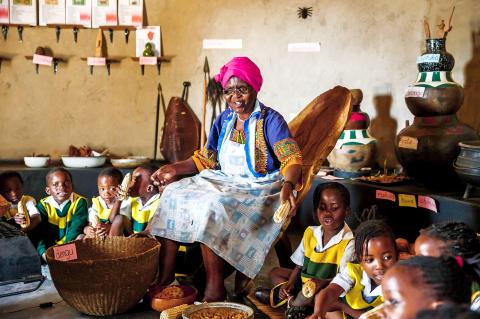
Photo: AFP
She was inspired to set up the miniature village after chatting with local children.
“I would ask a child about nhodo and they would stare at me with a blank face,” she said, referring to a game of counting pebbles in and out of a small pit in the ground, which was beloved by generations of Zimbabweans.
“It was all foreign to them. For me that was not a good sign,” she said, explaining how it spurred her “to do something to rescue our disappearing culture and traditions.”
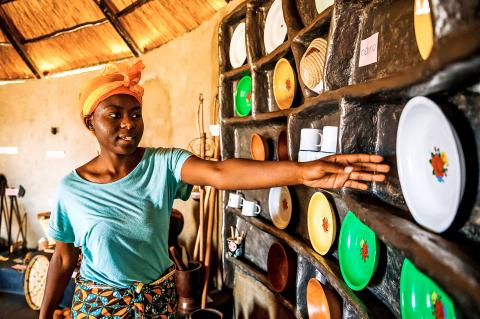
Photo: AFP
So Munongi, 80, used savings from her teaching career to build the homestead as a repository for indigenous knowledge and the country’s rich cultural heritage.
LOST LIFESTYLE
Finished last year, its circular walls and grass roof stick out among the surrounding modern brick and tile-roofed houses.
Inside she teaches children about a lifestyle that is either already lost or increasingly under threat due to rapid urbanization that has seen Harare’s population boom from 615,000 in 1980 to well over two million today.
“The idea was to give urban children an idea of how African people lived before and now,” Munongi said.
“Children in urban areas did not know a lot of things. This place is open for early childhood classes, primary school, secondary school, college and university students. There is a lot for them to learn.”
Adults pay US$3 and children US$1 to visit the homestead, which consists of the round hut, a cattle pen and a rabbit run.
There is also a simple replica of a traditional men’s court — stools and logs arranged in a circle for men to discuss village business around a fire.
On a clay platform inside the hut are artifacts including a hatchet, a club, a spear, a sword, a bow and arrows next to a cowhide drum, shakers, the marimba and other traditional music instruments.
Shelves along the walls display plates and other kitchen utensils neatly arranged above a set of pots.
Munongi, known as gogo (grandmother) by visitors, is something of a celebrity in Zimbabwe after she gained a degree in sociology, gender and development studies in 2016 at the age of 78.
Next she hopes to host cultural events such as traditional marriage ceremonies where the groom’s representatives negotiate the bride price with her family.
“I would like to urge all young children to visit,” said Tafadzwa Mawire, 10.
“They have an opportunity to eat roasted maize, they will play traditional games and listen to folk stories told by a grandmother.”
Hundreds of children have already visited Munongi’s project and she hopes that it will become part of every young Harare resident’s education.
Her granddaughter Vimbai Gudza, a 23-year-old with a biochemistry degree, helps out at the project as she searches for a job in Zimbabwe, where the economy has been in the doldrums for 20 years.
‘SO NOSTALGIC’
“There are things I couldn’t do before that I now can do, for example pounding grain into flour with a pestle and mortar,” she said, demonstrating her new skills.
“As someone who grew up in town, participating in the activities at the village is a learning experience as well for me.”
Project assistant Chipo Mautsire, who grew up in the rural district of Masvingo, uses her experience to winnow grain.
“Having grown up in a village myself I know what village life is like,” Mautsire said.
“There are many things children of today don’t know about like the fact that a child should kneel when greeting elders.”
Munongi’s niece Viola Rupiza was awestruck when she arrived home from a 14-year stint in Britain and visited her aunt’s village-in-the-city.
“I was so impressed. The village is so real. It reminded me of our visits to the rural home. It was so nostalgic,” she said.

The Directorate-General of Budget, Accounting and Statistics (DGBAS) told legislators last week that because the Chinese Nationalist Party (KMT) and Taiwan People’s Party (TPP) are continuing to block next year’s budget from passing, the nation could lose 1.5 percent of its GDP growth next year. According to the DGBAS report, officials presented to the legislature, the 2026 budget proposal includes NT$299.2 billion in funding for new projects and funding increases for various government functions. This funding only becomes available when the legislature approves it. The DGBAS estimates that every NT$10 billion in government money not spent shaves 0.05 percent off
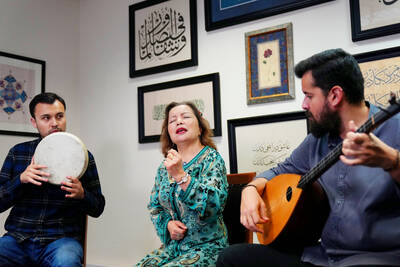
It is a soulful folk song, filled with feeling and history: A love-stricken young man tells God about his hopes and dreams of happiness. Generations of Uighurs, the Turkic ethnic minority in China’s Xinjiang region, have played it at parties and weddings. But today, if they download it, play it or share it online, they risk ending up in prison. Besh pede, a popular Uighur folk ballad, is among dozens of Uighur-language songs that have been deemed “problematic” by Xinjiang authorities, according to a recording of a meeting held by police and other local officials in the historic city of Kashgar in

Dec. 29 to Jan. 4 Like the Taoist Baode Temple (保德宮) featured in last week’s column, there’s little at first glance to suggest that Taipei’s Independence Presbyterian Church in Xinbeitou (自立長老會新北投教會) has Indigenous roots. One hint is a small sign on the facade reading “Ketagalan Presbyterian Mission Association” — Ketagalan being an collective term for the Pingpu (plains Indigenous) groups who once inhabited much of northern Taiwan. Inside, a display on the back wall introduces the congregation’s founder Pan Shui-tu (潘水土), a member of the Pingpu settlement of Kipatauw, and provides information about the Ketagalan and their early involvement with Christianity. Most

The People’s Republic of China (PRC) was out in force in the Taiwan Strait this week, threatening Taiwan with live-fire exercises, aircraft incursions and tedious claims to ownership. The reaction to the PRC’s blockade and decapitation strike exercises offer numerous lessons, if only we are willing to be taught. Reading the commentary on PRC behavior is like reading Bible interpretation across a range of Christian denominations: the text is recast to mean what the interpreter wants it to mean. Many PRC believers contended that the drills, obviously scheduled in advance, were aimed at the recent arms offer to Taiwan by the


 RSS
RSS