


Decades ago, at the height of the Cold War, the Soviet Union jealously guarded its famed ballet dancers, aware of the promotional value of tours by the Bolshoi Ballet and the then-Kirov Ballet, but fearful of defections by dancers eager to escape the artistic restrictions imposed by the government’s cultural censors.
All that began to change with Soviet leader Mikhail Gorbachev’s glasnost policy of increased openness in the late 1980s, which led to greater artistic freedom and the creation of several new troupes that were able capitalize on the rich history of Russian classical ballet and make extensive tours abroad, such as the Russian Festival Ballet — now known as the Russian National Ballet Theater, and the Moscow City Ballet, as well relative newcomers like the Royal Moscow Ballet.
Sometimes it is hard to keep track of the companies, given the similarities of the names.

Photo Courtesy of Moscow Classical Ballet
However, the history of the Moscow Classical Ballet, which opens at the National Theater in Taipei today, dates back to 1966, when it was founded as the State Academic Classical Ballet Theater under the Ministry of Culture, with Igor Moiseyev as artistic director.
The idea was to have a contemporary classical company that would present new works. The experiment did not last too long, as Yuri Zhdanov, who took over as director in 1971, began to add pieces from the 19th century golden era of Russian ballet. The troupe was also renamed the Classical Ballet.
Six years later, the husband and wife team of Vladimir Vasilyov and Natalia Kasatkina moved to the company from the Bolshoi Ballet to take up the roles of artistic director and principal choreographer respectively.
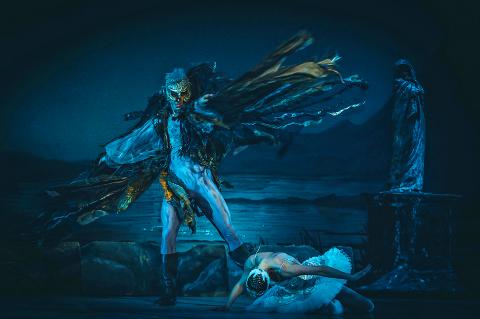
hoto Courtesy of Moscow Classical Ballet
Under their leadership and with a new name, the company not only began to tour internationally, it developed a reputation for international collaboration while maintaining the standards of Russian classical ballet. It also became the launch pad for several dancers who went on to have careers with companies such as the Royal Ballet and the American Ballet Theater.
While Vasilyov died in August last year at the age of 86, Kastkina continues to lead the company.
The Vasilyov-Kastkina production of Swan Lake was one of their early international forays and made history, at least by Russian ballet standards, by being a joint Russian-English production, created for a tour of the UK in 1988.
Well-known British theatrical designer Tim Goodchild was hired to do the sets, while his compatriot Kim Baker designed the costumes.
While Vasilyov and Kastkina kept to 1917 Swan Lake revival choreographed by Maris Petipa and Lev Ivanov, they included later elements added to the Bolshoi’s version by Alexander Gorsky and Asaf Messerer, which became known as the “Old Moscow” version. They also added some of their own choreography, especially in Act I.
Their flock of swans might be smaller than normal, but are no less impressive in the key scenes.
Perhaps to please their original UK audiences used to “united in death” endings seen in Western versions of Swan Lake, Vasilyov and Kastkina departed from the standard Soviet “happy ending” that sees Prince Siegfried kill the evil sorcerer Von Rothbart to free the swan queen Odette from his curse so they can live happily ever.
In their three-act version — spoiler alert — Siegfried and Rothbart kill each other and Odette dies, falling onto her prince’s body, while the rest of the swan maidens go free. .
One of the problems with the smaller Russian ballet troupes that are heavily dependent on international touring is that although the overall quality of the dancers — all graduates of top schools in Russia and former Soviet allies — they are also heavily dependent on a few star names.
The promotional material for the Taipei shows list just three principals, Marina Rzhannikova as Odette/Odile, Artem Khoroshilov as Siegried and Alexey Orlov as Von Rothbart; there is no way to tell who else might be dancing the leads for each of the five shows.
While Rzhannikova appears to be a strong dancer, it is unlikely her feet, not to mention the rest of her body, could survive five straight shows as Odette/Odile, including the two per day on Saturday and Sunday, but anything is possible.
Performance notes
WHAT: Swan Lake
WHEN: Tomorrow, Saturday and Sunday at 7:30pm, matinees on Saturday and Sunday at 2:30pm
WHERE: National Theater (國家戲劇院), 21-1 Zhongshan S Rd, Taipei City (台北市中山南路21-1號)
ADMISSION: NT$800 to NT$5,000; available at tickets.udnfunlife.com/application/UTK02/UTK0201_.aspx?PRODUCT_ID=N00D0M30 or at convenience store ticketing kiosks.

Ajay Verma, a consultant gastroenterologist at Kettering general hospital in Northamptonshire, says our gut is a “complex machine.” “It is constantly providing us with the nutrition we need, initially to grow and develop, and then for us to survive, thrive and repair from injury and illness.” How can we keep it functioning well? Put simply: “Make sure what you put into it is balanced, and that you clear out its waste products adequately,” Verma says. “In a general gastroenterology clinic, the most common conditions we see are irritable bowel syndrome (IBS), gastroesophageal reflux disease, inflammatory bowel disease and constipation,” says Nisha
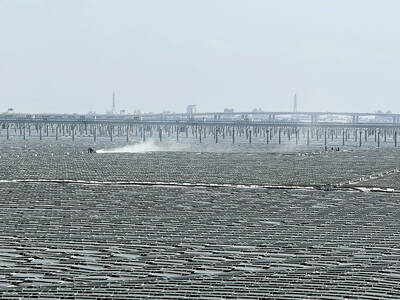
The arithmetic is straightforward and uncomfortable. By the end of 2025, Taiwan had committed itself to a 50-30-20 electricity mix — half natural gas, 30 per cent coal, 20 per cent renewables. The Ministry of Economic Affairs’s (MOEA) own monthly energy reports tell a different story. Natural gas reached 47.8 per cent of generation last year. Coal stood at 35.4 per cent, comfortably above its target ceiling. Renewables came in at 13.1 per cent, well short of the 20 per cent Taipei had pledged a decade earlier. Installed renewable capacity reached roughly half of the 12 gigawatts (GW) the government

Last week US President Donald Trump was asked by a reporter whether he would speak on the phone to the President of Taiwan. “l’ll speak to him. I speak to everybody. We have that situation very well in hand,” Trump said. This marked the second time in a couple of weeks he had said he would talk to the President of Taiwan. In 2016 he famously took a call from then-president Tsai Ing-wen (蔡英文), when he was president-elect. Despite warnings that the apocalypse was nigh because of a phone call, the world quickly forgot about the conversation between two democratically-elected presidents.
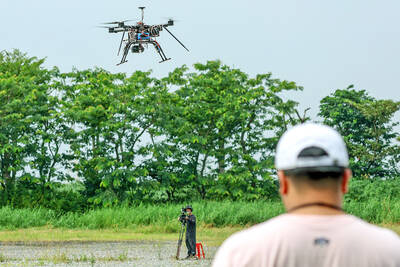
Taiwan’s drone exports are taking off, fuelled by the war in Ukraine, as Taiwanese companies seek a stake in the fast-growing global market for unmanned aerial vehicles (UAV). Low-cost drones used for reconnaissance and strikes are in high demand as governments around the world boost defense spending in the face of intensifying conflicts. A relative new player in the increasingly competitive industry, Taiwan’s pitch is to be an “Asian hub” for the production of UAVs and components free of Chinese materials, or “non-red.” That means its UAVs can be up to three times more expensive than their Chinese competitors, like the world’s biggest


 RSS
RSS