


With its dystopian story of racial exploitation behind the veneer of modern America, Sorry to Bother You, the first movie by the rapper Boots Riley, is showing the fresh vitality in African American cinema.
The movie, which hits US theaters tomorrow, comes a year after the runaway success of Get Out, the first feature film by Jordan Peele about a town of wealthy white people who conspire to implant themselves into African American bodies.
Sorry to Bother You, also made on a small budget, marks a new outlet for the militant voice of Riley, best known as the frontman of The Coup, the politically engaged and critically praised hip-hop group.

Photo: AP
With echoes of science-fiction classic Metropolis, the film focuses on exploitation at a telemarketing firm, whose workers are crammed into the basement as executives work on floors above them in vast rooms bathed in light.
Separating them is an elevator, which becomes the setting for several comical scenes. The hero Cassius — played by Lakeith Stanfield, who also starred in Get Out — can only ascend in the elevator, and the symbolic social ladder, as he switches into a “white voice.”
NEW SETTINGS FOR RACE
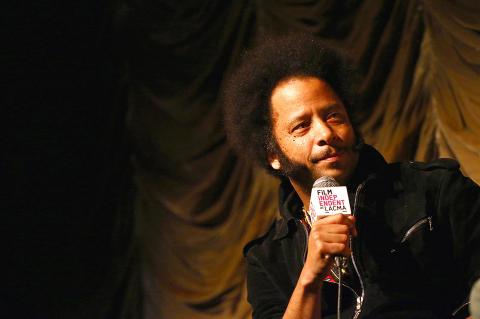
Photo: AFP
Much like Get Out, set in a placid town where the villain is said to have voted for Barack Obama, Sorry to Bother You shines a light not on police brutality or other more obvious issues in Donald Trump’s America but instead looks at racism in ostensibly safe confines.
In Sorry to Bother You, the CEO of fictitious corporation WorryFree reflects the worst traits of a Silicon Valley executive, a visionary who dreams of uber-workers who are half-human, half-horse.
Riley — the son of Chicago labor activists who has spent his life on the fringes of Silicon Valley in Oakland, California — searched for several years to find an audience for his screenplay. He first turned Sorry to Bother You into a 2012 album by The Coup which merged rap delivery with live orchestration.
The 47-year-old first-time director said it was an uphill battle to be taken seriously in film.
It’s “as difficult as it would be if your favorite saxophone player said he wanted to build your house. You are a musician with a script — who wants to read that?” he said.
The film pays tribute to several social movements of recent years including Black Lives Matter and Occupy Wall Street, in which Riley was active.
It is too early to tell if Sorry to Bother You, which won acclaim at the Sundance Film Festival in January, will see the same success as Get Out — let alone Black Panther, the much-larger budget film from Marvel about an African super-hero that has quickly become one of the highest-grossing movies of all time.
But cast members are saluting the rise of such films as proof that, some 30 years after the breakthrough of Spike Lee’s racial drama Do the Right Thing” African American cinema is dynamic, original and nuanced.
Tessa Thompson, who plays Cassius’ girlfriend Detroit in Sorry to Bother You, voiced hope that more movies would follow, saying that black cinema’s problem had never been a lack of talent.
“It really has to do with a lack of opportunity and a perceived lack of an audience. What you see with Get Out is that there is an audience for it — and the audience, by the way, is not just black,” said Thompson, whose previous films have included 2014’s historical saga Selma and last year’s action flick Thor: Ragnarok.
Stanfield said that African American films were showing they can be “imaginative and crazy” — and also simply fun.
“You don’t have to come see us talk about our place in America and cry all the time,” he said. “You can leave the theater feeling hopeful, like this film makes me feel, and still talk about the deep things that affect us every day.”

Taiwan’s overtaking of South Korea in GDP per capita is not a temporary anomaly, but the result of deeper structural problems in the South Korean economy says Chang Young-chul, the former CEO of Korea Asset Management Corp. Chang says that while it reflects Taiwan’s own gains, it also highlights weakening growth momentum in South Korea. As design and foundry capabilities become more important in the AI era, Seoul risks losing competitiveness if it relies too heavily on memory chips. IMF forecasts showing Taiwan widening its lead over South Korea have fueled debate in Seoul over memory chip dependence, industrial policy and
“China wants to unify with Taiwan at the lowest possible cost, and it currently believes that unification will become easier and less costly as time passes,” wrote Amanda Hsiao (蕭嫣然) and Bonnie Glaser in Foreign Affairs (“Why China Waits”) this month, describing how the People’s Republic of China (PRC) is playing the long game in its quest to seize Taiwan. This has been a favorite claim of many writers over the years, easy to argue because it is so trite. Very obviously, if the PRC isn’t attacking Taiwan, it is waiting. But for what? Hsiao and Glaser’s main point is trivial,

May 18 to May 24 Gathered on Yangtou Mountain (羊頭山) on Dec. 5, 1972, Taiwan’s hiking enthusiasts formally declared the formation of the “100 Peaks Club” (百岳俱樂部) and unveiled the final list of mountains. Famed mountaineer Lin Wen-an (林文安) led this effort for the Chinese Alpine Association (中華山岳協會). Working with other experienced climbers, he chose 100 peaks above 10,000 feet (3,048m) that featured triangulation points and varied in difficulty and character. The list sparked an alpine hiking craze, inspiring many to take up mountaineering and competing to “conquer” the summits. A common misconception is that the 100 Peaks represent Taiwan’s 100 tallest

The Chinese Nationalist Party (KMT), alongside their smaller allies the Taiwan People’s Party (TPP), are often accused of acting on behalf of the Chinese Communist Party (CCP). Some go so far as to call them “traitors.” It is not hard to see why. They regularly pass legislation to stymie the normal functioning of the ruling Democratic Progressive Party’s (DPP) administration, and they have yet to pass this year’s annual budget. They slashed key elements of the government’s proposed NT$1.25 trillion (US$40 billion) special military budget, and in the smaller NT$780 billion package they did pass, it is riddled with provisions that


 RSS
RSS