


There is a scene in the documentary Metal Politics Taiwan where Freddy Lim (林昶佐) tells the Dalai Lama that his wife is pregnant, the first time he had told anyone outside his immediate circle. Lim later insists that director Marco Wilms leave that bit out of the film.
“[Wilms] kept telling me, ‘This is very important to Taiwan and to you, please trust me,’” says Lim, a New Power Party legislator and former lead singer of popular heavy-metal band Chthonic.
For Lim, however, the incident was one of the many times that he lost patience with Wilms throughout the filming.
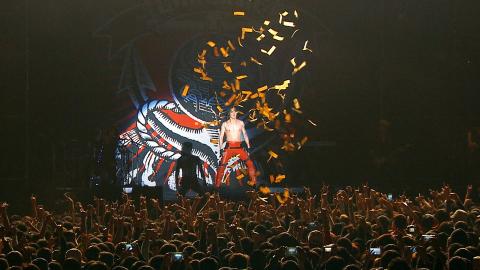
Photo courtesy of Urban Nomad Film Festival
“I thought it was just a television documentary where they would just follow me around for a bit,” he says. “But Marco wanted to capture everything. I angrily told him, ‘I’m a legislator, not an actor!’”
Lim later relented and allowed the scene to appear in the documentary.
“His personality is very suited for documentary making. He’s very persistent. But when I watched the initial cut, I was moved. I’m glad that I have a record of these moments,” Lim says.
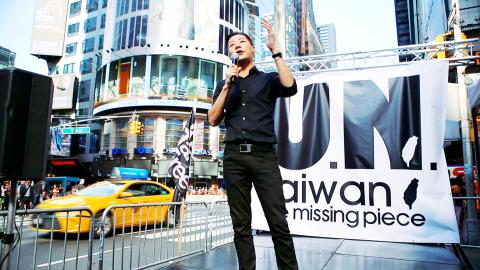
Photo courtesy of Urban Nomad Film Festival
Metal Politics Taiwan will be screened in Taipei on Saturday as part of the Urban Nomad Film Festival. A Q&A session with Wilms will follow the film.
HARD SELL
While Wilms’ last film, Art War, about street artists during the 2011 Arab Spring revolution, received much exposure in Taiwan, he says he could not find any local distributor for his latest documentary featuring Lim. Even Public Television Service turned him down.
“My first reaction when I heard that was, ‘That’s just how Taiwan is,’” Lim says during a post-screening discussion on Monday. “But Marco was shocked. And I started thinking whether I’m reacting too calmly to something that’s clearly not normal.”
Wilms spent a year filming Lim as a politician, recording everything from his casual chatter to impassioned speeches to a trip to Dharmasala for an audience with the Dalai Lama. Originally expecting Lim to be as provocative and aggressive a politician as he was on stage, Wilms found him polite and low-key — one who strives for balance and harmony.
“I keep wondering: why you don’t go for the conflict,” Wilms says, noting that Lim wasn’t even perturbed by pro-unification protesters calling him garbage, instead finding their verbal attacks entertaining.
The resulting film is a montage that moves between Lim’s public and private personas, various interviews and brief sketches of Taiwanese society and its recent political history.
TAIWAN’S COMPLICATED HISTORY
Wilms says Metal Politics Taiwan was much harder to make than Art War. On the surface, it’s a simple story of a heavy metal god turning politician. The challenging task, Wilms says, is explaining Taiwan’s complicated political history and international status to foreign audiences.
“Street art itself is a reflection of many layers of society,” Wilms says. “But Metal Politics Taiwan follows Freddy’s journey, and has to explain everything along the way,” he says.
But a politician’s life is hectic, and often isn’t that interesting. Wilms says about 80 percent of the footage is of Lim making a speech. Luckily, there were visual opportunities in between, such as Lim attending US President Donald Trump’s inauguration, street protests and Lim making a rare return to his rock star persona for the 2016 Tshing Shan Festival (青山祭).
Wilms says that he eventually learned that there are a number of strong supporters of unification with China, the film still revolves around Lim and his pro-Taiwan independence world view.
“I’m doing a movie about characters interesting to me and I create their universe as I see it,” he says. “Freddy told me about his point of view, and I visualize it.”
And to create the final layer, Wilms adds some of his observations of Taiwanese society, especially on social harmony and order. Unlike Germany, he says, people here are normally low-key and non-confrontational, but they’re able to make a big show when given the opportunity on stage (especially during protests), which falls in line with his observations of Lim after a year.
“It’s really hard for me to understand this schizophrenic behavior,” Wilms says. “But for Lim, it’s the same thing. It’s just two sides of one [coin].”
Metal Politics Taiwan will be screened on Saturday followed by a Q&A with the director. Tickets for Saturday’s screening are available at iNDIEVOX.com or at any 7-Eleven ibon kiosk. For the complete list of movies that are being shown until the film festival ends on Sunday, visit: urbannomad.tw.
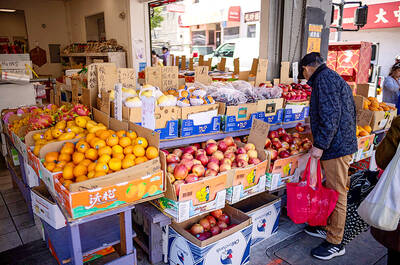
Ajay Verma, a consultant gastroenterologist at Kettering general hospital in Northamptonshire, says our gut is a “complex machine.” “It is constantly providing us with the nutrition we need, initially to grow and develop, and then for us to survive, thrive and repair from injury and illness.” How can we keep it functioning well? Put simply: “Make sure what you put into it is balanced, and that you clear out its waste products adequately,” Verma says. “In a general gastroenterology clinic, the most common conditions we see are irritable bowel syndrome (IBS), gastroesophageal reflux disease, inflammatory bowel disease and constipation,” says Nisha
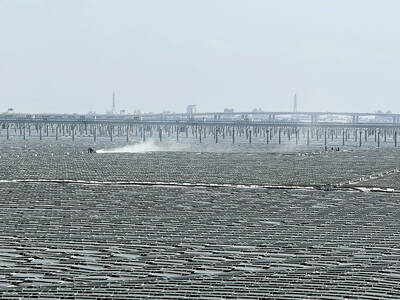
The arithmetic is straightforward and uncomfortable. By the end of 2025, Taiwan had committed itself to a 50-30-20 electricity mix — half natural gas, 30 per cent coal, 20 per cent renewables. The Ministry of Economic Affairs’s (MOEA) own monthly energy reports tell a different story. Natural gas reached 47.8 per cent of generation last year. Coal stood at 35.4 per cent, comfortably above its target ceiling. Renewables came in at 13.1 per cent, well short of the 20 per cent Taipei had pledged a decade earlier. Installed renewable capacity reached roughly half of the 12 gigawatts (GW) the government
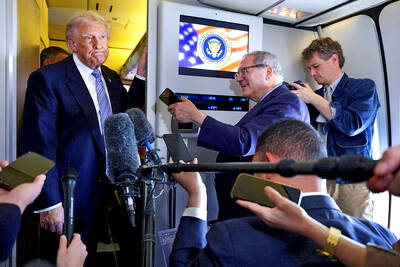
Last week US President Donald Trump was asked by a reporter whether he would speak on the phone to the President of Taiwan. “l’ll speak to him. I speak to everybody. We have that situation very well in hand,” Trump said. This marked the second time in a couple of weeks he had said he would talk to the President of Taiwan. In 2016 he famously took a call from then-president Tsai Ing-wen (蔡英文), when he was president-elect. Despite warnings that the apocalypse was nigh because of a phone call, the world quickly forgot about the conversation between two democratically-elected presidents.
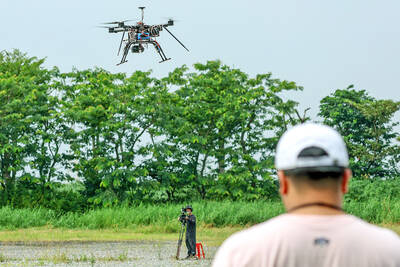
Taiwan’s drone exports are taking off, fuelled by the war in Ukraine, as Taiwanese companies seek a stake in the fast-growing global market for unmanned aerial vehicles (UAV). Low-cost drones used for reconnaissance and strikes are in high demand as governments around the world boost defense spending in the face of intensifying conflicts. A relative new player in the increasingly competitive industry, Taiwan’s pitch is to be an “Asian hub” for the production of UAVs and components free of Chinese materials, or “non-red.” That means its UAVs can be up to three times more expensive than their Chinese competitors, like the world’s biggest


 RSS
RSS