


When Bitfinex CEO Jan Ludovicus van der Velde sat down to chat with financial technology (fintech) legal expert Cheng Shu-kao (鄭旭高) in a cafe in downtown Taipei earlier this year, he was keen on setting up the headquarters for one of the world’s largest cryptocurrency exchanges in the nation’s capital.
But at the end of March, Bitfinex announced it was relocating to Switzerland, after issues with Taiwan’s banks and the vagueness of local regulations led them to look elsewhere.
“We lost out,” Cheng says. “This is why we need a transparent legal framework for crypto.”
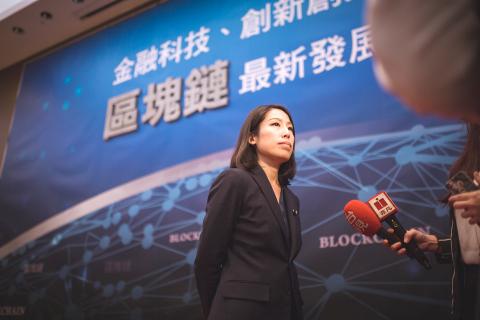
Photo Courtesy of Karen Yu
With the cryptocurrency sector poised to unleash a new wave of innovation in the world of finance, regulators around the world are grappling to create legal frameworks that steer the technology away from facilitating crime and toward powering economic growth. Cheng says Taiwan currently has no clear legal framework for the industry let alone a tax code or measures to combat fraud.
But that is about to change as new regulations are drafted, due to pass the legislature by November. Many involved in the ecosystem, from entrepreneurs to legal consultants, are relieved that the rules are coming, and tell the Taipei Times what laws would provide security as well as growth potential for Taiwan’s fintech future.
STORM IN A SANDBOX
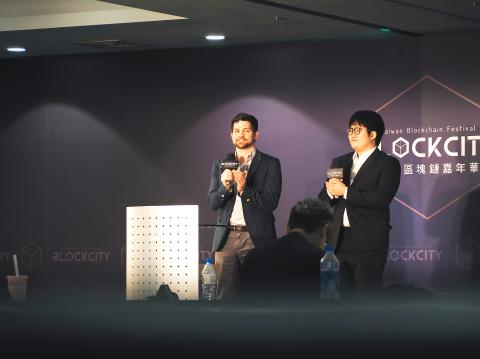
Photo courtesy of Blockcity Festival
The government in December last year passed the Act on Financial Technology Innovations and Experiments (金融科技創新實驗條例), adopting a “sandbox model” that affords legal leeway to fintech firms approved by the Financial Supervisory Commission.
The sandbox model seeks to reduce the time and cost of getting innovative ideas to the market, enabling greater access to finance for innovators while still ensuring appropriate consumer safeguards.
Cheng says the sandbox has been hamstrung by clause 25 of the act, which applies an anti-money laundering framework for enterprises involved.
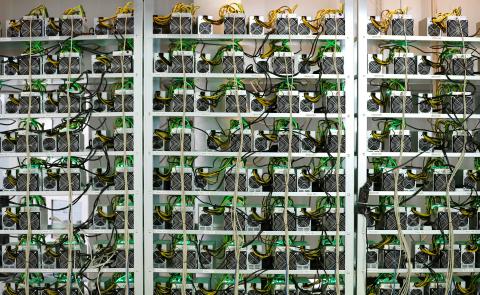
Photo: REUTERS
“This is a contradiction,” he says. “It sends mixed signals to companies and makes it difficult for them to assess the regulatory environment here.”
However, Democratic Progressive Party (DPP) Legislator Karen Yu (余宛如) says that even if clause 25 had not been included, blockchain-based enterprises would still have to comply with anti-money laundering regulations.
“No sandbox is the same,” says Jeremy Firster, co-founder of Taiwan-based Blockcamp, a consultancy and accelerator for blockchain-based startups. Firster says that by their nature sandboxes are legally flimsy and should be seen as a temporary solution for proper market regulation.
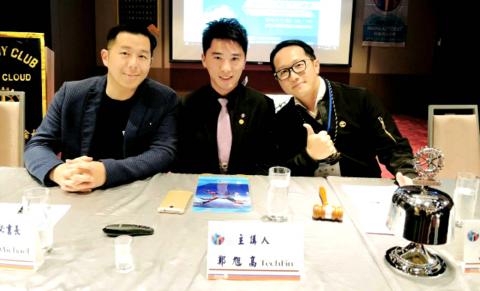
Photo courtesy of Lions Club Taiwan
Yu says lawmakers are yet to set the direction of that regulation, but will propose adopting the nuanced and flexible Swiss model at a public forum on the issue to be held at the end of this month.
THE RIGHT RATE
“Tax makes crypto credible,” Firster says. He adds that the tax code must be used to integrate the sector into the broader economy and not function simply as a government money grab.
Hung Chia-ming (洪嘉銘), marketing manager at MBAEX cryptocurrency exchange, agrees, adding that most in the industry share the view that taxes come with the territory of a good regulatory environment, provided rates don’t suppress the market.
Yet this is exactly what Cheng fears will happen.
By the end of this month, the government will, for the first time, levy taxes on cryptocurrency enterprises. Yet the tax administration has not announced which rate it will levy, leading some to fear it may apply the same rate as the sales tax, five percent.
Cheng says levying a 5 percent tax, which is deducted from the total amount, would discourage large-scale transactions, where profit margins are often a fraction of a percentage point of the transaction’s total value.
“If the government levies such a high rate it will scare off investors,” Cheng says. “We hope they can maintain the current tax-free period of 0 percent, while regulation for the industry is being devised.”
“That won’t happen,” Yu says of the suggestion, adding that such exemptions would be uncharacteristic of the Ministry of Finance.
A spokesperson for the Ministry of Finance told the Taipei Times that the ministry has no comment as it has yet to release a statement on which tax rate they will levy on the industry later this month.
The greater risk, Yu says, is that the high tax will drive the industry further underground.
“This is why an appropriate tax code is so critical to get the industry out of the shadows,” she says.
When it comes to the eventual code itself, Cheng advises the government to offer incentives for long-term investment by levying a higher rate on short term transactions of less than a week.
“This will help combat the market volatility that has become characteristic of crypto,” he says, adding that day trading is largely responsible for the giant price swings.
Firster says that along with the new taxation, the central bank should also begin exchanging cryptocurrencies directly into New Taiwan dollars, as currently traders have to do a double conversion via the US dollar, another inconvenience.
Hung says he hopes that the government will stipulate in law that a certain quota of the tax revenue will be redirected back into developing Taiwan’s fintech industry.
“We need more funds for infrastructure to support the industry as well as courses in schools to educate the next generation about this technology,” he says.
SECURING THE INDUSTRY
Lawmakers must also consider how to identify fraudsters and cybercriminals in the nascent industry, while protecting user privacy.
Hung says MBAEX already conducts vigorous “know-your-customer” background checks on traders who apply to join the exchange.
“It’s like applying for a visa,” he says. “You must provide your photo ID, passport, bank account details and more.”
Hung says such procedures are fast becoming the industry standard, and hopes they will soon be written into law, enabling exchanges to better cooperate with law enforcement in tracking down fraud rings.
Cheng goes a step further in suggesting an inter-exchange network be set up, similar to the Joint Credit Information Center (聯合徵信中心) in the nation’s banking industry. Sharing information, he adds, will lead to early detection of illegal activity by red-flagging suspicious transactions and profiling suspect traders.
Firster says blockchain technology can use zero knowledge proof — a cryptographical procedure that verifies data belongs to an individual without revealing information about that person — to anonymously confirm a trader is not a criminal. He says this will allow for greater security without infringing on privacy.
Yu says the regulation that is being laid down for the cryptocurrency will serve as a blueprint for all blockchain-based developments in Taiwan in the years to come.
“Blockchain is the next paradigm,” Firster says, adding the technology will become the backbone behind the nation’s Internet of Things and “smart” city initiatives — if, that is, it can get the regulations right.

By global standards, the traffic congestion that afflicts Taiwan’s urban areas isn’t horrific. But nor is it something the country can be proud of. According to TomTom, a Dutch developer of location and navigation technologies, last year Taiwan was the sixth most congested country in Asia. Of the 492 towns and cities included in its rankings last year, Taipei was the 74th most congested. Taoyuan ranked 105th, while Hsinchu County (121st), Taichung (142nd), Tainan (173rd), New Taipei City (227th), Kaohsiung (241st) and Keelung (302nd) also featured on the list. Four Japanese cities have slower traffic than Taipei. (Seoul, which has some

In our discussions of tourism in Taiwan we often criticize the government’s addiction to promoting food and shopping, while ignoring Taiwan’s underdeveloped trekking and adventure travel opportunities. This discussion, however, is decidedly land-focused. When was the last time a port entered into it? Last week I encountered journalist and travel writer Cameron Dueck, who had sailed to Taiwan in 2023-24, and was full of tales. Like everyone who visits, he and his partner Fiona Ching loved our island nation and had nothing but wonderful experiences on land. But he had little positive to say about the way Taiwan has organized its

Michael slides a sequin glove over the pop star’s tarnished legacy, shrouding Michael Jackson’s complications with a conventional biopic that, if you cover your ears, sounds great. Antoine Fuqua’s movie is sanctioned by Jackson’s estate and its producers include the estate’s executors. So it is, by its nature, a narrow, authorized perspective on Jackson. The film ends before the flood of allegations of sexual abuse of children, or Jackson’s own acknowledgment of sleeping alongside kids. Jackson and his estate have long maintained his innocence. In his only criminal trial, in 2005, Jackson was acquitted. Michael doesn’t even subtly nod to these facts.

Writing of the finds at the ancient iron-working site of Shihsanhang (十 三行) in New Taipei City’s Bali District (八里), archaeologist Tsang Cheng-hwa (臧振華) of the Academia Sinica’s Institute of History and Philology observes: “One bronze bowl gilded with gold, together with copper coins and fragments of Tang and Song ceramics, were also found. These provide evidence for early contact between Taiwan aborigines and Chinese.” The Shihsanhang Web site from the Ministry of Culture says of the finds: “They were evidence that the residents of the area had a close trading relation with Chinese civilians, as the coins can be


 RSS
RSS