


Allegory of the Island is a group exhibition of 20th century painter Wu Cheng-yen ( 吳承硯) and four of his former students. Wu was an award-winning artist and educator who immigrated to Taiwan in 1948 and taught for 25 years at Chinese Culture University. His teachings embraced the philosophy of prominent Chinese painter Xu Beihong (徐悲鴻), who promoted greater integration between Eastern and Western classical painting techniques. The five artists featured in this show continue this spirit of neo-oriental classicism, according to the gallery’s press release. Chen Mei-yao (陳美瑤), born and raised in Penghu, channels her affection for her hometown through her classic oil paintings infused with Chinese splash ink techniques. Hsu Pei-cheng (許旆誠) paints dream-like scenarios that are often based on his impressions of Taiwan. Lien Chien-hsing (連建興) is known for detailed, realist paintings of fantastical narratives that relate to the rise and fall of industrial economies around Taiwan. His painting, Countercurrent Flow, is a mesmerizing aerial view of mountains and rivers under misty clouds. Tan kuo-chih (譚國智) creates meticulous portraits of earthly terrain with close-up compositions of pebbles, stones, and wild sprouts of grass. Through close inspection of our natural environment, Tan says he finds the power of healing through the act of painting.
■ Capital Art Center, 2F, 343, Renai Rd Sec 4, Taipei (台北市仁愛路四段343號2樓), tel: (02) 2775-5268. Open Tuesdays to Satudays from 10am to 6:30pm
■ Until May 31
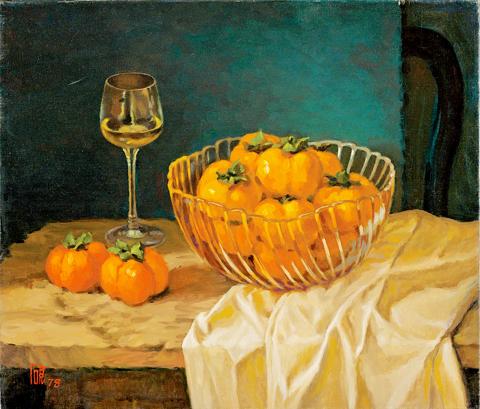
Photo Courtesy of Capital Art Center
Wu Tzu-an (吳梓安) is a Taiwanese experimental film and video artist who traveled through New Zealand last year during an artist residency sponsored by the Taipei Artist Village. During his residency, Wu segued away from his normal approach to video making, which depended heavily on video collaging and montage, and began experimenting with the relationship between his filmed subject and the mechanisms of image production. His current solo exhibition, Celestial Observation, features nine recent works that speak to the materiality of film, the process of filmmaking and his ongoing study of celestial bodies. Wu draws a historical connection between astronomy and cinema, pointing out that the stars we see in the sky are projections of light after traveling through enormous stretches of space and time. Stargazing is a short black-and-white video that documents the artist’s everyday ritual of watching the night sky. Wu shot each frame as a photograph using long exposure, and manipulated the exposure time over time, thereby creating an organic pulsation of lights as the film runs from frame to frame. Space/Noise is a looped projection of 80 slides that includes original footage, found films, and visual references that collectively form an association of ideas, including explorations of space, Buddhist mantras, tarot cards and 17th century scholar Athanasius Kircher.
■ Barry Room, Taipei Artist Village (台北國際藝術村百里廳), 7 Beiping E Rd, Taipei City (台北市北平東路7號), tel: (02) 3393-7377. Open Tuesdays to Sundays from 11am to 9pm
■ Until May 20
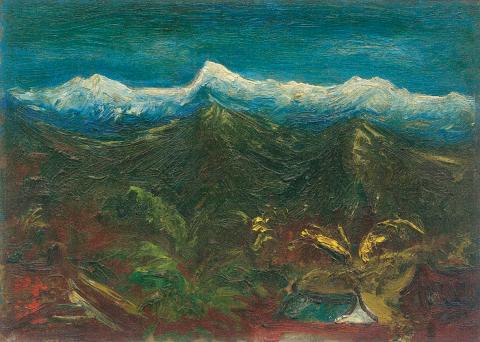
Photo Courtesy of Liang Gallery
Organized by the National Crafts Research and Development Institute, Tree of Life is an internationally touring exhibition that features over 60 works of arts and crafts from 16 different countries in Asia. Curated by a team of curators from Taiwan, India and Malaysia, the show is an artistic survey of the tree as a spiritual symbol bestowed with different meanings across Asian cultures, communities, histories and geographies. To the Malaysian Iban people, for example, the Tree of Life connects between heaven and earth; the Muslims speak of the Tuba Tree, which grows in heaven and is associated with the idea of blessedness; and the Buddhists praise the Bodhi tree, as the sacred site where Buddha attained enlightenment. Such diverse interpretations of trees are connected through a general “celebration, prayer, submission and appreciation of life,” according to the show’s press release. The show features both traditional craft and contemporary interpretations of traditional craft, including works of fiber, lacquer, metal, wood, bamboo and clay. Eight of the participating artists are recipients of the UNESCO-World Council Seal of Excellence, which recognizes their mastery and preservation of traditional crafts. The show will open in Nantou tomorrow, and travel to Taipei in September. Please check the organizer’s Web site for more details: www.ntcri.gov.tw.
■ Craft Design Hall, The National Crafts Research and Development Institute (台灣工藝研究發展中心), 573, Zhongzheng Rd, Caotun Township, Nantou County (南投縣草屯鎮中正路573號), tel: (049) 233-4141. Open Tuesdays to Sundays from 9am to 5pm.
■ Until Aug. 19
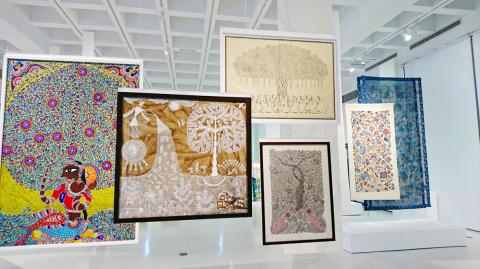
Photo Courtesy of The National Crafts Research and Development Institute
Currently on view at The National Museum of History is a retrospective of 20th century Taiwanese painter Wang Pan-yuan (王攀元). By The Passing of A Thousand Sails features a selection of watercolor, ink and oil paintings by the veteran artist who passed away last year at the age of 109. Wang was the recipient of the National Award of Arts, the highest honor of artistic achievement awarded by the Taiwanese government. His work embodies an expansive world of poetic introspection, nuanced sentiment and naive simplicity. Boundless earth and sky, the sun, a red clothed girl, dogs and horses are among a few of Wang’s favorite motifs that reoccur in many of his paintings throughout his career. Gueishan (龜山) is an abstract seascape dominated by an opaque, ultramarine blue sea topped by a small gray island shape against a brilliantly yellow skyline. Brief Life is a horizontal scroll of sumi-e ink wash featuring an abstract line of pedestrians that seem to be in deep contemplation. Crowd is a watercolor work on paper that portrays a lone man facing a larger-than-life sun.
■ National Museum of History (國立歷史博物館), 49 Nanhai Rd, Taipei City (台北市南海路49號), tel: (02) 2361-0270. Open Tuesdays to Sundays from 10am to 6pm
■ Until July 1
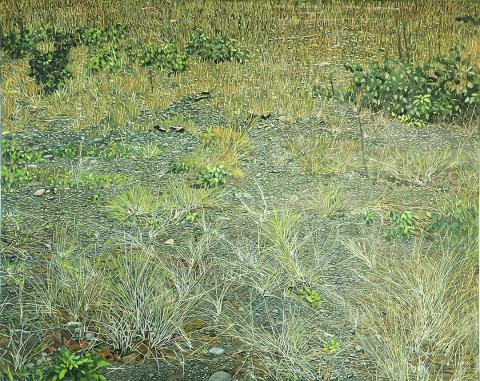
Photo Courtesy of Capital Art Center
Since the early 90’s, Liang Gallery has been committed to promoting Taiwanese artists who play a significant role in the fields of modern art, post-war abstract art and contemporary art. Run by husband and wife duo Yu Yen-liang (余彥良) and Claudia Chen (陳菁螢), the gallery began with interests in modern art history and have in the last decade expanded its roster into include a younger generation of artists. “From classic, modern to contemporary, Liang Gallery undertakes a comprehensive approach to promote Taiwanese art history to the public,“ said Chen in an interview earlier this year. The gallery celebrates its 25th anniversary this month with a modern art group exhibition, Liang Gallery 25th Anniversary — Passing Inheritance to the Future Generations / Visible and Invisible. The show features an impressive roster of 20 veteran artists, including Japanese artist and educator Kinichiro Ishikawa, who was instrumental in laying the foundations of modern art in Taiwan during the Japanese colonial period. Also featured in the show is 20th century painter Chen Cheng-po (陳澄波), who was the first Taiwanese artist to be selected for the Imperial Art Exhibition, organized by the Japanese colonial government. The show includes a selection of his paintings, including Spring of Ali Mountain which depicts an unadorned settlement of houses against a lusciously green landscape with blossoming flowers and sprouting leaves.
■ Liang Gallery (尊彩藝術中心), 366, Ruiguang Rd, Taipei City (台北市瑞光路366號), tel: (02) 2797-1100. Open Tuesdays to Sundays from 11am to 6pm
■ May 19 to July 1
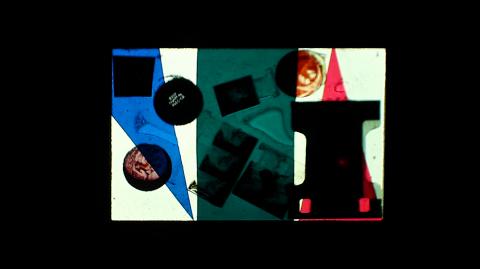
Photo Courtesy of the artist
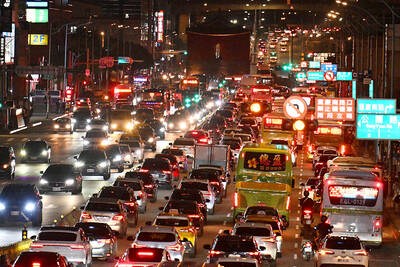
By global standards, the traffic congestion that afflicts Taiwan’s urban areas isn’t horrific. But nor is it something the country can be proud of. According to TomTom, a Dutch developer of location and navigation technologies, last year Taiwan was the sixth most congested country in Asia. Of the 492 towns and cities included in its rankings last year, Taipei was the 74th most congested. Taoyuan ranked 105th, while Hsinchu County (121st), Taichung (142nd), Tainan (173rd), New Taipei City (227th), Kaohsiung (241st) and Keelung (302nd) also featured on the list. Four Japanese cities have slower traffic than Taipei. (Seoul, which has some

In our discussions of tourism in Taiwan we often criticize the government’s addiction to promoting food and shopping, while ignoring Taiwan’s underdeveloped trekking and adventure travel opportunities. This discussion, however, is decidedly land-focused. When was the last time a port entered into it? Last week I encountered journalist and travel writer Cameron Dueck, who had sailed to Taiwan in 2023-24, and was full of tales. Like everyone who visits, he and his partner Fiona Ching loved our island nation and had nothing but wonderful experiences on land. But he had little positive to say about the way Taiwan has organized its
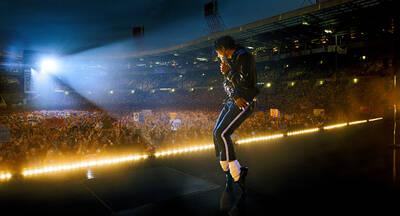
Michael slides a sequin glove over the pop star’s tarnished legacy, shrouding Michael Jackson’s complications with a conventional biopic that, if you cover your ears, sounds great. Antoine Fuqua’s movie is sanctioned by Jackson’s estate and its producers include the estate’s executors. So it is, by its nature, a narrow, authorized perspective on Jackson. The film ends before the flood of allegations of sexual abuse of children, or Jackson’s own acknowledgment of sleeping alongside kids. Jackson and his estate have long maintained his innocence. In his only criminal trial, in 2005, Jackson was acquitted. Michael doesn’t even subtly nod to these facts.
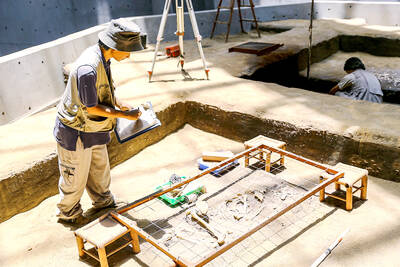
Writing of the finds at the ancient iron-working site of Shihsanhang (十 三行) in New Taipei City’s Bali District (八里), archaeologist Tsang Cheng-hwa (臧振華) of the Academia Sinica’s Institute of History and Philology observes: “One bronze bowl gilded with gold, together with copper coins and fragments of Tang and Song ceramics, were also found. These provide evidence for early contact between Taiwan aborigines and Chinese.” The Shihsanhang Web site from the Ministry of Culture says of the finds: “They were evidence that the residents of the area had a close trading relation with Chinese civilians, as the coins can be


 RSS
RSS