


The Suhua Highway (蘇花公路) has long had an unenviable reputation as being one of the nation’s most dangerous roads. After negotiating it in pouring rain many years ago while a typhoon bore down, I can confirm that, while not a relaxing drive at the best of times, in bad weather it is a full-on nightmare. Happily, recent improvements have seen sections of the former cliff-hugging road diverted through long tunnels, shortening the drive considerably and making it safer.
In good weather, the Suhua Highway is a major attraction in its own right, and driving along it is a highly desirable prelude or postlude to a Taroko Gorge (太魯閣峽谷) visit. Few places can compare in beauty and spectacle to that awesome chasm, but on a fine, sunny day, the views from the best stretches of the highway certainly come close. Far from simply being a great drive though, the Suhua Highway affords access to a number of amazing spots — the Lupi Stream (鹿皮溪), near Nanao (南澳) among them.
It’s a popular spot for local river tracing groups, so start early during weekends to avoid being held up at each of the many watery obstacles along the route.

Photo: Richard Saunders
The highlight, Jinyue Waterfall (金岳瀑布), is at the end of the river trace, much to the disappointment of many visitors who arrive at the car park to find that the waterfall can only be reached by wading up the river. The trace is only 90 minutes or so each way, and while it isn’t especially tough, it’s not a beginner’s trace either, so be sure to attempt a couple of easy routes first.
Most visitors who drive up here go no further than the series of pools just a minute’s walk from the parking area — a great spot to cool off on a hot day. The water here isn’t very deep, but the pools are broad and long, and don’t get especially crowded even on weekend afternoons. A few meters further on, the stream issues a narrow rocky chasm by plunging over the lower Jinyue Waterfall, which is about eight meters high. Courageous river tracers here climb the rocks to the left of the fall and jump into the huge, deep rock pool at its head, before riding over the smooth lip of the fall and plummeting into the pool at the bottom in one of Taiwan’s highest and most white-knuckle natural waterslides.
Unless you’re carrying proper equipment and have experience in technical river tracing, there’s no way to pass the narrow, rockbound gorge above the lower waterfall, so cross the stream and climb up the steep bank to the right of the waterfall. At the top a clear dirt trail leads through the woods for a couple of minutes, to rejoin the stream at the top of the impressive rocky defile.

Photo: Richard Saunders
It’s at least another hour from here up to the much bigger Jinyue Waterfall. There are a few fun obstacles en route, in the form of small falls, easy short scrambles up rocks and in one place a squeeze under a huge boulder. At the top, the 25-meter-high waterfall comes into view, lying at a 90-degree angle to the stream below and plummeting into a enormous pool of deep blue-green water that’s fantastic for swimming.
The river trace up to Jinyue Waterfall can be easily done in a morning, so unless you plan to spend the rest of the day lazing beside the river (a tempting option), there’s plenty of time to explore a very different nearby watery feature, the curiously named cliff-bound seashore: Mysterious Coast (神祕海岸).
Narrow back lanes run across the flat alluvial plain between Nanao village and the ocean, giving access to the unspoilt coastline. Head for the stretch south of the village, park at the end of the surfaced road and follow the wide, sandy beach southwards below the dramatic cliffs. After about 30 minutes’ walk there are several sea-eroded caves. The largest has an entrance 15 or 20 meters high, boring at least as deep into the cliff. Although the cave features in local tourist literature and many blogs, its relative remoteness means the cave is generally quieter than Jinyue Waterfall, making it a great place to relax for an hour while contemplating the day’s adventures.

Photo: Richard Saunders
Richard Saunders is a classical pianist and writer who has lived in Taiwan since 1993. He’s the founder of a local hiking group, Taipei Hikers, and is the author of six books about Taiwan, including Taiwan 101 and Taipei Escapes. Visit his Web site at www.taiwanoffthebeatentrack.com.
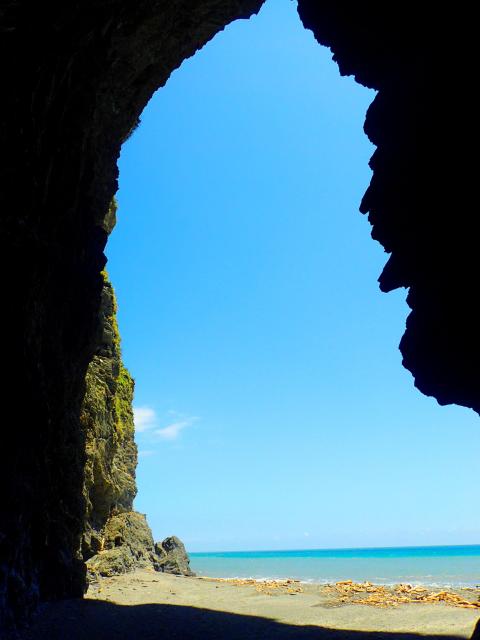
Photo: Richard Saunders

We lay transfixed under our blankets as the silhouettes of manta rays temporarily eclipsed the moon above us, and flickers of shadow at our feet revealed smaller fish darting in and out of the shelter of the sunken ship. Unwilling to close our eyes against this magnificent spectacle, we continued to watch, oohing and aahing, until the darkness and the exhaustion of the day’s events finally caught up with us and we fell into a deep slumber. Falling asleep under 1.5 million gallons of seawater in relative comfort was undoubtedly the highlight of the weekend, but the rest of the tour

Youngdoung Tenzin is living history of modern Tibet. The Chinese government on Dec. 22 last year sanctioned him along with 19 other Canadians who were associated with the Canada Tibet Committee and the Uighur Rights Advocacy Project. A former political chair of the Canadian Tibetan Association of Ontario and community outreach manager for the Canada Tibet Committee, he is now a lecturer and researcher in Environmental Chemistry at the University of Toronto. “I was born into a nomadic Tibetan family in Tibet,” he says. “I came to India in 1999, when I was 11. I even met [His Holiness] the 14th the Dalai

Following the rollercoaster ride of 2025, next year is already shaping up to be dramatic. The ongoing constitutional crises and the nine-in-one local elections are already dominating the landscape. The constitutional crises are the ones to lose sleep over. Though much business is still being conducted, crucial items such as next year’s budget, civil servant pensions and the proposed eight-year NT$1.25 trillion (approx US$40 billion) special defense budget are still being contested. There are, however, two glimmers of hope. One is that the legally contested move by five of the eight grand justices on the Constitutional Court’s ad hoc move

Stepping off the busy through-road at Yongan Market Station, lights flashing, horns honking, I turn down a small side street and into the warm embrace of my favorite hole-in-the-wall gem, the Hoi An Banh Mi shop (越南會安麵包), red flags and yellow lanterns waving outside. “Little sister, we were wondering where you’ve been, we haven’t seen you in ages!” the owners call out with a smile. It’s been seven days. The restaurant is run by Huang Jin-chuan (黃錦泉), who is married to a local, and her little sister Eva, who helps out on weekends, having also moved to New Taipei


 RSS
RSS