


It’s always a letdown when the opening sequence is the most interesting part of a movie. Luckily the scene, set in an outer space noodle restaurant whose food’s taste changes according to the owner’s mood, reoccurs throughout Didi’s Dreams (吃吃的愛), which is otherwise a rather pedestrian, over-the-top sap fest that has become typical of Taiwanese comedies.
It does have entertainment value, though, being one of those films that seems to be somewhat aware that it is cheesy, even going as far as to poke fun at itself and other cringe-worthy romance flicks. This may be its saving grace as the results are quite funny at certain points. The production is superb, living up to its whopping NT$250 million budget.
While food does play a minor part in the “main” story, one can’t help but wonder if the Chinese film title (literally “eat eat love”) would be more apt if it was entirely set in the outer space restaurant. It seems like a fun place with all kinds of bizarrely dressed customers who we first see competing to see who can stay still for the longest time. The core of the restaurant is the soup, which only the owner (Dee Hsu, 徐熙娣) can touch — and with her heart broken, the customers can taste her tears. When an astronaut garbageman seduces her and steals her soup … well, that’s the beginning of a promising movie.

Photo courtesy of Kbro Media
Instead, the main focus is Shangguan Didi (上官娣娣), also played by Hsu, who supposedly dreams of the restaurant every night (there’s a clever plot twist involving these two worlds that we don’t dare reveal). Her life is far less interesting as an aspiring actress who lives in the shadow of her superstar older sister, Shangguan Lingling (上官玲玲), played by Lin Chi-ling (林志玲). Their tense relationship drives the main plot as the two eventually end up being cast in the same movie. Here, the excessive plot devices to elicit all kinds of emotions are unleashed, probably to mask the thin storyline. And of course, you have the prerequisite ultra-considerate, caring boyfriend (Jin Shijia, 金世佳) who never leaves Didi’s side and even cuts her nails for her.
Given their professional standing in the film, it’s ironic that Lin, arguably Taiwan’s most famous female model, can’t really act or deliver her lines properly. Hsu is obviously more talented as far as entertaining goes (even lending her voice to the soundtrack, including a brainwashing tongue twister about a carp and a donkey) but in the film she can only land bit roles as zombies or bacteria in a stomach medicine commercial. She plays the carefree, impulsive and blunt Didi well, creating a likeable character that refers to herself as laoniang (老娘, this old lady).
Those even vaguely familiar with Taiwanese pop culture should know that the film will have its guaranteed audience from the fan base of the wildly popular variety show Here Comes Kangxi (康熙來了), hosted by Hsu and Kevin Tsai (蔡康永). The show aired its final episode last January, and those who miss the show should be excited about the reunion of the pair, although Tsai doesn’t appear on screen in his directorial debut. But only those very familiar with Taiwanese pop culture would know that several actors who play sadistic casting agents in the movie who give Didi a hard time are former guests who have been pranked by the hosts in the past.
As the show was also a smash hit in China, it’s no surprise that this is a joint Chinese-Taiwanese production. As a result you have a mix of Chinese and Taiwanese actors, which is not as bad as Hong Kong-China productions that switch incessantly between Cantonese and Mandarin as if the two languages are mutually intelligible. This kind of fantastical film is not aiming for authenticity, but it’s still a bit jarring when characters speak in different accents in a vague setting where the street scenes go from Taiwan to China in one motorcycle trip, and the subtitles inexplicably switches from simplified to traditional Chinese in different scenes. We don’t want to get too political here, but the audience does notice these things and it can be quite disconcerting. Unfortunately, there’s just so much more money to be made on the other side of the Taiwan Strait that there’s no stopping this trend.

Just after 6am, I walked up to the ticket gate at Taipei Main Station and entered the Taiwan Railway platform without scanning any ticket; instead, I flashed the Sanrio Fun Rail pass on my phone to the gate worker and was admitted. I found my train and prepared to board. My destination? This very same station. I was embarking on a 13-hour journey on one of two round-the-island trains operated by ezTravel. They run each day, one counterclockwise around the island and one clockwise. They differ in a number of ways from an ordinary Taiwan Railway train and can make for
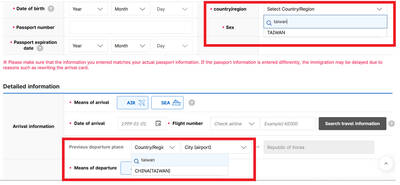
Jason Han says that the e-arrival card spat between South Korea and Taiwan shows that Seoul is signaling adherence to its “one-China” policy, while Taiwan’s response reflects a reciprocal approach. “Attempts to alter the diplomatic status quo often lead to tit-for-tat responses,” the analyst on international affairs tells the Taipei Times, adding that Taiwan may become more cautious in its dealings with South Korea going forward. Taipei has called on Seoul to correct its electronic entry system, which currently lists Taiwan as “China (Taiwan),” warning that reciprocal measures may follow if the wording is not changed before March 31. As of yesterday,

The Portuguese never established a presence on Taiwan, but they must have traded with the indigenous people because later traders reported that the locals referred to parts of deer using Portuguese words. What goods might the Portuguese have offered their indigenous trade partners? Among them must have been slaves, for the Portuguese dealt slaves across Asia. Though we often speak of “Portuguese” ships, imagining them as picturesque vessels manned by pointy-bearded Iberians, in Asia Portuguese shipping between local destinations was crewed by Asian seamen, with a handful of white or Eurasian officers. “Even the great carracks of 1,000-2,000 tons which plied

On Thursday, former Taipei mayor and founder of the Taiwan People’s Party (TPP) Ko Wen-je (柯文哲) was sentenced to 17 years in prison and had his civil rights suspended for six years over corruption, embezzlement and other charges. Seven others related to the case were also handed prison sentences, while two were found not guilty. It has been a bad week for the TPP. On Tuesday, prosecutors charged Chinese immigrant Xu Chunying (徐春鶯) with suspicion of taking part in Beijing-directed election interference. Xu has strong links to the TPP, which once offered her a party list legislator nomination. Tuesday also


 RSS
RSS