


In a daring nautical themed outfit, sex worker May confidently predicts the survival of Thai sleaze town Pattaya despite a junta attempt to tame the kingdom’s “Sin City.”
She is bullish because she, like tens of thousands of others in the industry, have no plans to give up their jobs. And there are no signs the hordes of foreign sex tourists are abating.
Two hours east of Bangkok, Pattaya’s bawdy reputation hails from the Vietnam War era when American GIs partied in their downtime.
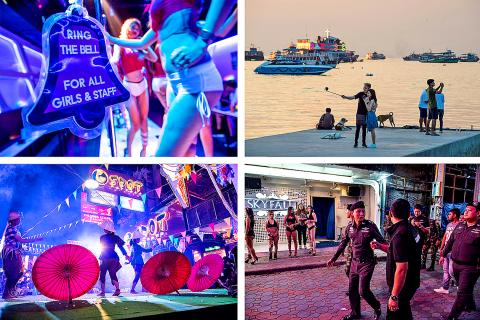
Photos: AFP/Roberto Schmidt
Today it spins money off its no-holds-barred reputation and its most successful sex workers earn anywhere between 70-150,000 baht (US$2 to US$4,400) a month, as much as ten times the national average wage.
“I make good money here, for me and my family,” May told AFP as she touted for clients near ‘Walking Street’ — a mile-long drag festooned with bars and clubs pouring out ear-crushing EDM music.
But concerns about the impact on Thailand’s reputation have spurred authorities to act, while frequent reports of underage sex workers, drug abuse and mafia operations further muddy Pattaya’s name.
May, who is transgender, said the strip has felt more subdued in recent weeks as police and soldiers conduct frequent patrols as part of a clean-up ordered by the censorious ruling junta.
Police Lieutenant Colonel Sulasak Kalokwilas is one of those tasked with what many might deem the ultimate Sisyphean task: weaning Pattaya off sex.
“We are suppressing obscene and dirty shows. We’re trying to make those bars disappear,” he says.
As he spoke, lines of women stood behind him in revealing outfits enticing punters into bars with names like Taboo and G-Spot as well as Fahrenheit — a nightspot boasting “The Hottest Girls in Pattaya.”
“The lady boys and women working there, they are not involved in the sex trade,” said Pattaya’s police chief Colonel Apichai Kroppeth, echoing the kind of Thai police rhetoric commonly divorced from reality.
“They work as waitresses, sit and chat with customers, some dance in shows,” he said.
BAR FINES, SHORT-TIMES
For many residents of the city the latest moral outrage fits a familiar pattern: negative overseas headlines prompt authorities to launch high-visibility — yet limited — crackdowns on an industry that pays the bills for everyone.
“You’re expecting the poachers to be the gamekeepers?” said one westerner who has made Pattaya his home, when asked if the latest clean-up will work.
The sex trade is a cash cow for the bar owners, girls, massage parlors, hotels, taxis, mafia and, many have long alleged, the cops charged with policing.
Thais call it pon prayote, says British journalist Andrew Drummond who reported on crime in Thailand for two decades.
“It means everyone benefits... it brings in massive amounts of money and simply couldn’t happen without police connivance.”
Apichai insisted there was “no bribery for sure” in his force.
Prostitution is illegal in conservative Thailand. Yet it remains ubiquitous for local and foreign customers alike.
Businesses use a well worn loophole to avoid prosecution, hiring sex workers inside the bars merely to entertain and talk to patrons.
A small “bar fine,” usually around 500 baht (US$14), secures private “short time” away from the bar where any deal struck for sex is purely between the punter and prostitute.
While authorities have vowed to shutter the trade, there is little discussion on what happens to the sex workers — who often support large families with their earnings. There are no exact numbers, but a 2014 UNAIDS report suggested some 140,000 females are employed by sex work across Thailand. Tens of thousands are thought to operate in Pattaya alone.
PAR FOR THE COURSE
Tourism officials are optimistic for change, citing the increasing number of families coming to the town’s resorts and its popularity for sports, such as jet-skiing and golf.
“In terms of facilities I think we are already there,” said Suladda Sarutilavan, Pattaya’s director of tourism.
Last year some 12 million tourists — seventy percent foreigners — visited a city which now boasts over 100,000 rooms across 2,000 hotels, from cheap backpackers to swanky golf courses and family apartments. While not everyone who comes is a sex tourist, she admits the city’s seedy image and crime headlines are a problem. “It makes us feel a little bit uncomfortable,” she said.
Two recent killings have renewed the spotlight on the city’s reputation as a bolthole for foreign criminals.
In January, British businessman Tony Kenway was gunned down as he left the gym, a hit police linked to “boiler room” scams.
In 2015 an Australian former Hells Angel was kidnapped in broad daylight and murdered.
Foreigners who have made Pattaya home lament the killings, but say they fail to tell the wider picture of a largely safe, affordable city.
“Every night I went out in Coventry there was always one or two fights. I feel completely safe here,” said Briton Bryan Flowers, who moved to Pattaya a decade ago and now owns a dozen bars.
Others argue fancy hotels, malls and golf courses can flourish in step with the town’s party reputation.
“It’s why a lot of people come here,” Simon Peatfield, another Brit who owns restaurants and sports bars, said.
“There’s only so much golf you can play.”

Just after 6am, I walked up to the ticket gate at Taipei Main Station and entered the Taiwan Railway platform without scanning any ticket; instead, I flashed the Sanrio Fun Rail pass on my phone to the gate worker and was admitted. I found my train and prepared to board. My destination? This very same station. I was embarking on a 13-hour journey on one of two round-the-island trains operated by ezTravel. They run each day, one counterclockwise around the island and one clockwise. They differ in a number of ways from an ordinary Taiwan Railway train and can make for
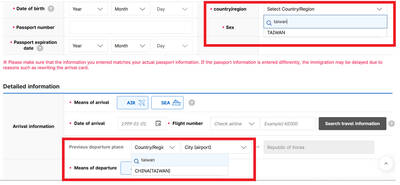
Jason Han says that the e-arrival card spat between South Korea and Taiwan shows that Seoul is signaling adherence to its “one-China” policy, while Taiwan’s response reflects a reciprocal approach. “Attempts to alter the diplomatic status quo often lead to tit-for-tat responses,” the analyst on international affairs tells the Taipei Times, adding that Taiwan may become more cautious in its dealings with South Korea going forward. Taipei has called on Seoul to correct its electronic entry system, which currently lists Taiwan as “China (Taiwan),” warning that reciprocal measures may follow if the wording is not changed before March 31. As of yesterday,
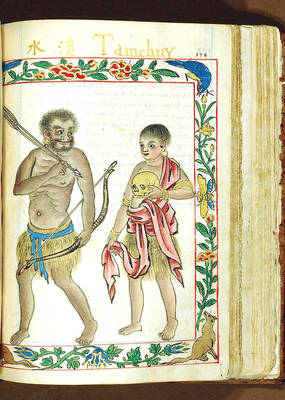
The Portuguese never established a presence on Taiwan, but they must have traded with the indigenous people because later traders reported that the locals referred to parts of deer using Portuguese words. What goods might the Portuguese have offered their indigenous trade partners? Among them must have been slaves, for the Portuguese dealt slaves across Asia. Though we often speak of “Portuguese” ships, imagining them as picturesque vessels manned by pointy-bearded Iberians, in Asia Portuguese shipping between local destinations was crewed by Asian seamen, with a handful of white or Eurasian officers. “Even the great carracks of 1,000-2,000 tons which plied

On Thursday, former Taipei mayor and founder of the Taiwan People’s Party (TPP) Ko Wen-je (柯文哲) was sentenced to 17 years in prison and had his civil rights suspended for six years over corruption, embezzlement and other charges. Seven others related to the case were also handed prison sentences, while two were found not guilty. It has been a bad week for the TPP. On Tuesday, prosecutors charged Chinese immigrant Xu Chunying (徐春鶯) with suspicion of taking part in Beijing-directed election interference. Xu has strong links to the TPP, which once offered her a party list legislator nomination. Tuesday also


 RSS
RSS