


One of princess Aalia Sultana Babi’s most prized possessions is a fossilized dinosaur egg she found an unsuspecting villager using to grind spices on her ancestral lands, an area billed as “India’s Jurassic Park.”
Babi rescued the egg and it now has pride of place among her collection of prehistoric fossils, part of a lifelong legacy of protecting the dinosaur remains on the land her family once ruled over.
“She didn’t know it was a dinosaur egg!” said Babi, 42, who has been dubbed the Dinosaur Princess for her work.
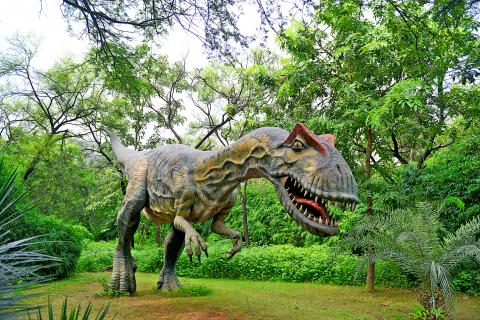
Photo: AFP
“I lovingly call it my masala (spice) egg,” she added of the rare find, a complete Titanosaurus egg belonging to the late Cretaceous period, around 99-65 million years ago.
It now sits in her home, in pride of place, wrapped in white silk inside a red velvet jewelry box.
Researchers found the 72-acre (29-hectare) sprawling family estate of Balinsor was littered with dinosaur fossils during a routine geological survey of the area situated in Gujarat in Western India, in the 1980s.
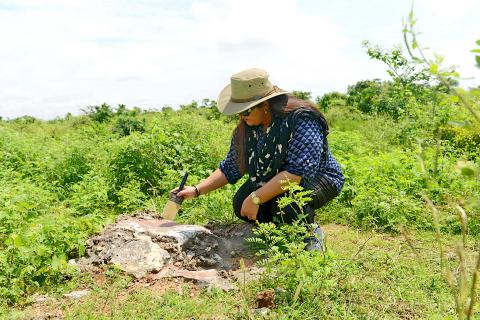
Photo: AFP
One find — estimated to be 67 million years old — was of a new species of dinosaur which scientists named Rajasaurus Narmadensis after the Hindi word for king and the local area around Narmada river. A T-rex-like carnivore, the Rajasaurus was a 30-foot (nine-meter) predator characterized by a unique crown of crested horns that feasted on long-necked sauropods — herbivores that also lived in the region. Local experts believe at least seven species of dinosaur once lived in the area.
UNTAPPPED POTENTIAL
Today visitors to the Balasinor Dinosaur Fossil Park can see fiberglass models of the huge beasts. But for Babi, the full potential of the place, is going untapped. It is estimated that around 10,000 fossilized dinosaur eggs were found in the area — but a significant number have been given to other museums. The park now has a somewhat neglected air: To the untrained eye it seems little more than a wild expanse of fenced-off scrubland, and without proper markings or explanations, some of the dinosaur remains can be mistaken for ordinary rocks.
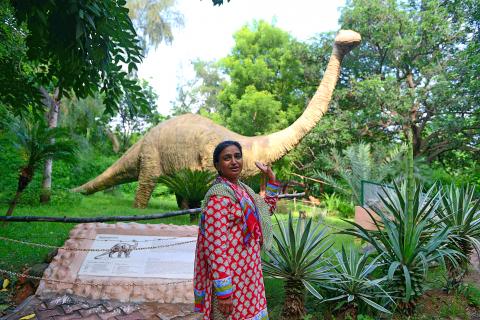
Photo: AFP
A single watchman guards the government-owned site against vandalism and local herders seeking grazing for their cattle.
Authorities have built a museum nearby, but it has yet to be completed — at the moment the only exhibits on display are a smattering of dinosaur models and posters.
The slow pace of progress is a source of frustration for local villagers, who say the site could be providing them with employment if it was fully developed.
“It’s good that Balasinor is getting so much attention. But it is of no use to us,” says 26-year-old Rajesh Chauhan, who is unemployed.
“We want the government to spare some thought for us. They are worried about animals that are long dead and gone, but have little concern for the living.”
‘MY SUBJECTS’
Babi, who conducts guided tours of the park for a fee, has lobbied authorities to do more, but says the fact that three separate government departments are involved means not much happens in a hurry.
“There’s a lot of potential to this place, it’s just that we need to wake up from our slumber and get going,” she said.
It could be a contender to be given UNESCO Geo Park status, but a lack of coordination between government departments means no submission has been made to the body, local media report.
Nonetheless, thousands of tourists visit in the cooler winter months, thanks in part to Babi’s efforts.
Passengers on the Maharaja Express, a luxury tourist train, can stay at the royal palace before touring the park — the only place in the world where you can hold a fossilized dinosaur egg, say local geologists.
Babi, who featured in the BBC reality show Undercover Princesses in 2009, said her passion for dinosaurs began when she started accompanying foreign geologists to the fossil park because she was the only local person who spoke English.
“I got drawn into it as it was something which was very unique and virtually in my backyard,” she told AFP.
“I started writing to scientists and gathering as much research material as I could.
“My affiliation is double-fold, because I feel these are my subjects that I need to protect.”

We lay transfixed under our blankets as the silhouettes of manta rays temporarily eclipsed the moon above us, and flickers of shadow at our feet revealed smaller fish darting in and out of the shelter of the sunken ship. Unwilling to close our eyes against this magnificent spectacle, we continued to watch, oohing and aahing, until the darkness and the exhaustion of the day’s events finally caught up with us and we fell into a deep slumber. Falling asleep under 1.5 million gallons of seawater in relative comfort was undoubtedly the highlight of the weekend, but the rest of the tour

Youngdoung Tenzin is living history of modern Tibet. The Chinese government on Dec. 22 last year sanctioned him along with 19 other Canadians who were associated with the Canada Tibet Committee and the Uighur Rights Advocacy Project. A former political chair of the Canadian Tibetan Association of Ontario and community outreach manager for the Canada Tibet Committee, he is now a lecturer and researcher in Environmental Chemistry at the University of Toronto. “I was born into a nomadic Tibetan family in Tibet,” he says. “I came to India in 1999, when I was 11. I even met [His Holiness] the 14th the Dalai

Following the rollercoaster ride of 2025, next year is already shaping up to be dramatic. The ongoing constitutional crises and the nine-in-one local elections are already dominating the landscape. The constitutional crises are the ones to lose sleep over. Though much business is still being conducted, crucial items such as next year’s budget, civil servant pensions and the proposed eight-year NT$1.25 trillion (approx US$40 billion) special defense budget are still being contested. There are, however, two glimmers of hope. One is that the legally contested move by five of the eight grand justices on the Constitutional Court’s ad hoc move

Stepping off the busy through-road at Yongan Market Station, lights flashing, horns honking, I turn down a small side street and into the warm embrace of my favorite hole-in-the-wall gem, the Hoi An Banh Mi shop (越南會安麵包), red flags and yellow lanterns waving outside. “Little sister, we were wondering where you’ve been, we haven’t seen you in ages!” the owners call out with a smile. It’s been seven days. The restaurant is run by Huang Jin-chuan (黃錦泉), who is married to a local, and her little sister Eva, who helps out on weekends, having also moved to New Taipei


 RSS
RSS