


After two months of an almost-daily regimen of at least 150 pull-ups, 100 core exercises and climbing up and down a power pole with bare hands 12 consecutive times, Lin Tsung-lin (林宗麟) and his four teammates were ready for the big annual showdown.
Last Wednesday, on the last day of Ghost Month, a newly-erected 43m structure could be seen from most parts of Yilan’s Toucheng Township (頭城). Known as a gupeng (孤棚), the bottom consists of 16 fir logs supporting a wooden platform, upon which 13 bamboo towers measuring 30m tall and laden with offerings such as duck, fish and pork point toward the sky. On the very top is the victory flag tied to a large branch.
ON YOUR MARKS, GET SET, GRAPPLE
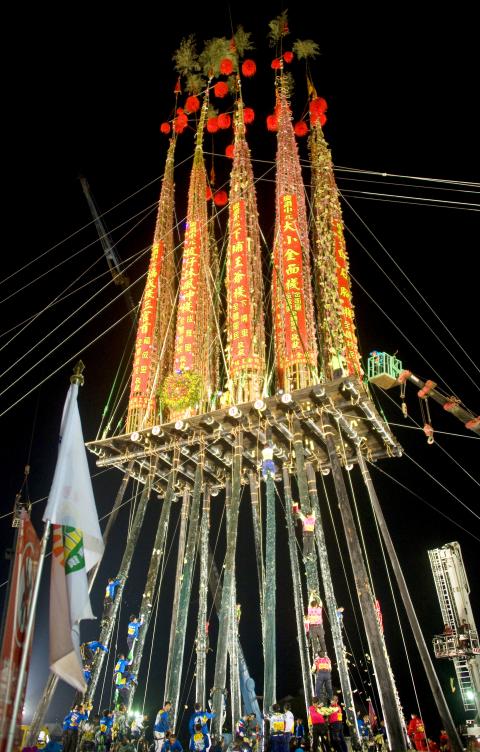
Photo: Han Cheung, Taipei Times
It’s said that the gates to the netherworld close around 11pm, and that’s when the wandering ghosts have to return to where they belong. Thus begins the Ghost Grappling Festival (搶孤), which is meant to appease these ghosts.
The action begins around 11:15pm. The first part is the hardest — 12 teams scale the logs that are slathered with about 200 gallons of butter. After throwing ghost money onto the logs to make them less slippery, Lin’s Luodong Town Hall team (羅東鎮公所) performs a standard procedure of standing on each other’s shoulders, with Lin on top — a spot reserved for the lighter, faster teammate with the best stamina.
He then slowly makes his way up by tying a rope from his body around the log. He loses his grip and slides downward twice — but he’s confident. After all, he shattered previous records by making it up to the platform in 8 minutes and 9 seconds last year. This year, the organizers had increased the amount of butter from last year’s 120 gallons.

Photo: Han Cheung, Taipei Times
Another contestant makes it up to the top of the pole first — but he has difficulties swinging up to the platform from underneath. Lin performs the maneuver in one swoop and beats him to the chase.
Lin chooses the bamboo structure with the most prize money (NT$156,000). However, as he nears the top, his rope gets tangled and he has to descend to fix it — only to watch another contestant reach the top of his structure first, using a knife to cut down the victory flag.
This causes a bit confusion of who is the real winner — but the announcer clarifies that first place belongs to the person who makes it to the platform first. This achievement earns Lin’s team NT$200,000.
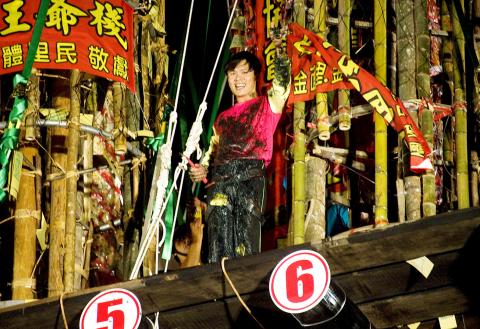
Photos: Han Cheung, Taipei Times
While Lin tirelessly climbs another structure and nets an additional NT$70,000, others are not as fortunate as some still remain on the bottom of the logs after repeatedly slipping down. One contestant makes it to the top but does not have any more energy to make advance to the platform, and is rescued by aerial lift and taken away by ambulance.
“Muscle endurance and stamina are the most important qualities in ghost grappling, and you can’t rely on explosiveness,” Lin says.
Festival tradition has it that all victory flags must be cut down by sunrise — if not, staff members will use a machine to complete the task. It was over by 12:30am.
TRADITION AS SPORT
Lin, 38, announces at the end of the night that he is retiring.
“Im busy with my ramen shop business, and it takes a lot of time to practice,” he says. “I’ve also sustained some muscle strains that probably won’t heal. But I’ll become a coach and train other young contestants.”
Although Lin only started “grappling for ghosts” four years ago, he had always been training his body as a long-time dragon boat racer. He decided to try ghost grappling at the suggestion of his dragon boat teammates, who also make up his grappling squad.
A native of nearby Luodong, Lin did not know much about the festival before he joined.
“I always had the impression that it was very dangerous,” he says. “They did not use safety nets or hooks before.”
The festival, which originated in the early 1800s to remember the spirits of the Han Chinese who died when they entered the area and clashed with Aboriginals, was cancelled in 1949 due to multiple injuries (and possibly Martial Law), and did not return until 1991. Today, it makes up the only two ghost grappling festivals in Taiwan — however, the Hengchun version only requires participants to make it to the platform.
Lin adds that over the years, his team took on increasingly strict training schedules. They discussed their weaknesses, figured out which muscles to work on and improved their ranks until they won last year — and Lin wanted to win two championships in a row before calling it quits.
“I don’t think many people treat a folk activity like a serious sport,” Lin laughs.
But he also thinks their attitude may be the key to preserving the tradition. Despite the lively atmosphere and massive media coverage, Lin says the popularity of the festival has been declining over the years, as prize money could go up to NT$800,000 in its heyday.
“Young people don’t really like watching this anymore, and spectators have decreased,” he says. “But I hope that people don’t just see it as a folk activity — it can be a sport. Like dragon boat racing — it used to be a folk activity but now it’s an internationally sanctioned sport. Ghost grappling can take that path, too.”

Ajay Verma, a consultant gastroenterologist at Kettering general hospital in Northamptonshire, says our gut is a “complex machine.” “It is constantly providing us with the nutrition we need, initially to grow and develop, and then for us to survive, thrive and repair from injury and illness.” How can we keep it functioning well? Put simply: “Make sure what you put into it is balanced, and that you clear out its waste products adequately,” Verma says. “In a general gastroenterology clinic, the most common conditions we see are irritable bowel syndrome (IBS), gastroesophageal reflux disease, inflammatory bowel disease and constipation,” says Nisha
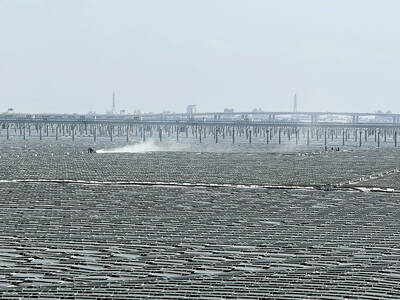
The arithmetic is straightforward and uncomfortable. By the end of 2025, Taiwan had committed itself to a 50-30-20 electricity mix — half natural gas, 30 per cent coal, 20 per cent renewables. The Ministry of Economic Affairs’s (MOEA) own monthly energy reports tell a different story. Natural gas reached 47.8 per cent of generation last year. Coal stood at 35.4 per cent, comfortably above its target ceiling. Renewables came in at 13.1 per cent, well short of the 20 per cent Taipei had pledged a decade earlier. Installed renewable capacity reached roughly half of the 12 gigawatts (GW) the government

Last week US President Donald Trump was asked by a reporter whether he would speak on the phone to the President of Taiwan. “l’ll speak to him. I speak to everybody. We have that situation very well in hand,” Trump said. This marked the second time in a couple of weeks he had said he would talk to the President of Taiwan. In 2016 he famously took a call from then-president Tsai Ing-wen (蔡英文), when he was president-elect. Despite warnings that the apocalypse was nigh because of a phone call, the world quickly forgot about the conversation between two democratically-elected presidents.
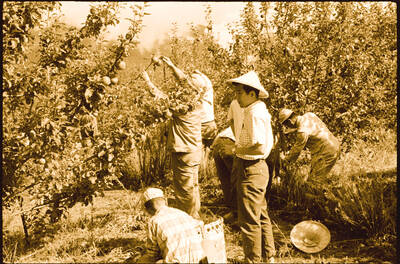
May 25 to May 31 Few believed that apples could be cultivated on a commercial scale in Taiwan’s high mountains. When horticulturalist Cheng Chao-hsiung (程兆熊) first proposed the idea in 1955, both American and Taiwanese colleagues dismissed it as implausible, arguing that temperate fruit could not be reliably grown on a subtropical island, especially on rugged terrain. However, it was this terrain in the Central Mountain Range where many Chinese Civil War veterans were resettled in the late 1950s. With limited job prospects and no family in Taiwan, they were placed on cooperative farms aimed toward self-sufficiency. Some say the conditions


 RSS
RSS