


Composer Hans Zimmer, physicist Jim Al-Khalili and science documentary Particle Fever have been announced as the inaugural winners of the Stephen Hawking Medal for Science Communication.
The gongs are intended to recognize individuals or endeavors that have propelled science into the public consciousness. They will be presented by Hawking later this month at the Starmus Festival in Tenerife.
“In this special inaugural year of the awards, I have been invited to personally select the awardees,” said Hawking. “The winners have made outstanding contributions in the articulation and portrayal of science to the public, within the three categories of science, art and film.”
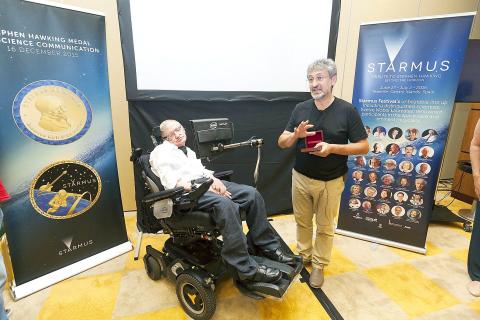
Photo: EPA/RAMON DE LA ROCHA
Scooping the science award for his role in documentaries such as The Secrets of Quantum Physics, broadcaster and physicist Jim Al-Khalili said he was “absolutely delighted and honored” to receive the medal.
“This a vindication that practicing research scientists can also be accepted and acknowledged as successful communicators,” he said.
“Like Stephen, I feel strongly that it is both a duty and privilege to share my wonder about the workings of the Universe and our place in it with as wide an audience as possible.”
The sweeping score for the science-fiction blockbuster Interstellar, a film lauded by Hawking for its credible physics, won composer Hans Zimmer the arts medal, while Particle Fever, a documentary about the Large Hadron Collider and the hunt for the Higgs Boson directed by Mark Levinson, received the film award.
“This is really the first time we are recognizing composers and filmmakers for communicating science,” said Garik Israelian, founder and director of the Starmus festival. “It is so interesting how these people appreciate science and how they bring science into music or into visual art and I think we ought to recognize this.”
Hans Zimmer said he felt “truly grateful and deeply honored” to receive the award. “We artists constantly strive to search for and provoke through new questions in our work. That is one of the links between the arts and the sciences. The constant desire to be part of the adventure of the unknown.”
Theoretical particle physicist and a producer of Particle Fever, David Kaplan, said it was fantastic to win the medal. “Stephen Hawking is a great physicist and as a communicator of science, has left an indelible mark on the planet. It is truly an honor,” he said.
Taking place from June 27 in Tenerife, the third Starmus Festival is not only a celebration of music and science — it is also a tribute to Hawking himself.
Called Beyond the Horizon the festival’s lineup includes a bevy of Nobel laureates, astronomer royal Lord Martin Rees and astronaut Chris Hadfield as well as medal winners Zimmer and Al-Khalili.
Also taking part are such luminaries as Richard Dawkins, Carolyn Porco and Kip Thorne — the theoretical physicist and science consultant for Interstellar, against whom Hawking once lost a bet on whether the object known as Cygnus X-1 was in fact a black hole. In conceding the wager, Hawking had to stump up for a year’s subscription to Penthouse magazine for Thorne.
Each of the award winners will receive a medal bearing a depiction of the cosmonaut Alexei Leonov undertaking the first spacewalk in 1965. His umbilical cable is showing as being linked to the iconic “Red Special” guitar of the Queen musician and astrophysicist Brian May — a nod to the connection between music and science. On the other side of the medal is a portrait of Hawking created by Leonov himself.
“We want to really bring close these two big worlds of art and science
and Hawking is really the person who can do that,” said Israelian.
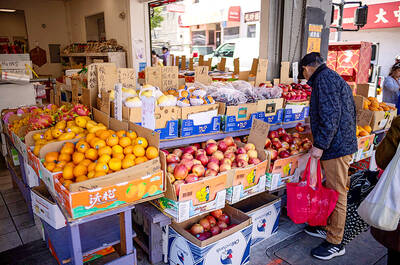
Ajay Verma, a consultant gastroenterologist at Kettering general hospital in Northamptonshire, says our gut is a “complex machine.” “It is constantly providing us with the nutrition we need, initially to grow and develop, and then for us to survive, thrive and repair from injury and illness.” How can we keep it functioning well? Put simply: “Make sure what you put into it is balanced, and that you clear out its waste products adequately,” Verma says. “In a general gastroenterology clinic, the most common conditions we see are irritable bowel syndrome (IBS), gastroesophageal reflux disease, inflammatory bowel disease and constipation,” says Nisha
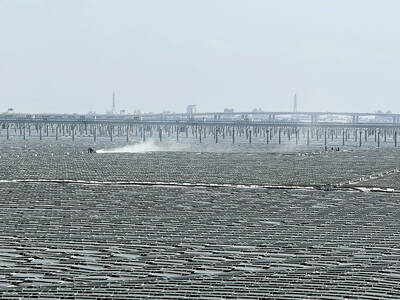
The arithmetic is straightforward and uncomfortable. By the end of 2025, Taiwan had committed itself to a 50-30-20 electricity mix — half natural gas, 30 per cent coal, 20 per cent renewables. The Ministry of Economic Affairs’s (MOEA) own monthly energy reports tell a different story. Natural gas reached 47.8 per cent of generation last year. Coal stood at 35.4 per cent, comfortably above its target ceiling. Renewables came in at 13.1 per cent, well short of the 20 per cent Taipei had pledged a decade earlier. Installed renewable capacity reached roughly half of the 12 gigawatts (GW) the government
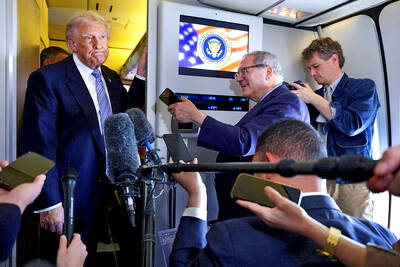
Last week US President Donald Trump was asked by a reporter whether he would speak on the phone to the President of Taiwan. “l’ll speak to him. I speak to everybody. We have that situation very well in hand,” Trump said. This marked the second time in a couple of weeks he had said he would talk to the President of Taiwan. In 2016 he famously took a call from then-president Tsai Ing-wen (蔡英文), when he was president-elect. Despite warnings that the apocalypse was nigh because of a phone call, the world quickly forgot about the conversation between two democratically-elected presidents.
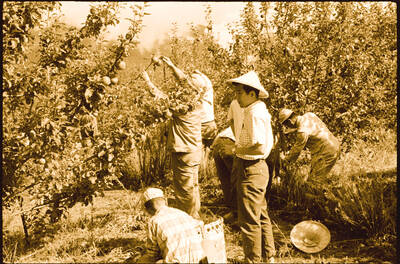
May 25 to May 31 Few believed that apples could be cultivated on a commercial scale in Taiwan’s high mountains. When horticulturalist Cheng Chao-hsiung (程兆熊) first proposed the idea in 1955, both American and Taiwanese colleagues dismissed it as implausible, arguing that temperate fruit could not be reliably grown on a subtropical island, especially on rugged terrain. However, it was this terrain in the Central Mountain Range where many Chinese Civil War veterans were resettled in the late 1950s. With limited job prospects and no family in Taiwan, they were placed on cooperative farms aimed toward self-sufficiency. Some say the conditions


 RSS
RSS