


It is usually Cloud Gate Dance Theater (雲門舞集) that gets the invitations from the National Theater Concert Hall to take part in its festivals and dance series, but last year the Taiwan International Festival of Arts (TIFA) programmers commissioned Cloud Gate 2’s (雲門2) artistic director Cheng Tsung-lung (鄭宗龍) to create a new work for this year’s festival.
The result is 13 Tongues (十三聲), Cheng’s first full-length work for the company, which premiered last Friday at the National Theater.
The inspiration for the work comes from a story the Taipei native’s mother told him about a legendary street performer in Bangka, the Hoklo (Taiwanese) name for a part of Wanhua District (萬華) in the 1960s. The man was famed for creating different voices for all the characters in the stories that he told, that he was known as “13 Tongues.”
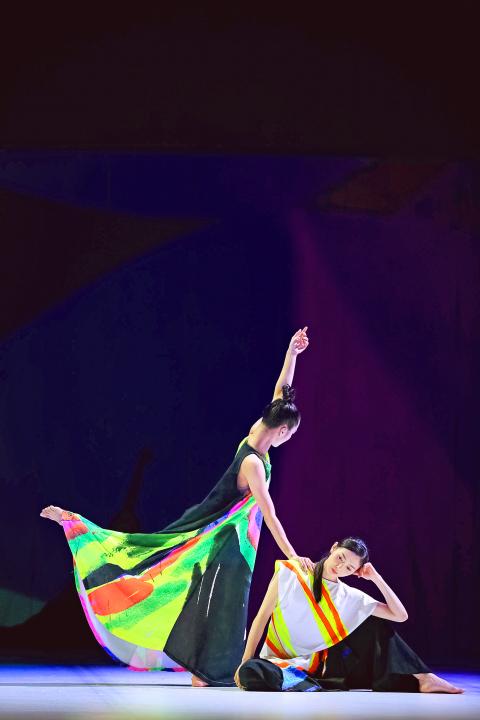
Photo courtesy of National Theater Concert Hall
Tsung took that tale and added visual and aural memories of his Wanhua childhood — the calls of street vendors, the chants of Taoist processions, beggars crawling on the street, gangsters fighting — mixing choreography and vocalizations by the dancers to recreate a slice of the chaotic street life of Taipei’s oldest district.
Tseng made his dancers’ vocal muscles as much a part of his choreography as the rest of their bodies, with one early scene requiring the dancers howl, scream and laugh as if they were inmates in a Hollywood version of a mental asylum. In other scenes, the men chant Taoist mantras and the women sing Hoklo folksongs.
For the score, Cheng turned to Taiwanese composer Lim Giong (林強), who combined electronic music, Nakashi tunes from the Japanese colonial era and folk melodies from the Hengchun Peninsula (恆春半島) with slices of silence so that all the audience hears is the dancers’ footfalls and breathing.
Cheng admitted in an interview that he had trouble maintaining energy and interest in creating a 70-minute work and it shows. While 13 Tongues rarely drags, it does hit a few speed bumps, with the viewer left wondering how — and when — Cheng is going to push his narrative forward. However, the eye never lacks for something or someone to watch, and Cheng was generous in doling out the solos and duets.
There are repeated motifs: a high-stepping wide-legged side-to-site gait with loosely swinging arm movements of Taoist parades, head-bopping short-step shuffles and hip-swiveling turns, while the choreography shifts from ensembles to solos, pairs and trios and occasionally, a bit of everything together.
The company begins the work in a variety of simple black costumes by Lin Bing-hao (林秉豪) that were a mix-match of wide-legged pants and long tunics tops. But about three-fifths of the way through, several of the dancers sit at the front of the stage, backs turned, and unobtrusively begin to remove their tops and change into new clothes that had been placed on the floor before the start of the show. The dancers switch out from sitting to performing until everyone has had time to change their tops, while the audience’s focus is kept on the ones still dancing.
The new tops, with fluorescent designs by He Jiang-sing (何佳興) provide a flood of colors under black lights that are reminiscent of the cacophony of neon shop signs that flood Taipei’s streets at night before the projections explode into a series of kaleidoscopic imagery.
The last bit of pyrotechnics from production designer Ethan Wang (王奕盛) is the reappearance of gigantic koi, swimming up a descending black curtain before disappearing into the top of the stage with a final swish of its tail.
I left the theater thinking that 13 Tongues should be considered a work-in-progress, and hoping that Cheng will have the chance to tinker with it the way he did his 2009 piece The Wall (牆), which when restaged in 2011 seemed almost like a new piece.
The TIFA performances in Taipei took place at the start of the Cloud Gate 2’s annual Spring Riot tour, but the company is taking 13 Tongues on the road, with performances tonight and tomorrow night at the Taichung Chungshan Hall (台中中山堂), the Chiayi Performing Arts Center (嘉義縣表演藝術中心演藝廳) on March 25 and 26, and at Dadong Cultural Center (大東文化藝術中心) from April 1 to 3.

As mega K-pop group BTS returns to the stage after a hiatus of more than three years, one major market is conspicuously missing from its 12-month world tour: China. The omission of one of the group’s biggest fan bases comes as no surprise. In fact, just the opposite would have been huge news. China has blocked most South Korean entertainment since 2016 under an unofficial ban that also restricts movies and the country’s popular TV dramas. For some Chinese, that means flying to Seoul to see their favorite groups perform — as many were expected to do for three shows opening

Taiwan’s semiconductor industry consumes electricity at rates that would strain most national grids. Taiwan Semiconductor Manufacturing Co (TSMC) alone accounted for more than 9 percent, or 2,590 megawatts (MW), of the nation’s power demand last year. The factories that produce chips for the world’s phones and servers run around the clock. They cannot tolerate blackouts. Yet Taiwan imports 97 percent of its energy, with liquefied natural gas reserves measured in days. Underground, Taiwan has options. Studies from National Taiwan University estimate recoverable geothermal resources at more than 33,000 MW. Current installed capacity stands below 10 MW. OBSTACLES Despite Taiwan’s significant geothermal potential, the

In our discussions of tourism in Taiwan we often criticize the government’s addiction to promoting food and shopping, while ignoring Taiwan’s underdeveloped trekking and adventure travel opportunities. This discussion, however, is decidedly land-focused. When was the last time a port entered into it? Last week I encountered journalist and travel writer Cameron Dueck, who had sailed to Taiwan in 2023-24, and was full of tales. Like everyone who visits, he and his partner Fiona Ching loved our island nation and had nothing but wonderful experiences on land. But he had little positive to say about the way Taiwan has organized its

The entire Li Zhenxiu (李貞秀) saga has been an ugly, complicated mess. Born in China’s Hunan Province, she moved to work in Shenzhen, where she met her future Taiwanese husband. Most accounts have her arriving in Taiwan and marrying somewhere between 1993 and 1999. She built a successful career in Taiwan in the tech industry before founding her own company. She also served in high-ranking positions on various environmentally-focused tech associations. She says she was inspired by the founding of the Taiwan People’s Party (TPP) in 2019 by Ko Wen-je (柯文哲), and began volunteering for the party soon after. Ko


 RSS
RSS