


Taiwan in Time: Oct.19 to Oct. 25
Taiwan is one of a handful countries in the world not a member of the UN, stemming back to Oct. 25, 1971 when UN General Assembly Resolution 2758 was ratified in a two-thirds vote.
The resolution, sponsored by Albania, recognized the People’s Republic of China (PRC) as “the only legitimate representative of China to the United Nations” and expelled “the representatives of Chiang Kai-shek [蔣介石] from the place which they unlawfully occupy at the United Nations and in all the organizations related to it.”
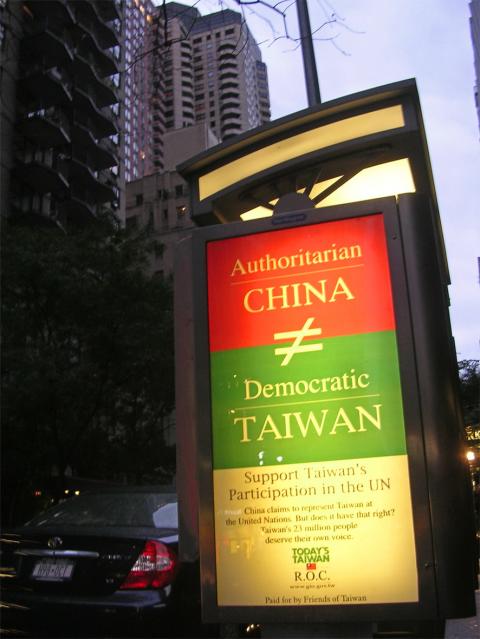
Photo: Wang Pei
The issue was that after the Chinese Civil War, the PRC under the Chinese Communist Party gained control of China, with Chiang’s Republic of China (ROC) government under the Chinese Nationalist Party (KMT) relegated to Taiwan and other minor islands. Yet both governments continued to claim to be the legitimate ruler of both China and Taiwan.
In fact, the ROC was a charter member of the UN, formed also this week, on Oct. 24, 1945, along with the Soviet Union, the UK and the US.
The UN General Assembly debated transferring China’s seat from the ROC to the PRC throughout the 1950s and 1960s, but the US was able to use its influence to block the move.
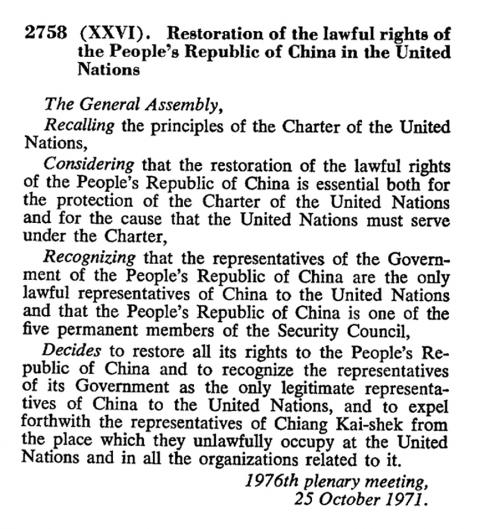
Photo courtesy of Wikimedia Commons
As early as 1950, the UK recognized the PRC as the legitimate government of China, severing relations with the ROC. But things really started changing in the 1960s, as the PRC gained the support of a large number of newly independent nations (mostly in Asia, South America and Africa) that changed the composition of the international body. And in 1964, even France, decided to recognize the PRC.
Starting in 1961, the US and other countries would introduce a resolution every year deeming any proposal to change China’s representation an “important question” that required a two-thirds majority to pass. That resolution would pass every time, but the vote for the subsequent resolution regarding accepting the PRC became increasingly tighter, reaching a tie in 1965.
Canada established ties with the PRC in October 1970. A month later, for the first time a majority supported the PRC’s admission with a 51 to 49 vote — although still not meeting the two-thirds requirement.
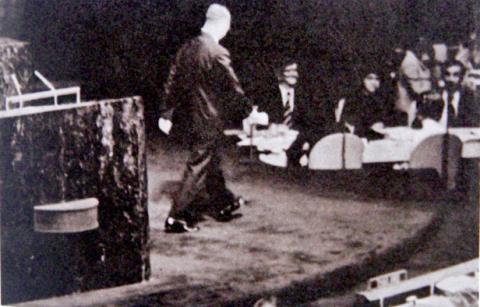
Photo taken from the book ‘The KMT and The ROC’
The US had tried to propose the idea of dual representation by allowing both governments into the UN (with the PRC taking over the Security Council seat) but neither Chiang nor the PRC would likely have agreed to such an idea due to their insistence on being the sole ruler of China and Taiwan.
The US submitted a dual representation resolution in 1971 nonetheless. Albania, however, had already submitted its bid to admit the PRC and it was to be voted on first. If passed, then dual representation would be a moot point. The Americans made one last effort by proposing to remove the “expulsion of Chiang” part from Albania’s resolution, but the motion was rejected.
Before the vote, the ROC delegation announced that they would not take part in further proceedings and walked out of the General Assembly.
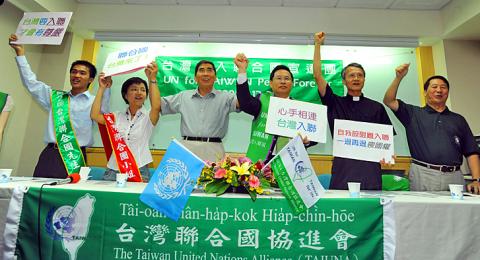
Photo: Wang Yi-sung, Taipei Times
On Oct. 27, Chiang officially declared the ROC’s withdrawal from the UN and its refusal to recognize the resolution.
“The United Nations has set justice aside, shamefully prostrating to evil forces and cowardly yielding to violence,” he wrote. “The United Nations that my country helped form is now a hotbed of evil, and history will prove that the Republic of China’s declaration of withdrawal will also be the declaration of the destruction of the United Nations.”
“My compatriots, the fate of our country is not in the hands of the United Nations, but in our own,” he added.
The resolution never directly mentioned the ROC or Taiwan, but the country’s bid for membership starting in the 1990s under variations of “Republic of China, Taiwan” and in 2007 as “Taiwan.”
It has continuously been rejected largely because of China’s opposition and claim that Taiwan is part of its territory and not a sovereign country.
In 2008, President Ma Ying-jeou (馬英九) stopped applying as part of his “diplomatic truce” policy toward China, but Taiwanese-Americans continue to protest outside the UN Headquarters in New York each year.
Taiwan in Time, a column about Taiwan’s history that is published every Sunday, spotlights important or interesting events around the nation that have anniversaries this week.

Ajay Verma, a consultant gastroenterologist at Kettering general hospital in Northamptonshire, says our gut is a “complex machine.” “It is constantly providing us with the nutrition we need, initially to grow and develop, and then for us to survive, thrive and repair from injury and illness.” How can we keep it functioning well? Put simply: “Make sure what you put into it is balanced, and that you clear out its waste products adequately,” Verma says. “In a general gastroenterology clinic, the most common conditions we see are irritable bowel syndrome (IBS), gastroesophageal reflux disease, inflammatory bowel disease and constipation,” says Nisha
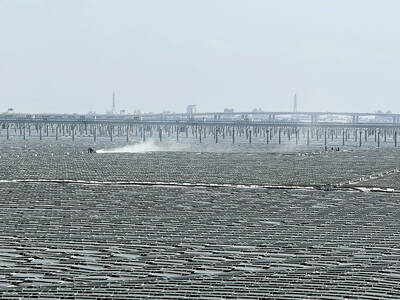
The arithmetic is straightforward and uncomfortable. By the end of 2025, Taiwan had committed itself to a 50-30-20 electricity mix — half natural gas, 30 per cent coal, 20 per cent renewables. The Ministry of Economic Affairs’s (MOEA) own monthly energy reports tell a different story. Natural gas reached 47.8 per cent of generation last year. Coal stood at 35.4 per cent, comfortably above its target ceiling. Renewables came in at 13.1 per cent, well short of the 20 per cent Taipei had pledged a decade earlier. Installed renewable capacity reached roughly half of the 12 gigawatts (GW) the government

Last week US President Donald Trump was asked by a reporter whether he would speak on the phone to the President of Taiwan. “l’ll speak to him. I speak to everybody. We have that situation very well in hand,” Trump said. This marked the second time in a couple of weeks he had said he would talk to the President of Taiwan. In 2016 he famously took a call from then-president Tsai Ing-wen (蔡英文), when he was president-elect. Despite warnings that the apocalypse was nigh because of a phone call, the world quickly forgot about the conversation between two democratically-elected presidents.
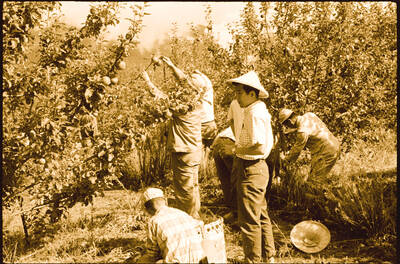
May 25 to May 31 Few believed that apples could be cultivated on a commercial scale in Taiwan’s high mountains. When horticulturalist Cheng Chao-hsiung (程兆熊) first proposed the idea in 1955, both American and Taiwanese colleagues dismissed it as implausible, arguing that temperate fruit could not be reliably grown on a subtropical island, especially on rugged terrain. However, it was this terrain in the Central Mountain Range where many Chinese Civil War veterans were resettled in the late 1950s. With limited job prospects and no family in Taiwan, they were placed on cooperative farms aimed toward self-sufficiency. Some say the conditions


 RSS
RSS