


GUSTAV MAHLER, Symphony No. 9, Budapest Festival Orchestra, Channel Classics CCS SA 36115 [CD]
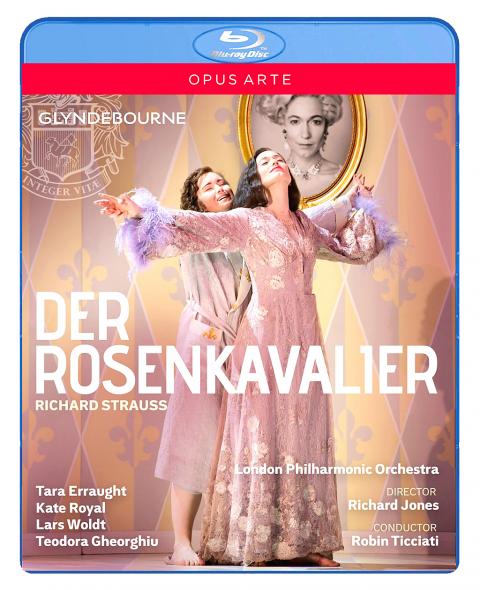
EDWARD ELGAR, Enigma Variations, Leonard Bernstein, DG — E4134902 [CD]
RICHARD STRAUSS, Der Rosenkavalier, Conductor: Robin Ticciati, Opus Arte OA1170D [DVD]
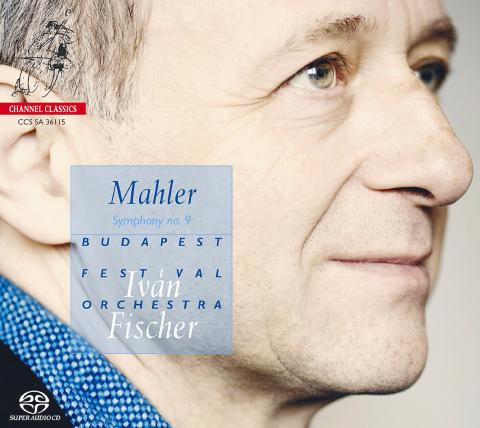
The way YouTube offers you clips of similar interest after you have selected and watched one item can have some fascinating results. Recently I began with Gustav Mahler’s 9th Symphony and ended with Edward Elgar’s Enigma Variations, with Leonard Bernstein providing the bridging links.
It started when I saw a review of the Mahler symphony on Presto Classical (www.prestoclassical.co.uk). Although the recording concerned is a CD, there is nonetheless a video clip on offer featuring the Budapest Festival Orchestra’s conductor, Ivan Fischer. There he refers to Leonard Bernstein’s theory that the complex beat the symphony opens with is Mahler’s comment on his own irregular heartbeat. The whole video is excellent and well worth watching.
This led to another item, Leonard Bernstein discoursing in fantastical terms on the same symphony. It’s about death, he says, and lies behind, in his view, virtually all modern literature, and some popular music to boot. This seems to me a wild view that would be impossible to defend. The way Bernstein stares at you as if he himself is some sort of Messiah doesn’t help. I watched it in amazement, but was by the end happy to click forward to the next item.
This turned out to be Bernstein giving what someone had dubbed “the greatest five minutes in music education.” It’s about the chords that were available to European composers in different centuries, and what happened when all the options were finally covered. Less ambitious than his piece on Mahler’s 9th Symphony, it certainly gives you less opportunity to disagree. He sounds so professional, for one thing, whereas on Mahler he sounds like an amateur, self-taught guru.
From there I jumped to Bernstein rehearsing the BBC Symphony Orchestra in the Nimrod episode from Elgar’s Enigma Variations. And then from this it was an easy leap to the finished, published version of the same work with the same orchestra. Nimrod is again offered as a separate item on YouTube. This is an absolutely superlative rendition, and clearly the entire CD is well worth acquiring.
After that, my mind inevitably went to Bernstein’s recording of Giuseppe Verdi’s Falstaff with the Vienna Philharmonic, and Dietrich Fischer-Dieskau in the title role. Praising this to the skies is made easier by Falstaff being one of my favorite operas, and my having heard many recordings of it only helped me decide that this was almost certainly the best. As I commented when reviewing it [in the Taipei Times May 15, 2012], it can be hard to find, but is available via ArchivMusic (www.arkivmusic.com).
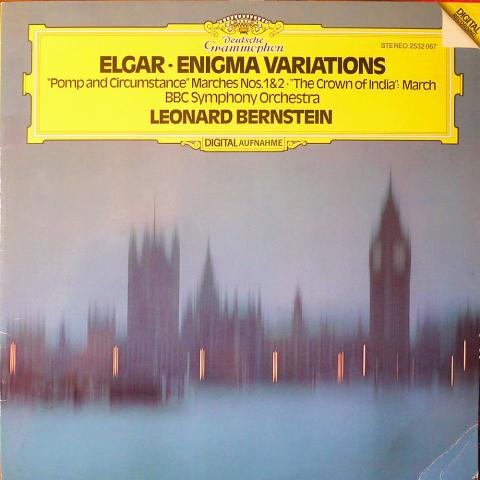
The glories of opera leads me to note that there’s a new DVD of Richard Strauss’s Der Rosenkavalier from Glyndebourne Opera with the London Philharmonic orchestra conducted by Robin Ticciati and directed by Richard Jones. I have yet to see this, but its appearance puts me in mind of the superlative Rosenkavalier from the Salzburg Festival of 2004 with the Vienna Philharmonic conducted by Semyon Bychkov and starring Adrianne Pieczonka and Angelika Kirchschlager [reviewed in the Taipei Times April 10, 2011]. I praised many aspects of this production at the time, but perhaps failed to stress the superb playing of the Vienna Philharmonic. It’s worth buying this pair of DVDs for this alone, the naked pranksters and the frolicking on a bed of Octavian and Sophie in the last act notwithstanding.
This is astounding music, and was a huge volte-face for Strauss. It premiered in 1911 and was characterized by a sumptuous late-Romanticism that had opera-houses queuing up to stage it. Yet Strauss’s previous two operas, Salome (1905) and Elektra (1909), had been high points in modernist dissonance and barbarity. Half the musical world attended the Elektra premiere, agog to hear what Strauss would come up with after the lurid horrors of Salome. Nothing about it had been revealed beforehand, and it proved to be savage indeed. But how equally startled the musical world must have been to be confronted by Strauss’s melodic and retrospective Der Rosenkavalier only two years later.
In fact, the young Strauss was probably demonstrating that he could do virtually anything. And he could. He gets my vote for the greatest 20th century composer, despite the rival claims of lovers of Mahler, Stravinsky and Shostakovich.
Finally, the death last month of Peter Cropper, founder and first violinist of the UK’s Lindsay Quartet, is very sad news. The Lindsays’ recordings of Haydn, Mozart and Beethoven were much loved, yet already their exquisite rendering of Dvorak’s String Quartets Nos. 12 (“American”) and 13 is unavailable on Amazon. Cropper was the public image of the Lindsays, too much so for some, but there’s no fault to be found in his flawless playing and his ever-enthusiastic promulgation of the cause of chamber music.
A fitting tribute to Cropper would be to watch the DVDs of the Lindsays in Finland playing, and talking about, six Haydn quartets [Opus Arte 0920 D; reviewed in the Taipei Times January 11, 2007]. Its fascination is endless.
If this column looks this month as if it mostly consists of references to past reviews, this is in part because we are experiencing difficulty in getting hold of new material for review. Any recording companies willing to send us samples should contact the newspaper immediately.

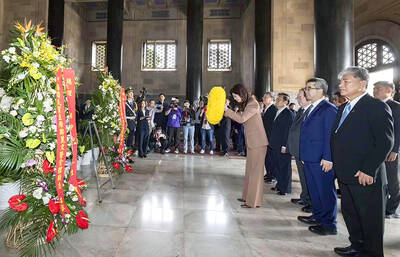
The problem with Marx’s famous remark that history repeats itself, first as tragedy, the second time as farce, is that the first time is usually farce as well. This week Chinese Nationalist Party (KMT) Chair Cheng Li-wun (鄭麗文) made a pilgrimage to the People’s Republic of China (PRC) “to confer, converse and otherwise hob-nob” with Chinese Communist Party (CCP) officials. The visit was an instant international media hit, with major media reporting almost entirely shorn of context. “Taiwan’s main opposition leader landed in China Tuesday for a rare visit aimed at cross-strait ‘peace’”, crowed Agence-France Presse (AFP) from Shanghai. Rare!

What is the importance within the Chinese Nationalist Party (KMT) of the meeting between Xi Jinping (習近平), the leader Chinese Communist Party (CCP), and Cheng Li-wun (鄭麗文), the leader of the KMT? Local media is an excellent guide to determine how important — or unimportant — a news event is to the public. Taiwan has a vast online media ecosystem, and if a news item is gaining traction among readers, editors shift resources in near real time to boost coverage to meet the demand and drive up traffic. Cheng’s China trip is among the top headlines, but by no means

A recent report from the Environmental Management Administration of the Ministry of Environment highlights a perennial problem: illegal dumping of construction waste. In Taoyuan’s Yangmei District (楊梅) and Hsinchu’s Longtan District (龍潭) criminals leased 10,000 square meters of farmland, saying they were going to engage in horticulture. They then accepted between 40,000 and 50,000 cubic meters of construction waste from sites in northern Taiwan, charging less than the going rate for disposal, and dumped the waste concrete, tile, metal and glass onto the leased land. Taoyuan District prosecutors charged 33 individuals from seven companies with numerous violations of the law. This

Sunflower movement superstar Lin Fei-fan (林飛帆) once quipped that the Democratic Progressive Party (DPP) could nominate a watermelon to run for Tainan mayor and win. Conversely, the DPP could run a living saint for mayor in Taipei and still lose. In 2022, the DPP ran with the closest thing to a living saint they could find: former Minister of Health and Welfare Chen Shih-chung (陳時中). During the pandemic, his polling was astronomically high, with the approval of his performance reaching as high as 91 percent in one TVBS poll. He was such a phenomenon that people printed out pop-up cartoon


 RSS
RSS