


At 42 the Cloud Gate Dance Theatre (雲門舞集) finally has a home to call its own — at least for the next 40 years.
And what a home it is. The complex — the Cloud Gate Theater, also known as the Tamsui Culture and Art Education Center (淡水文化藝術教育中心) — in Tamsui District (淡水), New Taipei City, boasts six floors that are filled with rehearsal studios, studio/theaters, a scene shop, dressing rooms, offices, art gallery, a main theater and meditation room.
Outside, there is a broad balcony, perfect for watching sunsets over the Tamsui River and Guanyinshan (觀音山), a sweeping staircase that doubles as seating for outdoor performances, an outdoor stage area, lawn, a tea shop and bookstore/coffee shop.
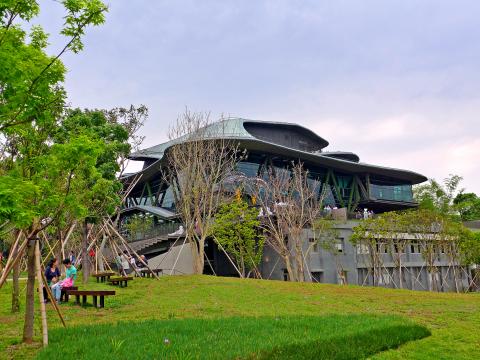
Photo: Lin Ya-wen, Taipei Times
It is an inviting place, tucked in between the 126-year-old Hobe Fort and the 96-year-old Taiwan Golf Club, accessible from the Tamsui MRT station (淡水捷運站) by public bus, or on show days, by shuttle buses organized by the Cloud Gate staff
The complex brings Cloud Gate Dance Theatre, Cloud Gate 2 (雲門2), management staff and the Cloud Gate Culture and Arts Foundation together under one roof for the first time in decades.
It is a home born out of tragedy and necessity.
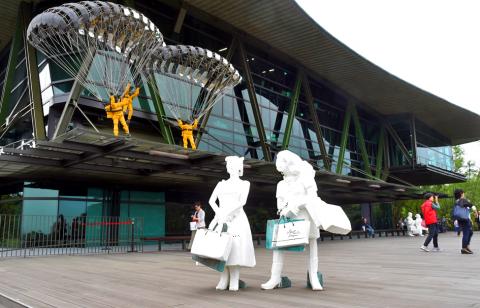
Photo: Lin Ya-wen, Taipei Times
SCOUTING THE PREMISES
The dancers and technical staff of the two troupes were left homeless by a pre-dawn fire on Feb. 11, 2008, that gutted a nearly 661 square meter studio and warehouse, in what was then Bali (八里), Taipei County that the company had used for 16 years. The blaze reduced props, costumes, scenery, other equipment and archives to ashes, and forced Cloud Gate founder and artistic director Lin Hwai-min (林懷民) and his top aides to scramble to find temporary places to work and rehearse.
The then-Taipei County Government pitched in, eager to keep the nation’s best-loved dance troupe in the county, and offered the abandoned Tamsui Arts Education Center to Lin. The center was a two-story, square concrete building, which had once been a Central Radio Station facility and needed a lot of renovation work before it could be used by dancers, but the site came with plenty of lawn.
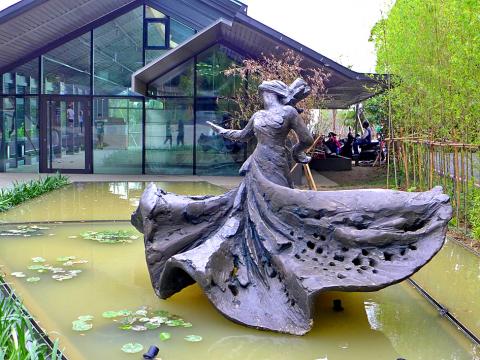
Photo: Lin Ya-wen, Taipei Times
However, the legalities of turning a piece of government property over to a private institution and the lack of legislation covering private investment in cultural enterprises created a paperwork nightmare that took a while to resolve.
The following year, Cloud Gate was finally able to sign a build-operate-transfer (BOT) contract with the county government, which gave it 40-year operating rights to the site, with a possible 10-year extension, before the property reverts to what is now New Taipei City.
The contract was conditional, in that Cloud Gate had to raise the funds to build the complex and run a theater on its own. In the end, donations were received from 4,155 individuals and corporations, including US$5 million from the Alphawood Foundation Chicago, which has been a major sponsor of Cloud Gate Dance Theatre tours to that city.
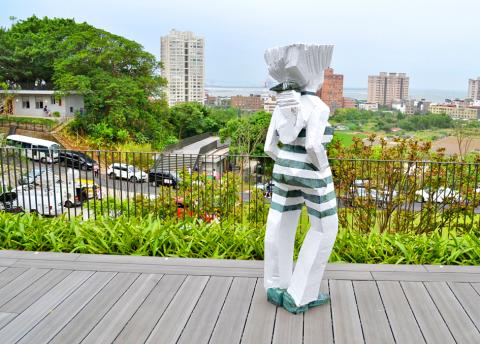
Photo: CNA
A decision was made to keep the original concrete building and add onto it.
Huang Sheng-yuan (黃聲遠) of Fieldoffice Architects won the job of integrating the old building with a new superstructure designed to accommodate the needs of not just two professional dance troupes but visiting companies as well.
He said he wanted to integrate the building with its hilly landscape, and for it to flow on different levels.
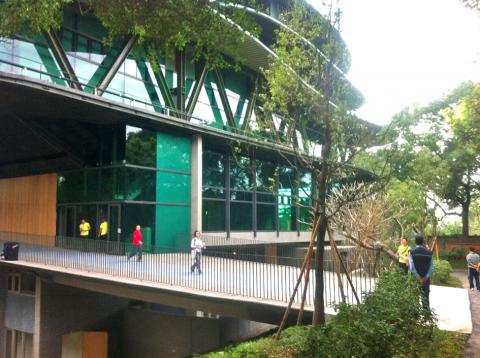
Photo: Diane Baker, Taipei Times
“Like the Cloud Gate dancers — they sink down and then rise,” he said after a ceremony and media tour in November last year to mark the end of the major construction work on the site.
He also included a wooden wall outside the main theater, into which the names of the major donors were carved.
The wall serves as a reminder to the companies of their supporter and of the expectations society has of them, Lin said.
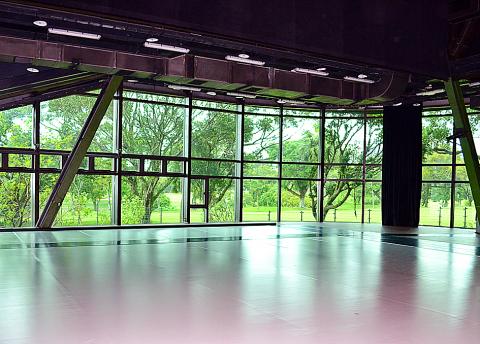
Photo: CNA
GRAND OPENING
The two dance companies began moving over from their temporary quarters in Bali and the administrative and foundation staff shifted from their downtown Taipei offices in a gradual process that saw everyone moved in before the start of the Lunar New Year this year.
It is the first time that everyone has been together under one roof in decades.
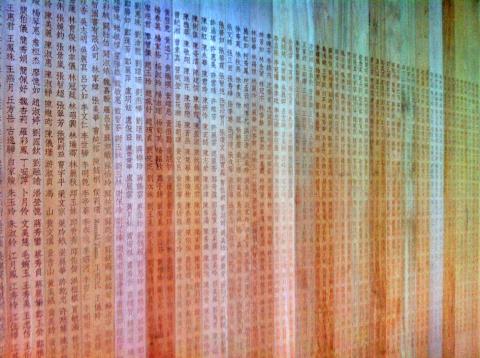
Photo: Diane Baker, Taipei Times
The complex had its formal grand opening last month, with Cloud Gate 2 inaugurating the new theater with its Spring Riot 2015 production, which wrapped up on Sunday.
Two special exhibitions were also opened: a selection of sculptures by noted Taiwanese artists Ju Ming’s (朱銘) White Living World series lent by the Ju Ming Museum(朱銘美術館) down the road in Jinshan District (金山) are outside, and Liu Chen-hsing’s (劉振祥) “In Between The Moments: Cloud Gate in a Photographer’s Memory” is on the first floor gallery (open Tuesdays to Sundays from 10am to 6pm).
Liu has worked closely with Cloud Gate Dance Theatre for more than two decades and his photos are often used by the troupe in its promotional materials.
Members of the Cloud Gate family appeared both exhilarated, relieved and nervous over the weekend. Exhilarated and relieved that their new home is finally open and the first shows and all the transportation arrangements went smoothly, but nervous because the staff has a better idea of what their life will be like in the new facility — a lot more work. For Cloud Gate — actually the foundation — has become a producer not just of its own productions, but of other companies and artists as well.
ASSORTED PERFORMANCES
A busy performance schedule has already been laid out for the main theater for the rest of the year, starting with two young Taiwanese choreographers who worked with Cloud Gate before striking out of their own: Bulareyaung Pagarlava and Huang Yi (黃翊).
Huang Yi Studio’s (黃翊工作室) will be performing Huang Yi & Kuka (黃翊與庫卡) from June 26 to June 28; Bula’s brand new troupe, the Bulareyaung Dance Company (布拉瑞揚舞團台北首演), will perform La Ke (拉歌) from July 10 to July 12, Cloud Gate 2 will perform again on Sept. 12 and Sept. 13 and Cloud Gate Dance Theatre will reprise one of Lin’s most popular works, Moon Water (水月) from Oct. 2 to Oct. 4.
However, the complex is not just for dancers or dance lovers.
The Migration Music Festival (流浪之歌音樂節), which has been held in Taipei’s Zhongshan Hall, is migrating to Tamsui this year on Sept. 26 and Sept. 27.
The Golden Bough Theatre’s (金枝演社) production of Troy, Troy…Taiwan (祭特洛伊戶外環境劇場) will be performed outdoors from Oct. 16 to 25; the Tainaner Ensemble (台南人劇團) will take to the stage with Chaos 10th Anniversary (K24十週年紀念版) — 60 roles by nine actors in a six-hour comedy marathon — from Oct. 31 to Nov. 22 and then the Flying Group Theatre and Double Time Music (飛人集社X二拍子) with Circle of Life from Dec. 4 to Dec. 20, which combines a puppet show, concert and exhibition.
In addition, a Cloud Gate Forum begins on May 23 to celebrate writers and the greats of Taiwanese literature, running for eight consecutive Saturdays through Dec. 23.
Cloud Gate is hoping to see a lot of its new neighbors in its new home. Residents of Tamsui are eligible for discounted tickets to all shows and lectures.
However, there are more than just visual delights to tempt people into visiting the complex. Light refreshments are also on offer at the Tree House (大樹書房) bookstore and cafe, which sells coffees and sweets, and the Whisper of Flowers (花語餐廳), a small tea shop run by King Ping Chiyu that offers a variety of hot and cold teas, and xiao chi (小吃, small eats) such as xiao long bao (小籠包) and gua bao (割包) with a choice of fillings.
The teashop is open Tuesdays to Sunday from 10:30am to 7pm, except on performance days, when it stays open until 8pm. The bookstore is open from 11am to 6:30pm Tuesday to Sundays and until 8pm on performance days.
Since parking is limited near the fort and the golf course, Cloud Gate is encouraging visitors to use public transportation. On show days or when there is a lecture being held, free shuttle buses will run from the Tamsui MRT station to the theater. The 836 bus from the station also stops near the site.
The Taipei Department of Cultural Affairs also collaborated with Cloud Gate to decorate the exterior and interior of a special “Cloud Gate” MRT train, which began running on the Taipei MRT’s Xinyi line last month and will run through the end of July.
The train, which makes eight daily roundtrip trips on the line, features illustrations from nine classic works from the repertoire of the two dance troupes.
This story has been updated since it was first published to correct the name of the tea shop to Whisper of Flowers.
Ajay Verma, a consultant gastroenterologist at Kettering general hospital in Northamptonshire, says our gut is a “complex machine.” “It is constantly providing us with the nutrition we need, initially to grow and develop, and then for us to survive, thrive and repair from injury and illness.” How can we keep it functioning well? Put simply: “Make sure what you put into it is balanced, and that you clear out its waste products adequately,” Verma says. “In a general gastroenterology clinic, the most common conditions we see are irritable bowel syndrome (IBS), gastroesophageal reflux disease, inflammatory bowel disease and constipation,” says Nisha
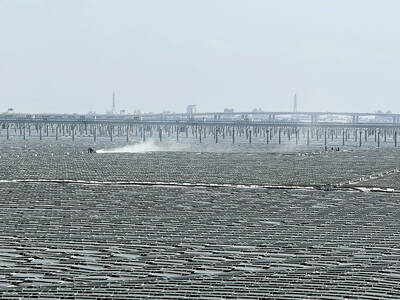
The arithmetic is straightforward and uncomfortable. By the end of 2025, Taiwan had committed itself to a 50-30-20 electricity mix — half natural gas, 30 per cent coal, 20 per cent renewables. The Ministry of Economic Affairs’s (MOEA) own monthly energy reports tell a different story. Natural gas reached 47.8 per cent of generation last year. Coal stood at 35.4 per cent, comfortably above its target ceiling. Renewables came in at 13.1 per cent, well short of the 20 per cent Taipei had pledged a decade earlier. Installed renewable capacity reached roughly half of the 12 gigawatts (GW) the government

Last week US President Donald Trump was asked by a reporter whether he would speak on the phone to the President of Taiwan. “l’ll speak to him. I speak to everybody. We have that situation very well in hand,” Trump said. This marked the second time in a couple of weeks he had said he would talk to the President of Taiwan. In 2016 he famously took a call from then-president Tsai Ing-wen (蔡英文), when he was president-elect. Despite warnings that the apocalypse was nigh because of a phone call, the world quickly forgot about the conversation between two democratically-elected presidents.

May 25 to May 31 Few believed that apples could be cultivated on a commercial scale in Taiwan’s high mountains. When horticulturalist Cheng Chao-hsiung (程兆熊) first proposed the idea in 1955, both American and Taiwanese colleagues dismissed it as implausible, arguing that temperate fruit could not be reliably grown on a subtropical island, especially on rugged terrain. However, it was this terrain in the Central Mountain Range where many Chinese Civil War veterans were resettled in the late 1950s. With limited job prospects and no family in Taiwan, they were placed on cooperative farms aimed toward self-sufficiency. Some say the conditions


 RSS
RSS