


The allegations of teachers’ preying on students have come from two very different New York-area high schools in the past two weeks: one in this well-off suburb, the other at a selective school in the heart of Brooklyn. In one case, a woman is accused of having sex with five boys; in the other, it is a man, accused of crossing the line with seven girls.
Both were teachers who seemed more like friends, known for giving easy A’s. And both cases are defined by technology: Prosecutors say the adults groomed the students using text messages. They sent sexually provocative pictures on the Snapchat app, believing them to be private. In Maplewood, the teacher apparently allowed sex with one boy to be captured on video, which students then circulated in the hallways.
Schools have struggled with teacher-student relationships probably forever and most famously since Mary Kay Letourneau was arrested in Washington state in 1997 for having sex with a 12-year-old student.
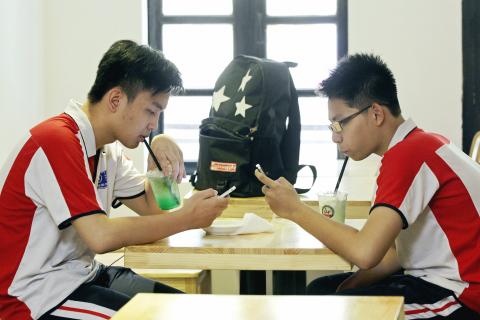
Photo: EPA
GAME CHANGER
But only recently have schools had to deal with relationships enabled by new technology. In the past five years, many schools have responded with social media policies. Last year, a West Virginia district banned any personal texting between teachers and students; three years ago, Missouri passed a law barring teachers from using any “non-work-related Internet site which allows access” to past or current students.
Parents and school administrators alike fear it has become harder to maintain boundaries when teachers routinely give out their cellphone numbers to talk about homework. And a new generation of teachers has grown up communicating primarily through the Internet or texting, where divisions between work and private life easily blur.
“This is an American problem more than a Maplewood problem,” said Kate McCaffrey, the mother of a Columbia High School student here who alerted school officials last spring when she heard that the teacher arrested in September, Nicole Dufault, had sent naked pictures of herself to a student on Snapchat. “The teachers say to the students, ‘Any problem, feel free to call me.’”
“The children are living in this social media world that the adults don’t get,” McCaffrey added.
Texting and social media have made it easier for teachers to get directly to students, but can also make sexual misconduct easier to prosecute. In Maplewood and in Brooklyn, parents have used the cases to argue how hard it is to get rid of bad teachers. But tenured teachers can be fired for immoral conduct, and texts and videos can make that plain.
“The Internet allows things that were previously hidden and hard to see to come to light,” said David Finkelhor, the director of the Crimes Against Children Research Center at the University of New Hampshire. “In the old days, if the inappropriate activities started with the gym teacher putting his hands on the student’s breasts, if she was uncomfortable and went to tell somebody about it, it might not go anywhere, or he would say, ‘No, she was mistaken.’ If he sends a picture of himself in his underwear or says something sexually provocative in a text exchange, that’s easier to prosecute and easier for the young people or their parents to bring to official attention.”
NEW POLICIES
New York City schools adopted a social media policy two years ago after several teachers were arrested on accusations of inappropriate sexual contact with students. The policy barred teachers from contacting students on Web sites like Twitter and Facebook but did not address contact by text message or cellphone. And complaints of sexual misconduct have risen each year since, according to city records.
It is harder to quantify the problem nationally. Surveys that rely on self-reporting suggest that cases of sexual abuse have declined since use of the Internet became pervasive, Finkelhor said. But the surveys do not break out cases of sexual abuse in schools. And no national database does so.
In Maplewood, parents had long complained about Dufault, 35, who taught mostly lower-level English courses. Last year, several parents said, they told administrators that she made inappropriate comments in class — about a miscarriage, about her sex life, about her divorce. Administrators spoke to her about it, parents said, but she went back to the classroom and complained that someone had told on her.
EXPLICIT VIDEOS
In June, McCaffrey’s daughter told her there was a video of a boy opening a Snapchat picture from a teacher, in which she appeared to be masturbating.
Her daughter clammed up when asked who the teacher or the student was. But a friend of McCaffrey’s asked her son, who asked friends. “They all knew, ‘Oh, yeah, that’s Ms. Dufault,’” McCaffrey said. Several had seen the video. “This was just another day at school.”
McCaffrey told school administrators, who apparently called students in to ask about the video. But it was unclear what the administrators learned. (School officials have declined to comment since the arrest.) The police asked McCaffrey whether her daughter would give a sworn statement. “I said ‘no — then I’ll never hear anything from her again.’”
Other parents said the police went to the boy, who denied having the video.
Dufault taught in the school’s summer program for at-risk students in July. By then, court papers say, she had already had sex with four of the five boys — four are 15, one is 17 — in her car and on high school property. Those assaults, as they are considered under New Jersey law, continued as she taught summer school, court papers say.
This fall, parents said, students began sending around a video showing Dufault performing oral sex on one of the boys.
On Sept. 18, students learned in an announcement from the principal that a teacher had been arrested. Dufault’s classroom was roped off with a sign calling it “unusable.” The principal asked students and teachers not to speak to the media.
Dufault’s lawyer, Timothy Smith, said Dufault had a shunt put in her brain during surgery to correct a problem that surfaced during pregnancy. That, he said, may have made her vulnerable to being a “victim.”
Parents have wondered why it took so long to recognize the problem, when there had been complaints about Dufault.
In an interview, one parent recalled a French teacher who talked to students about his sex life. The school let him go after his first year of teaching there. But only one student complained; other students were reluctant to come forward.
“The mentality of the kids is bizarre,” said a parent who did not want to be identified because of the sensitivity of the situation. “They didn’t want to get this guy in trouble.”
Students and parents said the same was true of Dufault and Sean M. Shaynak, the 44-year-old Brooklyn Technical High School teacher accused of pursuing seven girls, giving some of them alcohol and cigarettes, taking one to a nude beach and another to a sex club, sending them suggestive text messages and photos and having sex with two of them after they reached the legal age of consent. Both teachers were liked by students because their classes were easy, and these teachers acted more like friends than teachers.

Ajay Verma, a consultant gastroenterologist at Kettering general hospital in Northamptonshire, says our gut is a “complex machine.” “It is constantly providing us with the nutrition we need, initially to grow and develop, and then for us to survive, thrive and repair from injury and illness.” How can we keep it functioning well? Put simply: “Make sure what you put into it is balanced, and that you clear out its waste products adequately,” Verma says. “In a general gastroenterology clinic, the most common conditions we see are irritable bowel syndrome (IBS), gastroesophageal reflux disease, inflammatory bowel disease and constipation,” says Nisha
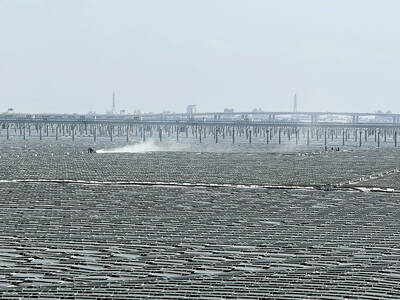
The arithmetic is straightforward and uncomfortable. By the end of 2025, Taiwan had committed itself to a 50-30-20 electricity mix — half natural gas, 30 per cent coal, 20 per cent renewables. The Ministry of Economic Affairs’s (MOEA) own monthly energy reports tell a different story. Natural gas reached 47.8 per cent of generation last year. Coal stood at 35.4 per cent, comfortably above its target ceiling. Renewables came in at 13.1 per cent, well short of the 20 per cent Taipei had pledged a decade earlier. Installed renewable capacity reached roughly half of the 12 gigawatts (GW) the government
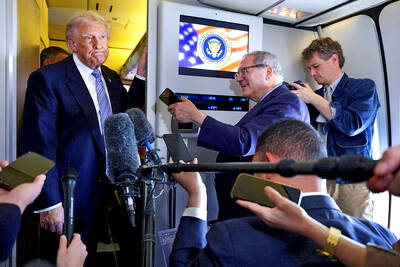
Last week US President Donald Trump was asked by a reporter whether he would speak on the phone to the President of Taiwan. “l’ll speak to him. I speak to everybody. We have that situation very well in hand,” Trump said. This marked the second time in a couple of weeks he had said he would talk to the President of Taiwan. In 2016 he famously took a call from then-president Tsai Ing-wen (蔡英文), when he was president-elect. Despite warnings that the apocalypse was nigh because of a phone call, the world quickly forgot about the conversation between two democratically-elected presidents.
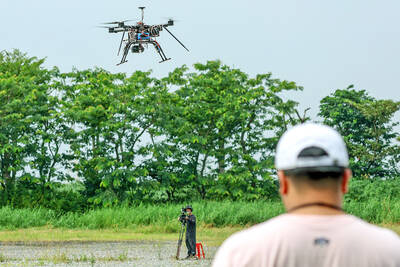
Taiwan’s drone exports are taking off, fuelled by the war in Ukraine, as Taiwanese companies seek a stake in the fast-growing global market for unmanned aerial vehicles (UAV). Low-cost drones used for reconnaissance and strikes are in high demand as governments around the world boost defense spending in the face of intensifying conflicts. A relative new player in the increasingly competitive industry, Taiwan’s pitch is to be an “Asian hub” for the production of UAVs and components free of Chinese materials, or “non-red.” That means its UAVs can be up to three times more expensive than their Chinese competitors, like the world’s biggest


 RSS
RSS