


The death of rock ‘n’ roll has been predicted many times , but thundering drums, heavy bass lines, slick guitar solos and high-pitched shrieks, like the whistling in Guns and Roses’ Patience, will never go out of style. Tomorrow night, DJs Pyro and Amy Rao (饒仲玫) headline Rockstars at 18TC, where punters will be able to let their inner David Lee Roth-wearing spandex out.
California native DJ Pyro (real name Michael Homer) has been deejaying for more than 10 years and started out doing house parties and as a mobile DJ.
“It was a good way for me to make extra money and of course it was fun,” Pyro said in an e-mail interview with the Taipei Times.

Photo courtesy of Michael Homer
“I grew up in Southern California during the gangsta rap and G-funk era so while I did love it, I didn’t limit myself to only listening to only hip-hop. At home I would listen to everything from new age to alternative rock.”
Piano playing is what turned DJ Amy Rao on to music at a young age. As a teen, she knew she wanted to work in music and was a voracious consumer of music magazines.
“After I turned 18, I started to go to clubs and loved the idea of playing music to make people dance, so when I got the opportunity to become a DJ it seemed like a natural choice,” Rao said.
Pyro and Rao’s paths first crossed in 2007, when Pyro came to Taiwan for a university exchange program.
“I went to the club she was working at and became friends with her and the other resident DJs,” Pyro said.
“Amy being a DJ at a time when there weren’t that many female DJs was attractive to me,” he said.
Soon after, Pyro moved to Taiwan permanently.
One of the best things about dating a DJ when you are a DJ is learning new skills from your partner.
“Since we’ve been together, Pyro has helped me learn more about the different popular styles of music in America, both new and old,” Rao said. “I also learned about a lot of groups that I never heard of before.”
Rao re-paid the favor by teaching Pyro about Greater Taichung’s music scene. Pyro and Rao will be playing a different style of music than clubbers are used to hearing tomorrow night. Rao’s definition of rock comes from the punk rockers she used to hang out with.
“My favorite rockers are the Offspring, Red Hot Chili Peppers and the Ting Tings. I grew up around a skate crowd and those were the type of bands we listened to,” Rao said.
Pyro, on the other end of the spectrum, has always been partial to classic rock, citing Pink Floyd, Led Zeppelin, Fleetwood Mac, The Eagles, Ted Nugent and Lynyrd Skynyrd.
“To me there is a noticeable difference in the quality of music that came out in the 1970s compared to now,” adding that tomorrow night he’ll play rock from the 1950s to the turn of the century.
“It is a rock party,” he said.
“I’ll also be dressed as a rock star and be getting pretty crazy on stage. I’ll have a few bottles of tequila with me to share with anyone that wants to get crazy, too.”
■ Rockstars, featuring DJs Pyro and Amy Rao, takes place tomorrow night from 10pm to 4am at 18TC, 38 Dachuan St, Greater Taichung (台中市大川街38號). Admission is NT$400 for ladies and NT$600 for men, which includes a drink.

Taiwan’s overtaking of South Korea in GDP per capita is not a temporary anomaly, but the result of deeper structural problems in the South Korean economy says Chang Young-chul, the former CEO of Korea Asset Management Corp. Chang says that while it reflects Taiwan’s own gains, it also highlights weakening growth momentum in South Korea. As design and foundry capabilities become more important in the AI era, Seoul risks losing competitiveness if it relies too heavily on memory chips. IMF forecasts showing Taiwan widening its lead over South Korea have fueled debate in Seoul over memory chip dependence, industrial policy and

“China wants to unify with Taiwan at the lowest possible cost, and it currently believes that unification will become easier and less costly as time passes,” wrote Amanda Hsiao (蕭嫣然) and Bonnie Glaser in Foreign Affairs (“Why China Waits”) this month, describing how the People’s Republic of China (PRC) is playing the long game in its quest to seize Taiwan. This has been a favorite claim of many writers over the years, easy to argue because it is so trite. Very obviously, if the PRC isn’t attacking Taiwan, it is waiting. But for what? Hsiao and Glaser’s main point is trivial,
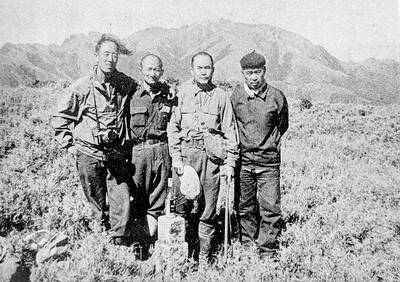
May 18 to May 24 Gathered on Yangtou Mountain (羊頭山) on Dec. 5, 1972, Taiwan’s hiking enthusiasts formally declared the formation of the “100 Peaks Club” (百岳俱樂部) and unveiled the final list of mountains. Famed mountaineer Lin Wen-an (林文安) led this effort for the Chinese Alpine Association (中華山岳協會). Working with other experienced climbers, he chose 100 peaks above 10,000 feet (3,048m) that featured triangulation points and varied in difficulty and character. The list sparked an alpine hiking craze, inspiring many to take up mountaineering and competing to “conquer” the summits. A common misconception is that the 100 Peaks represent Taiwan’s 100 tallest

The Chinese Nationalist Party (KMT), alongside their smaller allies the Taiwan People’s Party (TPP), are often accused of acting on behalf of the Chinese Communist Party (CCP). Some go so far as to call them “traitors.” It is not hard to see why. They regularly pass legislation to stymie the normal functioning of the ruling Democratic Progressive Party’s (DPP) administration, and they have yet to pass this year’s annual budget. They slashed key elements of the government’s proposed NT$1.25 trillion (US$40 billion) special military budget, and in the smaller NT$780 billion package they did pass, it is riddled with provisions that


 RSS
RSS